Sunday, July 30, 2017

Malaria already endemic in the Mediterranean by the Roman period

Malaria was already widespread on Sardinia by the Roman period, long before the Middle Ages, as indicated by research at the Institute of Evolutionary Medicine of the University of Zurich with the help of a Roman who died 2,000 years ago.
Even today, Malaria is one of the greatest medical challenges worldwide, killing hundreds of thousands of people every year. In the past, people have adapted to the threat of malaria in various ways. These methods range from interventions in the environment like draining swamps, to genetic adaptations in the human body.

Read the rest of this article...

Tomb depicting famous gladiator brawl discovered in Pompeii


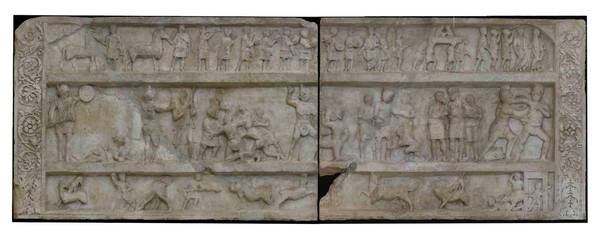
A brawl between gladiators that ended in tragedy, narrated by Tacitus, and a mysterious character that probably died in it is a 2,000-year-old mystery of Pompeii brought to light by a marble monumental tomb with the longest funerary epigraph ever found. The excavation was connected with the rehabilitation of state-owned property as part of the Great Pompeii Project in the San Paolino area near Porta Stabia, one of the accesses to the ancient city.

The tombstone was made shortly before the eruption that destroyed Pompeii in 69 AD and was presented on Thursday in the archaeological area. The inscription is over 4 meters long, in seven narrative registers, and though it does not include the deceased's name, it describes in detail the major events in the life of the man buried within it: from the acquisition of the 'toga virilis' to his wedding, and describes the munificent activities that accompanied such events such as public banquets, largess, the holding of gladiatorial games and battling large beasts.


Read the rest of this article...

Fused imaging reveals sixth century Roman Law text in Medieval book binding


16th century copy of Hesiod examined with different imaging techniques by Northwestern researchers 
[Credit: Emeline Pouyet]

After being hidden for centuries, the secrets within medieval manuscripts might soon come to light. By fusing two imaging techniques — visible hyperspectral imaging and x-ray fluorescence — an interdisciplinary team of Northwestern University researchers has developed a new, non-destructive technology that gives access to medieval texts hidden inside of ancient bookbindings.

Between the 15th and 18th centuries, bookbinders recycled the bindings from medieval parchments into new binding materials for printed books. While scholars have long been aware that books from this time period often contain hidden fragments of earlier manuscripts, they never had the means to read them.

“For generations, scholars have thought this information was inaccessible, so they thought, ‘Why bother?’” said Marc Walton, senior scientist at the Northwestern University-Art Institute of Chicago Center for Scientific Studies (NU-ACCESS). “But now computational imaging and signal processing advances open up a whole new way to read these texts.”

Read the rest of this article...

Friday, July 21, 2017

Extremely rare Roman sarcophagus lifted from ancient Southwark burial site

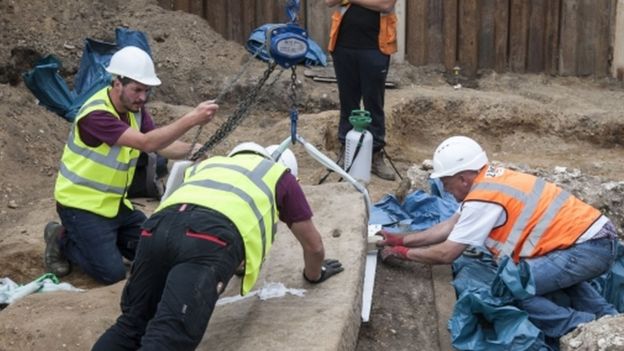
rchaeologists prepare to lift the lid of Roman sarcophagus found in Southwark, London 
[Credit: Lauren Hurley/PA Wire]

This is an exceptional find for London, where only two similar late Roman sarcophagi have been discovered in their original place of burial in recent years: one from St Martin-in-the Fields near Trafalgar Square (2006) and one from Spitalfields in 1999.

The excavation, which began in January this year, revealed a large robber trench around the coffin and found that the lid had been moved, suggesting that the coffin was discovered and robbed in the past. However, it is possible that only the precious items were removed, and the less valuable artefacts, such as the body itself, still remain within the stone sarcophagus.

Southwark and the City of London are remarkable in being the only two London Boroughs that have their own, in-house, dedicated archaeologist. Southwark Council champions archaeology and has dedicated planning policies to ensure that the borough’s ancient history is identified, protected and managed for future generations. The Harper Road excavation is just one of the many archaeological projects that are currently running across Southwark.

Read the rest of this article...

Wednesday, July 19, 2017

More extraordinary Roman writing tablets found at Vindolanda Roman Fort


More ‘Vindolanda writing tablets’ full of visible cursive Latin text have been unearthed at Vindolanda Roman Fort, on Hadrian’s Wall

Archaeologists at Vindolanda Roman Fort on Hadrian’s Wall have discovered a new hoard of around 25 Roman ink documents, known as the Vindolanda writing tablets, as part of an extraordinary excavation season at the archaeological site.

Found during the latest dig at the former Roman Army encampment, the tablets containing letters, lists and personal correspondence were discovered lying in the damp and anaerobic earth where they had been discarded towards the end of the 1st century AD.

Read the rest of this article...

Roman 'domus' with mosaic floors unearthed in Auch, France


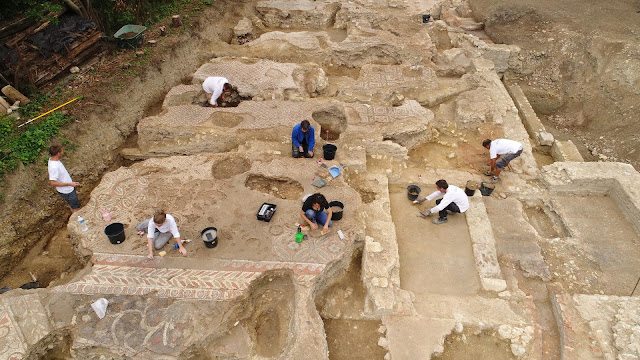
Excavation of Roman Imperial-era domus in Auch, France 
[Credit: © Jean-Louis Bellurget, Inrap]

Archaeologists have discovered the ruins of a luxurious 5th-century Roman palace in Auch in the Gers – and they face a race against time to excavate it. 

Abandoned some 16 centuries ago, this aristocratic ‘domus’ possessed private baths and splendid mosaics on the ground. It was close to the centre of the ancient Roman city of Augusta Auscorum, which was the capital of the province of Novempopulanie - and near the centre of the modern town of Auch.

Originally found by the landowner digging foundations to build a house, just 50cm below the surface the impressive 2-metre-deep ruins have been revealed. Since the end of April, l’Institut National de Recherches Archéologiques Préventives (Inrap) has been bringing to light a part of what was once a vast aristocratic home.

Read the rest of this article...

Ancient roman sarcophagus found at London building site


An ancient Roman sarcophagus has been excavated from a building site in central London.
The 1,600-year-old coffin found near Borough Market is thought to contain the remains of a member of nobility.
Archaeologists have been unable to identify the body as the stone coffin has been left filled with soil after being robbed, experts believe.
The sarcophagus will now be taken to the Museum of London's archive for analysis.
The coffin was found several metres underground with its lid slid open, which indicates it was plundered by 18th century thieves.

Read the rest of this article...

Monday, July 17, 2017

Roman coin find in Orkney thrills archaeologists

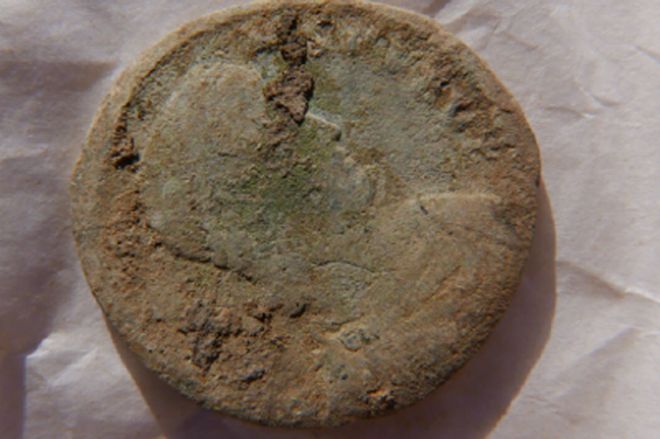
The coin was uncovered in a dig on Rousay in Orkney

Archaeologists are thrilled by the discovery of a Roman coin during the excavation of an archaeological site in Orkney.
The copper alloy coin was found at the Knowe of Swandro, the location of a Neolithic chambered tomb, Iron Age roundhouses and Pictish buildings.
The archaeological site is at risk from coastal erosion.
Roman finds have been made before in Orkney, and other Scottish islands including the Western Isles.
The coin found in the Knowe of Swandro dig on Rousay is believed to date from the mid 4th Century AD.
Read the rest of this article...

Thursday, June 29, 2017

Roman oil and wine pottery found at Ipplepen dig site

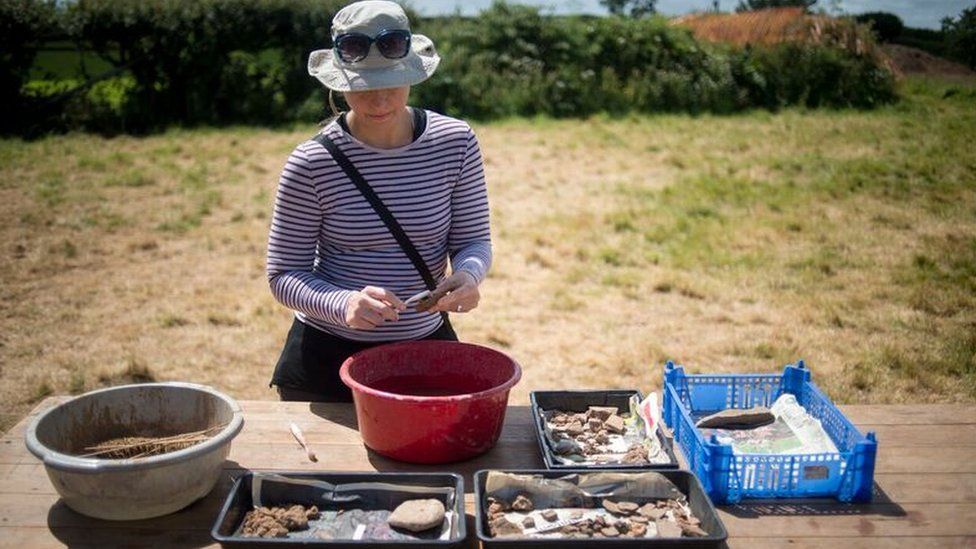
Archaeologists washing evidence of the iron works and pottery

Archaeologists say pre-Roman Britons who lived in a rural location since the 4th Century BC may have enjoyed Mediterranean oil and wine.

Radiocarbon analysis of a dig site showed there was a settlement at Ipplepen, Devon, for about 1200 years longer than previously thought.

The discovery of Roman pottery suggests there was a community trading widely with the Roman world.

University of Exeter archaeologists are digging at the site this month.

Read the rest of this article...

Rome Metro Excavations Unearth 3rd Century 'Pompeii-Like Scene'

Digging for Rome's new subway has unearthed the charred ruins of an early 3rd-century building and the 1,800-year-old skeleton of a crouching dog that apparently perished in the same blaze that collapsed the structure.

A significant discovery was made under Rome’s metro system [Credit: Getty]

Archaeologists on Monday said they made the discovery on May 23 while examining a 10-meter (33-foot) -deep hole bored near the ancient Aurelian Walls as part of construction work for the Metro C line.

"A Pompeii-like scene" was how the Culture Ministry described the findings that evoked comparisons to the inhabitants trapped by the 79 A.D. Vesuvius volcanic explosion and preserved for centuries in the ruins of Pompeii.

Read the rest of this article...

UN ATELIER DE POTIER DU IER SIÈCLE DE NOTRE ÈRE À THONON-LES-BAINS


À Thonon-les-Bains, en Haute-Savoie, une équipe de l’Inrap étudie, sur une surface de 1 400 m²,  un atelier de potier de la seconde moitié du Ier siècle de notre ère qui s’insère dans un quartier artisanal situé au sud-est de l’agglomération antique de Thonon.

Read the rest of this article...

Monday, June 26, 2017

Cyprus reveals rare Roman horse race mosaic in Akaki


Scenes from a chariot race are depicted in a rare Roman mosaic found in rural Cyprus.
Dating from the 4th Century AD, it lies in Akaki, a village not far from Nicosia.
Only nine similar mosaics - showing a hippodrome race - have been found at ancient Roman sites.
The ornate 26-metre-long (85ft) mosaic was probably part of a wealthy man's villa. The excavation is led by archaeologist Fryni Hadjichristofi.

Read the rest of this article...

Ancient skulls shed light on migration in the Roman empire

A student uses a digitizer to record geometric morphometric sites on a skull.
Credit: NC State University

Skeletal evidence shows that, hundreds of years after the Roman Republic conquered most of the Mediterranean world, coastal communities in what is now south and central Italy still bore distinct physical differences to one another -- though the same could not be said of the area around Rome itself.

Using state-of-the-art forensic techniques, anthropologists from North Carolina State University and California State University, Sacramento examined skulls from three imperial Roman cemeteries: 27 skulls from Isola Sacra, on the coast of central Italy; 26 from Velia, on the coast of southern Italy; and 20 from Castel Malnome, on the outskirts of the city of Rome.

Read the rest of this article...

Wednesday, May 31, 2017

Roman Bath House Found In Carlisle

Roman ruins described as a "once-in-a-lifetime find" have been discovered during work to rebuild a cricket pavilion in Carlisle.


The site at Edenside [Credit: Stuart Walker, The Cumberland News]

The remains of a Roman Bath House were uncovered as part of work to move Carlisle Cricket Club's pavilion, which was damaged during Storm Desmond.

The site is thought to be about 1,600 years old and has already unearthed weapons, pottery and coins. The find is close to the Hadrian's Wall World Heritage site.

Read the rest of this article...

Thursday, May 18, 2017

Oldest working Roman arch in Britain damaged by lorry driver who got stuck following his sat nav

Experts are assessing damage to the oldest Roman arch in the UK still used by traffic after a lorry driver got stuck following his sat nav CREDIT: RICHARD VAMPLEW/MEDIA LINCS

The oldest Roman arch in Britain which is still used by traffic has been damaged after a lorry driver who was following his sat nav became wedged underneath it. 

Police were called to the third century Newport Arch in Lincoln after a distribution lorry became lodged under the Grade I listed edifice at 1pm on Thursday. 

Fragments of stone from the monument could be clearly seen on the ground after it took over half an hour to free the HGV.

Read the rest of this article...

Tuesday, May 16, 2017

More ancient ruins found at Verulamium after gas pipe gives archaeologists chance to dig deeper

Area being dug through by archaeologists

More of an ancient Roman city have been discovered by archaeologists.

The burnt remains of a 1,800-year-old kiln, use to create pottery, have been unearthed at Verulamium after essential work began to re-lay a gas pipe, giving archaeologists the opportunity to dig deep underground.

The team has also redrawn the map of the Roman city after making a series of discoveries including evidence of an expensive townhouse and the absence of a tower which would have sat in the corner of the city walls.

Simon West, District Archaeologist for St Albans City and District Council’s Museums team, said: “The pottery kiln is another exciting discovery that gives us a greater understanding of how Verulamium was set up.

Read the rest of this article...

Friday, May 5, 2017

Rome unveils 'museum' metro station packed with hundreds of ancient artefacts found during construction


Ancient Roman amphorae on display in Rome's newest underground metro station, San Giovanni. CREDIT: ANDREW MEDICHINI/AP

For Romans, the daily commute will never be the same again.  The city on Friday unveiled a brand new underground station that boasts a trove of archeological treasures that were found during its construction.

They range from iron spearheads and gold coins decorated with emperors’ heads to a delicate perfume bottle made from turquoise glass and marble statues of scantily-clad nymphs.

There are giant amphorae, bronze fish hooks from an ancient Roman fish farm, the remains of a first century BC woven basket and even a collection of 2,000 year old peach stones, from when the area was a rich farming estate providing food for the imperial elite.

Read the rest of this article...

Wednesday, May 3, 2017

Last resting place of Rome's emperors to be restored and opened to tourists in £5 million project

The restoration of the mausoleum will take two years. The monument will be opened to tourists in 2019. CREDIT: EPA

The largest funerary monument in the world after the pyramids of Egypt, it echoes with the ghosts of emperors and the splendour that once was Rome.

Now, after decades of being neglected, the Mausoleum of Augustus, a hulking stone building on the banks of the River Tiber, is to be restored and opened to tourists.

Visitors will be able to venture into its cavernous interior, where the cremated remains of the Emperor Augustus were later joined by other emperors, including Tiberius, Claudius, Vespasian and the psychotic, scheming Caligula.

Read the rest of this article...

Friday, April 7, 2017

Divers search lake for Roman Emperor Caligula's pleasure barge, site of wild orgies

Today, the serene waters of Lake Nemi make it a quaint getaway, one that is best known for its peaceful landscapes and the area's delicious wild strawberries.
But in ancient Roman times, the volcanic lake southeast of Rome was the anchor point for Emperor Caligula's pleasure ships - massive and ornate barges that were rumored to be the sites of wild orgies and other excessive indulgences.
For nearly 2,000 years, the sunken remains of Caligula's pleasure ships tantalized divers, who launched expeditions to recover them, with little success.
It wasn't until 1927, when Italian dictator Benito Mussolini ordered Lake Nemi drained, that two of the ships began to be fully revealed. Measuring 230 and 240 feet long, the "Nemi ships" recovered over the next several years astounded researchers with their advanced technology.
Read the rest of this article...

A Lost Roman City Has Been Discovered in Southern France


For the first time in over a thousand years, archeologists have laid eyes on the ancient Roman town of Ucetia, which is decked out with some surprisingly well-preserved mosaics.

The discovery by the French National Institute for Preventive Archaeological Research (INRAP) was made near modern-day Uzès in the south of France during the construction of a school. The 4,000-square-meter (43,056-square-foot) site contains artifacts ranging from the Roman Republic era (1st century BCE) to the late antiquity (7th century), right through to the Middle Ages.

The town’s existence was first hinted at when researchers found an inscription saying Ucetia on a stone slab in nearby Nîmes. A few isolated fragments and mosaic pieces suggested the site of the mysterious Roman town, but it remained hidden until INRAP started to dig beneath the surface.

Read the rest of this article...