The Roman Archaeology Blog is concerned with news reports featuring Roman period archaeology. If you wish to see news reports for general European archaeology, please go to The Archaeology of Europe Weblog.
Sunday, May 25, 2014
Maryport Roman Settlement Excavation Yields New Finds
The Hadrian's Wall Trust's research and community archaeology project at the Maryport Roman settlement - directed by Oxford Archaeology North and funded by philanthropist Christian Levett - is revealing new evidence and raising more questions about this internationally famous site.
Site director John Zant said: "We're piecing together the complex story of the site over at least a couple of hundred years from around AD 100 to AD 300.
"From our work so far it's possible there may be an earlier fort than the remains we can see in the next field, and possibly even a lost Roman harbour to the north of the present day harbour.
Read the rest of this article...
Friday, May 16, 2014
Roman military camp found in eastern Germany
Archaeologists have confirmed the presence of a long-lost Roman military camp deep in eastern Germany. The 18-hectare site, found near the town of Hachelbich in Thuringia, would have sheltered a Roman legion of up to 5000 troops. Its location in a broad valley with few impediments suggests it was a stopover on the way to invade territory further east.
Soil marks where Roman soldiers once dug a trench to defend their temporary camp [Credit: © TLDA]
“People have been searching for evidence of the Romans in this part of Germany for 200 years,” says team leader Mario Kuessner, an archaeologist working for the state of Thuringia. “It took a long time before we realized what we had, and we wanted to be sure.”
Read the rest of this article...
Tuesday, May 13, 2014
Roman way station unearthed in Bulgaria
Archaeologists from Bulgaria's National History Museum have uncovered the roadside Sostra complex, situated on the Roman cursus publi-cus from Oescus to Philippopolis.
The rooms of the roadside station were heated by a hypocaust system where warm air heats not only the floors of buildings, but also their walls [Credit: НИМ]
The roadside complex was an important point of rest for dignitaries and even emperors and their relatives who were travelling from Oescus (currently the village of Gigen, Pleven district) to Philippopolis (currently the city of Plovdiv), according to reports of dnevnik.bg.
Römische Truppen in Thüringen
Nach vielen Jahren der Suche ist jetzt zum ersten Mal der archäologische Nachweis römischer Truppenpräsenz in Mitteldeutschland gelungen. Beim Dorf Hachelbich im Kyffhäuserkreis ist im Zuge mehrjähriger Untersuchungen durch das Thüringische Landesamt für Denkmalpflege und Archäologie ein römisches Marschlager aus dem 1. bis 3. Jh. n. Chr. zweifelsfrei lokalisiert worden.
Read the rest of this article...
Tuesday, May 6, 2014
Roman tomb found in south-western Bulgaria
An entirely preserved Roman tomb was discovered in Bulgaria’s south-west resort of Sapareva Banya, the historical museum in the city of Kyustendil announced.
Archaeologists excavate a grave in Bulgaria’s Sapareva Banya Resort [Credit: BGNES]
During the construction of a private guest house, the workers have found what turned out to be 24 graves, the oldest of which dates back to 4th century AD, Bulgarian National Radio (BNR) reported.
An intact plaque was found inside one of the walls. Most likely it was a family tomb, as the archaeologists have found the remains of a man, a woman and a child, as well as the remains of cremation. It is assumed that the man was a soldier, because of his military footwear, BNR informs.
Read the rest of this article...
Support Past Preservers on The Hadrian's Wall Hike
This September Nigel Hetherington of Past Preservers will be returning to his ancestral homelands and taking part in the English Heritage's Hadrian's Wall Hike to raise funds for much needed conservation along the famous route.
Read the rest of this article...
Two Roman mosaics set to be unearthed in Dorset
Work is due to begin on unearthing two mosaics discovered at the site of a Roman villa in the Dorset countryside.
A meander-style mosaic was discovered on the site of the villa [Credit: EDAS/BBC]
The first signs of the mosaics were spotted last year at the site near Puddletown which is being excavated by volunteers.
Lilian Ladle of the East Dorset Antiquarian Society said it was "very fortunate" they had survived.
Read the rest of this article...
Thursday, May 1, 2014
Vikings Online Course
Vikings: Raiders, Traders and Settlers
12 May to 25 July 2014
Vikings: Raiders, Traders and Settlers is an online archaeology course run by the University of Oxford's Department of Continuing Education.
The course runs for ten weeks and successful completion carries an award of ten CATS points. Students write two short assignments as part of the course.
Online forums for each unit enable students to discuss the topic being studied, and help from the online tutor is always available
You can find more details here...
You can find details of other online archaeology courses here...
Tuesday, April 29, 2014
A ROMAN HOARD FROM THE END OF EMPIRE
Dutch archaeologists have recently completed the rescue excavation of a unique treasure hoard dating to the beginning of the 5th century AD, from a field in Limburg. The hoard partially consists of a combination of gold coins and pieces of silver tableware which had been deliberately cut up (hacksilver).
The complete hoard was shown at a press conference on Friday, April 25 in Limburg Museum (Venlo) where archaeologists highlighted the significance of the find as a key piece of evidence for our understanding of the final phase of Roman rule in the Netherlands, around the year AD 411. Placing the treasure into perspective within the political and military chaos at the time, why was the precious and richly decorated Roman silver tableware cut into pieces and buried?
Read the rest of this article...
In search of Roman writing tablets at Vindolanda fort
Archaeologists taking part in the summer excavation programme at Vindolanda Roman Fort, on Hadrian’s Wall say they are hopeful the dig will yield more examples of the famous Vindolanda tablets discovered at the site in 1973.
Excavations at Vindolanda Roman Fort, just south of Hadrian’s Wall in Northumberland (Northern England) have brought to light more than 1600 tablets to date [Credit: © The Vindolanda Trust]
The wooden leaf tablets with ink text are the oldest surviving instances of hand written script in Britain, containing everything from military directives to party invites revealing the day-to-day life of Romans on and around Hadrian's Wall.
The five-month dig at the important Roman site, which boasts a complex of at least nine forts and settlements at the heart of the wall, has already yielded the remains of late 4th century and post-Roman buildings, glass beads, stone counters and an intriguing rusty clump of chain mail.
Monday, April 28, 2014
Buried city of Pompeii unveils three new houses
There is new real state to be seen in the Pompeii, Italy, archaeological site, with three restored houses open to the public.
POMPEII , Italy, April 17 (UPI) -- In time for Easter tourists, three additional houses in the ancient city of Pompeii, Italy, buried in a volcano eruption in 79 A.D., were opened Thursday.
Italian Culture Minister Dario Franceschini inaugurated the three restored houses, or domus, in a ceremony at the celebrated archeological site. The houses were formerly occupied by the families of Marcus Lucretius Fronto, Romulus and Remus and Trittolemo, the office of Pompeii’s archeological superintendent said.
Superintendent Massimo Osanna described them as “aristocratic houses.”
Read the rest of this article...
POMPEII , Italy, April 17 (UPI) -- In time for Easter tourists, three additional houses in the ancient city of Pompeii, Italy, buried in a volcano eruption in 79 A.D., were opened Thursday.
Italian Culture Minister Dario Franceschini inaugurated the three restored houses, or domus, in a ceremony at the celebrated archeological site. The houses were formerly occupied by the families of Marcus Lucretius Fronto, Romulus and Remus and Trittolemo, the office of Pompeii’s archeological superintendent said.
Superintendent Massimo Osanna described them as “aristocratic houses.”
Read the rest of this article...
Ancient Rome was bigger than previously thought, archaeologists find
Archaeologists have discovered that the Ancient Roman neighbourhood of Ostia was far bigger than previously thought, extending over the River Tiber
British scientists have discovered a new section of the boundary wall of the river port of ancient Rome which they say proves that the city was much larger than previously estimated Photo: PA
British scientists have discovered a new section of the boundary wall of the river port of ancient Rome which they say proves that the city was much larger than previously estimated.
Researchers from the universities of Southampton and Cambridge uncovered the extra section of the wall at Ostia while conducting a survey of an area between the port and another Roman port called Portus - both of which are about 30 miles from the Italian capital.
Scholars had thought the Tiber formed the northern edge of Ostia, but this new research, using geophysical survey techniques to examine the site, has shown that Ostia's city wall continued on the other side of the river.
Ancient Roman theatre discovered in Florence
(ANSA) - Florence, April 14 - Archaeologists digging up the remains of an ancient Roman theatre discovered under the Palazzo Vecchio in Florence have found a "vomitorium" or corridor used by as many as 15,000 theatre goers in the first and second centuries A.D., city officials say.
The latest find at the site in the centre of the Tuscan capital includes the original painted stone pavements along which spectators used to walk from the outer circle of the theatre to the orchestra pit, which already had been excavated during previous digs. Also discovered were well shafts going as deep as more than 10 metres below the current surface of Florence, providing water and waste disposal for the theatre, as well as remains of the foundations of the walls used to build the Salone dei Cinquecento.
Read the rest of this article...
Friday, April 11, 2014
Leicester dig unearths Iron Age mint and Roman tile with dog paw prints
unearthed: The Roman tile with possible dog paw prints
Archaeologists believe they might have stumbled across an Iron Age mint which produced gold and silver coins for the coveted Hallaton Treasure.
The dig at Blackfriars, in the city, unearthed coin mould fragments which, combined with evidence from previous excavations, seems to confirm the site was a 2,000-year-old Corieltauvi tribe mint.
The Corieltauvi controlled most of the East Midlands, with Leicester as its capital.
Archaeologists believe the Blackfriars site could have produced some of the 5,000 silver and gold coins found in 2000, near the Leicestershire village of Hallaton.
Read the rest of this article...
Thursday, April 3, 2014
Satellites and sensors to halt crumbling of Italy's Pompeii
ROME (Reuters) - The ruins of ancient Pompeii will be monitored by satellites and sensors under an agreement with Italian defense and technology group Finmeccanica to try to stop theUNESCO world heritage site from crumbling.
The state-controlled group will help train staff and donate its technology for free for three years in an investment worth up to 2 million euros ($2.75 million), after which the equipment will be left to the restoration project.
Regular collapses of walls and houses in the treasured Roman town that was covered by ash in a volcanic eruption in 79 AD have caused an international outcry and increased pressure for an end to delays dogging a 105-million-euro restoration project part-funded by the European Union and launched last year.
Read the rest of this article...
Wednesday, April 2, 2014
Saudi royal family could pay for restoration of Roman monuments
Deal brokered by mayor of Rome could see Saudi Arabia provide millions of euros to restore neglected sites in exchange for loans of priceless artworks
The government in Riyadh have shown a particular interest in in the Emperor Augustus's mausoleum, a giant, circular structure located near the Tiber River Photo: Alamy
A training barracks used by Roman gladiators and the 2,000-year-old mausoleum of the Emperor Augustus could be restored with money from the Saudi royal family, in the latest effort by Italy to secure funding for its crumbling cultural heritage.
In a deal brokered by Ignazio Marino, the mayor of Rome, the Saudi royals are to provide millions of euros to pay for the restoration of some of the capital's neglected monuments.
The government in Riyadh has been presented with a dossier of nine historic sites to choose from, with greatest interest said to be in the Emperor Augustus's mausoleum, a giant, circular structure near the Tiber River that has been virtually abandoned for decades.
Monday, March 31, 2014
Developers destroy 2,000-year-old Winchester Roman wall
AFTER: The site after the wall was destroyed.
IT was a plan that sparked outrage.
But despite pleas to save a 2,000-year-old Roman wall from destruction, developers have gone ahead and carted the relic off in a lorry.
As previously reported, historians were angered when it emerged thatBargate Homes were considering breaking the wall down to make way for 14 homes at the site, in Southgate Street, Winchester.
But the proposal has now become a reality.
Colin Cook, of the Winchester Area Tourist Guides Association, witnessed the destruction.
He said: “It’s desperately sad. I have got sympathy with Bargate Homes but Winchester City Council planners need to be a lot more aware of the sensitivities of these sites when they’re giving permission. As far as I can see it’s gone away on a lorry. There is no possibility of rebuilding it anywhere else.”
Read the rest of this article...
Roman Emperor Dressed As Egyptian Pharaoh in Newfound Carving
A newfound stone carving reveals Roman Emperor Claudius dressed as an Egyptian pharaoh while wearing an elaborate crown. The hieroglyphs say Claudius is raising the pole of the cult chapel of Egyptian fertility god Min and suggests a ritual like this took place around the summertime.
Credit: Photo by Marleen De Meyer, line drawing by Troy Sagrillo.
An ancient stone carving on the walls of an Egyptian temple depicts the Roman emperor Claudius dressed as an Egyptian pharaoh, wearing an elaborate crown, a team of researchers has discovered.
In the carving, Emperor Claudius, who reigned from A.D. 41 to 54, is shown erecting a giant pole with a lunar crescent at the top. Eight men, each wearing two feathers, are shown climbing the supporting poles, with their legs dangling in midair.
Read the rest of this article...
Hadrian’s Wall Trust to close within six months as funding evaporates
The trust set up to manage Hadrian’s Wall is to close in six months after funding dried up, leaving support for the World Heritage Site “uncertain”.
Hadrian's Wall stretches 84 miles [Credit: Rex Features]
Hadrian’s Wall Trust revealed it is to close this week, with a series of organisations scrabbling to put funding in place to ensure one of Britain’s most famous monuments can be adequately maintained in the long term.
Linda Tuttiett, chief executive of the Trust, said: “We hope and pray resources can be found to keep the heritage site safe” after confirming that funding cuts had forced the trustees to close the seven-year-old organisation.
Beachy Head Lady was young sub-Saharan Roman with good teeth, say archaeologists
Was this Sussex’s first sub-Saharan resident? Heritage Officer Jo Seaman reveals the quest for the Beachy Head Lady in Eastbourne
The figure known as Beachy Head Lady has gone on show to the public in Eastbourne
© Graham Huntley
They were held in the basement of the town hall, where I keep my archaeology collection. They came primarily from two main Saxon cemeteries that were excavated – one in particular had over 200 graves.
Read the rest of this article...
Unearthing a Roman civilian's past at Maryport
An archaeological team is unearthing the remains of a Roman fort and settlement in the hope of gaining a better understanding of everyday Roman civilian life.
The settlement is believed to have been divided into a series of long plots which extended along a 1,378ft (420m) length of Roman road leading to the fort gate [Credit: Hadrian's Wall Trust]
Oxford Archaeology (OA) and a team of volunteers are excavating an extramural settlement at Maryport Roman fort on the west coast of Cumbria.
Built high on the cliffs overlooking Solway Firth, it is believed the fort was founded in the First Century AD when the Roman army initially entered the region.
Tuesday, March 25, 2014
Shipwrecks Lost to Time That Archaeologists Would Love to Get Their Hands On
This 102-foot-long Roman barge from the first century A.D. was lifted in 2011 from the Rhône River in Arles, France. It was virtually intact after two millennia in the mud.
Finding modern ships lost at sea, even with the help of radar, sonar, and satellites, can be a herculean task. But trying to find a shipwreck from thousands of years ago is even harder. It's like looking for a wooden needle in a haystack after part of the needle has rotted away.
Underwater archaeologists keep looking, though, because finding one of these shipwrecks could yield a treasure trove of information—from how ancient peoples built their vessels to where they traveled and who their trading partners were.
Figuring out those connections would allow researchers to better understand ancient economies, and to put the cultures into a more global context, says James Delgado, director of maritime heritage for the U.S. National Oceanic and Atmospheric Administration (NOAA).
Read the rest of this article...
Did women in Greece and Rome speak?
Gold finger-ring with a seated woman, perhaps Penelope. Western Greek, around 400 BC – 300 BC, possibly made in Sicily. GR 1867,0508.402
Did women in Greece and Rome speak? Stupid question; of course they did. They must have chattered and joked together, laughed at the silliness of their menfolk, advised (or chatted up) their husbands, given lessons to their children… and much, much more.
But nowhere in the ancient world did they ever have a recognised voice in public – beyond, occasionally, complaining about the abuse they must often have suffered. Those who did speak out got ridiculed as being androgynes (‘men-women’). The basic motto (as for Victorian children) was that women should be seen and not heard, and best of all not seen either.
Read the rest of this article...
Sunday, March 23, 2014
Cambridge University archaeologists find 'oldest' Roman irrigation system
It is thought the beds would have been used to grow grapes or asparagus
Excavations at a Cambridge University development have revealed what archaeologists believe is Britain's oldest-known Roman irrigation system.
Planting beds and pit wells were unearthed at the North West Cambridge site near Huntingdon Road.
Chris Evans from the university's archaeological unit said they dated from between 70 AD and 120 AD.
It was an "unparalleled discovery" and "effectively the first irrigation system we've seen", he said.
Read the rest of this article...
Monday, March 17, 2014
Diving into archaeology
Only the foundations of the former basilica remain under Lake Iznik
The rubble-strewn remains of a 1,600-year-old basilica, dedicated to St Neophytos, have been discovered under Lake Iznik in Turkey’s northwestern Bursa province. Though located only 20 metres from the shore, and at a depth of around 2 metres, the basilica’s existence was unknown until January, when aerial photographs of the area were taken as part of a project to record local historic monuments. A diving team has now investigated the submerged structure and, due to similarities with the Hagia Sophia church in Iznik, experts have dated it to the fourth or fifth centuries. They have suggested it was built on the spot where Roman soldiers martyred St Neophytos in AD303; occurrences of the saint’s name have been found nearby and Medieval engravings show the saint being killed on the edge of a lake. It is thought an earthquake in AD740 caused the basilica to collapse and sink under the lake. The future of the site now rests in the hands of Turkey’s Culture and Tourism Ministry, who can designate it a protected site or open it up to recreational divers.
Read the rest of this article...
Still discovering things about the Ghajn Tuffieha Roman baths
The Roman baths along the road from Mġarr to Gћajn Tuffieћa were unearthed by accident in 1929, but archaeologists and other experts are still discovering things at the site.
So said the deputy leader of excavations, Heritage Malta’s David Caruana, who was speaking at a lecture organised by Din l-Art Ħelwa last week.
The baths were discovered when workers were digging down to pass a conduit to enable the flow of water to water the fields. A certain Mr Rizzo, presumably their foreman, informed Sir Temi Zammit that, under some three feet of soil, they had discovered remains that they thought were archaeological.
Read the rest of this article...
Sunday, March 16, 2014
British Museum's Warren Cup branded a forgery
A Roman silver drinking vessel that depicts two sets of male lovers is one of the most prized jewels in the British Museum, singled out by director Neil MacGregor for his critically acclaimed History of the World in 100 Objects.
The British Museum says the Warren Cup dates from the 1st century AD
[Credit:: Martin Godwin/Guardian]
But on Wednesday, 15 years after the British Museum bought the Warren Cup for £1.8m, a highly respected German archaeologist suggested it could be a forgery.
At a public debate staged by King's College London, Prof Luca Giuliani challenged the museum's view that it dates from the 1st century AD.
Laser and radar unveil the secrets of Roman bridges
3D model of the Roman bridge of Segura, on the border between Spain and Portugal.
Credit: Grupo de Geotecnologías Aplicadas (UVigo)
Dscovering hidden arches, visualising the sloped outline characteristic of the medieval period, finding a Renaissance engraving on a Roman arch or detecting restorations: these are some of the results that have been obtained by researchers at the University of Vigo (Spain) in their study of more than 80 Roman and medieval bridges. The assessment was carried out with the help of a ground-penetrating radar, a laser scanner and mathematical models, technology that benefit conservation.
In recent years, UNESCO and other organisations concerned with the conservation of cultural heritage have underlined the importance of using non-destructive methods to document monuments´ characteristics and evaluate their state of conservation.
Read the rest of this article...
Saturday, March 8, 2014
Damaged Pompeii to receive Italy rescue fund
A number of structures, including the Temple of Venus and Roma, were damaged by heavy rainfall on Sunday and Monday. The decay prompted calls for action from the European Union and the United Nations.
Heavy rain washed away the walls of this tomb area in Pompeii [Credit: AAP/BBC]
The site, where volcanic ash smothered a Roman city in AD79, has suffered slow degradation for many years. It is one of the world's greatest archaeological treasures. Every year, some 2.5m tourists visit Pompeii, which sits near the southern city of Naples.
Read the rest of this article...
Friday, February 28, 2014
Archaeology: ancient Roman house found in Arezzo
An important archeological find of ancient Roman ruins has been made at the Medici Fortress of Arezzo in central Italy. During work for the reorganization of the historic building, evidence of an ancient Roman structure dating from the early decades of the first century AD were brought to light - probably a residence, or domus.
The new findings were presented by the regional superintendent of archaeological heritage, Andrea Pessina, who announced the continuation of work thanks to an immediate loan of 10,000 euros to identify more precisely what is there, as the structure could turn out to be an ancient public building of a much larger dimension. The Roman find is of enormous value for understanding the history of the city, Pessina said, and complements other discoveries such as the Church of San Donato in Cremona, dating back to the year 1000, found a few metres from the Roman structure, now being restored with financing in part from Prada proprietor Patrizio Bertelli.
The ancient ruins are believed to be a residential building from the Roman period in which three rooms so far have been identified. Remains of painted wall and floors have been found in two partially investigate rooms. The building, located in the northeastern plateau of the San Donato hill, was perched above the hillside's the steep slopes overlooking the valley below.
Read the rest of this article...
Thursday, February 27, 2014
Roman 'gladiator school' recreated virtually
The gladiator school was on a scale to rival Rome's famous ludus magnus, archaeologists say
Archaeologists have made a virtual reconstruction of a Roman gladiator school discovered on the banks of the River Danube in Austria.
The so-called ludus was on a scale to rival the famous ludus magnus, the gladiatorial school behind the Colosseum in Rome.
The remains at Carnuntum were mapped using sophisticated aerial surveys and ground-penetrating radar.
The archaeologists published their findings in the journal Antiquity.
Carnuntum was the capital of Upper Pannonia in Roman times and a major trading centre for amber.
Read the rest of this article...
Wednesday, February 26, 2014
Little Pompeii' found 70 km northeast of Venice
The largest, best-preserved ancient Roman funerary complex found in Italy since the 19th century has been discovered at an archeological dig 70 km northeast of Venice, researchers announced Friday.
The 3rd-century funerary complex preserved by natural disaster [Credit: ANSA]
An imposing monument from the third century AD was located outside the ancient walls of what was once the Roman colony of Iulia Concordia, now in the town of Concordia Sagittaria.
The site was likened to a "little, flood-plain Pompeii" in a guided tour at the restoration site in Gruaro, Veneto. Just as Pompeii was buried by the volcanic eruption of Mount Vesuvius in 79 AD, a natural disaster wiped out and preserved sarcophagi in Iulia Concordia.
Read the rest of this article...
Tuesday, February 25, 2014
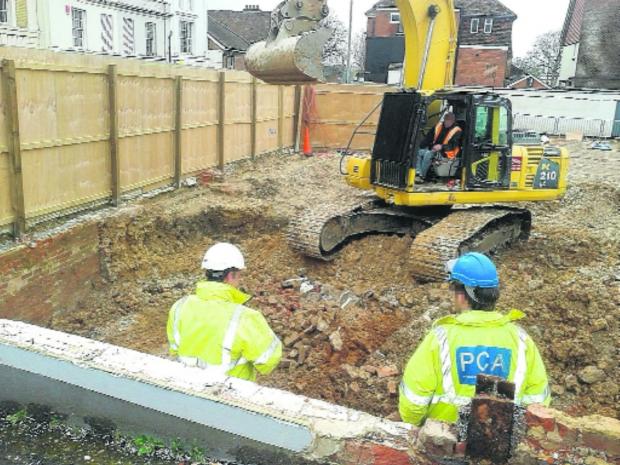
Decapitated body unearthed at housing development
A decapitated body has been pulled out of the ground at a small housing development in Wanborough.
The building site at Stanley Close, Wanborough, where the skeleton was found [Credit: Swindon Advertiser]
The skeleton, which was buried in a shallow grave, is thought to date back around 1,700 years, at a time when a Roman farming settlement occupied the area.
Archaeologists believe the person would likely have been a criminal, executed and dumped just outside of the town.
Read the rest of this article...
Sunday, February 23, 2014
Were the ancient Greeks and Romans colour blind?
Homer left historians with the impression that the ancient Greeks and Romans had an underdeveloped appreciation of colour. The ancients, in fact, were a shade more sophisticated than that and understood colour in a completely different way to us, argues Mark Bradley.
People in ancient cultures saw colour in an altogether different way from you and me. The most famously perplexing description of colour in the ancient Mediterranean world is the 'wine-dark sea' in The Iliad and The Odyssey. Have you ever looked at the sea and thought that it was the colour of claret?
One of the first people to argue that the ancient Greeks had an under-developed colour sense was a 19th century British prime minister. As well as being a politician, William Gladstone was a classics scholar and in his spare time did a study of colour usage in early Greek literature.
Read the rest of this article...
German treasure hunter finds Roman gold hoard
A hobby archaeologist with a metal detector has discovered a trove of gold and silver in a German forest dating back to late Roman times, fuelling speculation it could be the legendary Nibelung treasure that inspired Richard Wagner's opera cycle.
The collected gold jewellery pieces on display on Tuesday as part of the cache of barbarian treasures unearthed in Rhineland-Palatinate [Credit: DPA]
The haul from the western state of Rhineland Palatinate, worth about 1 million euros, includes silver bowls, brooches and other jewelry from ceremonial robes and small statues that adorned a grand chair, said archaeologists.
Quake-hit ancient city of Tralleis being restored
The ancient city of Tralleis in Aydın is being restored after suffering damage through ages of heavy seismic activity. When the work is complete, the ancient city will host large more tourists
“A structure which formed the entrance gate of the gymnasium building, and which became the symbol of Aydın, suffered the heaviest damage due to earthquakes,” said Aydın Culture and Tourism Director Nuri Aktakka. “As part of a project, it will be strengthened and illuminated so that it will even be seen from the entrance of the city. Also, restorations have been continuing to revive a columned road that was discovered in Tralleis. The ancient city will become a place worth a visit within a year.”
Read the rest of this article...
Tuesday, February 11, 2014
Gladiator Heads? Mystery of Trove of British Skulls Solved
A trove of skulls and other body parts unearthed in the heart of London may have once belonged to Roman gladiators, war captives or criminals, a new study suggests.
The remains, described in the January issue of the Journal of Archaeological Science, belonged to about 40 men, mostly ages 25 to 35, and were marred by violence: cheek fractures, blunt-force trauma to the head, decapitation and injuries from sharp weapons, said study co-author Rebecca Redfern, a curator and bioarchaeologist at the Museum of London. [In Images: Skulls of the Gladiators and War Captives]
Great Britain's ancient cities are littered with archaeological treasures, many of which are often dug up accidentally prior to construction. For instance, in 2013, the burial site of King Richard III was found under a parking lot in Leicester, England, and in April 2013, a medieval knight's tomb was uncovered under a Scottish parking lot.
Read the rest of this article...
Monday, February 3, 2014
Iron industry revered by Romans discovered during link road dig in East Sussex
Archaeological finds in East Sussex suggest why the Romans would have pushed for control of a sophisticated iron production line
An epicentre of the prehistoric iron industry, coveted by the conquering Romans for its sophisticated production techniques and believed by archaeologists to have been one of the finest sites of its kind in ancient Europe, has been discovered during a major roadbuilding project in Sussex.
Dozens of boreholes, 181 trial trenches and 24 test pits have been investigated by Oxford Archaeology along the future 5.6km link road between Bexhill-on-Sea and Hastings. The evidence ranges from the late Mesolithic and Neolithic periods to the Bronze, Iron, Saxon and Medieval ages.
Read the rest of this article...
Sunday, February 2, 2014
Summer Courses in Archaeology
The Oxford Experience Summer School
Courses in Archaeology
The Oxford Experience Summer School is held at Christ Church, Oxford
The Oxford Experience Summer School offers a number of one-week courses in archaeology as part of its programme.
Participants live in Christ Church - the largest of the Oxford Colleges - and take their meals in the Great Hall, which is the hall that inspired the Hogwarts Hall in the Harry Potter films.
Courses are limited to a maximum of twelve participants and tend to fill up rather quickly, so early application is advised.
Training Digs for 2014
Remains of Roman temple found under Milan Cathedral
The remains of a pagan temple believed to have been devoted to the goddess Minerva have been found under the Milan Cathedral.
Milan Cathedral from the Square [Credit: WikiCommons]
The announcement was made Wednesday during the presentation of other archaeological finds, the remains of the ancient Mediolanum Forum discovered recently under the basement of the building housing the Pinacoteca Ambrosiana and the Biblioteca Ambrosiana. Archaeological excavations to unearth the remains of the large city that, beginning in 292 A.D., was the capital of the Western Roman Empire for over a century continue despite funding difficulties. So far, part of the floor made out of what is known as 'Verona stone' has been found. The base of a section of an arcade can also be seen. The entire forum occupied an estimated surface area of 166 by 55 square meters.
Read the rest of this article...
Subscribe to:
Posts (Atom)


