Sunday, September 25, 2016

Roman Skeleton With 'Bent Feet' Found At Dorset Quarry


Tests are being carried out to find out how the man died 
[Credit: Hills Quarry]

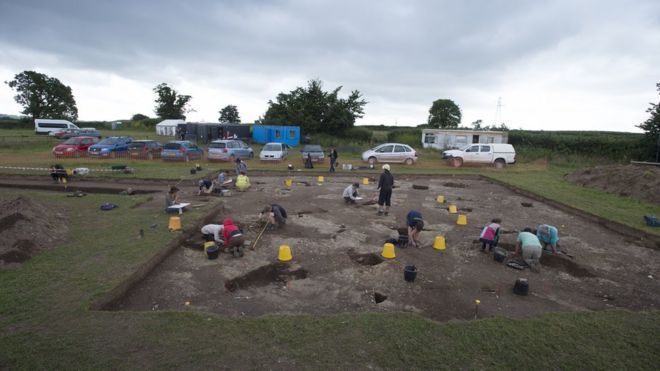
Archaeologists made the discovery at Woodsford, near Dorchester, where they have been carrying out excavations for several years.

Thames Valley Archaeological Services said the man died in his 20s or 30s.

Tests are being carried out to determine how he died and to understand more about his "unusual grave".

The limestone sarcophagus was found in a 1.80m (5ft 11in)-long, 0.55m (1ft 10in)-wide and 0.3m (1ft)-deep grave.

Read the rest of this article...

DES TECHNIQUES UNIQUES AU MONDE POUR RESTAURER UN BATEAU GALLO-ROMAIN DE QUINZE MÈTRES


Les fouilles préventives réalisées sur prescription de l’Etat par une équipe d’archéologues de l’Inrap sur le parc Saint-Georges avaient mis au jour, en 2003, 16  bateaux dont un chaland datant du deuxième siècle de notre ère, vraisemblablement utilisé pour le commerce fluvial sur le Rhône.
Propriété de la Métropole de Lyon, ce chaland est destiné au musée gallo-romain de Lyon Fourvière. Dans cette perspective, il a subi une restauration complète, conjointement pilotée par un archéologue de l’Inrap et une restauratrice d’Arc-Nucléart.

Read the rest of this article...

Friday, September 16, 2016

Two New Roman Photo Spheres


Following a trip to France, I have now uploaded two new Roman period archaeological photo spheres.  They are as follows:


Tuesday, August 9, 2016

Roman goddess unearthed at South Shields culture spot


Delighted volunteers at a South Shields culture spot had a blast from the past after unearthing a Roman goddess. 

Volunteers from the WallQuest community archaeology project and the Earthwatch Institute made the startling discovery at Arbeia Roman Fort. 

The dramatic discovery is a beautifully crafted miniature bronze figure of the Roman goddess Ceres which is thought to be a mount from a larger piece of furniture. 

Ceres was the goddess of agriculture, grain and fertility which is a highly appropriate goddess for Arbeia because it was a supply base where thousands of tons of grain were stored in granaries to feed the army stationed along Hadrian’s Wall.

Read the rest of this article...

Restored Pompeii kitchens show how Romans cooked


The ancient Roman kitchens of a Pompeii launderette have once again been kitted out with pots and pans as part of a new project that is trying to give visitors a sense of what day-to-day life in the city was like.


The kitchens at the Fullonica di Stephanus 
[Credit: Archaeological Superintendency of Pompeii]

Before they were buried by a volcanic eruption in AD 79, the kitchens once provided food for the hungry attendants of the three-storey launderette, the Fullonica di Stephanus.

The Fullonica was the place where wealthy Roman patricians sent their togas to be washed in huge baths using clay and urine. The garments were then rinsed, dried and placed on special presses to ensure they returned to their noble owners crease-free.

Thanks to a refurbishment which finished on Monday, the kitchens inside the Fullonica now appear as they did 2,000 years ago, complete with metal grills, pots, pans and earthenware crockery.

Read the rest of this article...

Monday, August 1, 2016

Ceres Figurine Found In South Shields


A beautifully crafted miniature bronze figure of the Roman goddess Ceres was found by volunteers from the WallQuest community archaeology project and the Earthwatch Institute at Arbeia Roman Fort, South Shields.


The figure of the Roman goddess Ceres uncovered in South Shields 
[Credit: Arbeia Fort]

The artifact thought to be a mount from a larger piece of furniture. Ceres was the goddess of agriculture, grain and fertility which is a highly appropriate goddess for Arbeia because it was a supply base where thousands of tons of grain were stored in granaries to feed the army stationed along Hadrian’s Wall.

This is the second goddess that the WallQuest project has found at Arbeia in two years. In 2014, a local volunteer found a carved stone head of a protective goddess, ortutela.

Read the rest of this article...

High-Tech Tools Yield Roman Discovery


A team of Duke scholars and students spent this summer at two historic sites in Italy and made significant discoveries. The team, based in part in the dig@lab, a digital laboratory run by Maurizio Forte, a professor of classical studies and art, art history and visual studies, discovered two Roman Empire-era facilities, a public building and an amphitheater.

The project team included Duke faculty members Bill Seaman, David Johnson, Todd Berreth and Regis Kopper, as well as Nevio Danelon, a post-doctoral fellow; Katherine McKusker, PhD student; Benedict Parfit, an undergraduate student. Everette Newton, who works with Duke's Nicholas School of the Environment's marine lab, piloted the drone used in the excavation. The team also included scholars from other universities.

Read the rest of this article...

Thursday, July 14, 2016

Decorated Roman bronze belt found in Leicester excavations


Archaeologists from University of Leicester Archaeological Services (ULAS) have recently excavated a Late Roman cemetery at Western Road in Leicester’s West End. Amongst the 83 skeletons recorded by the team, one burial is proving to be very exciting.

The simple grave in question had been dug into mudstone on the west bank of the River Soar, to the south-west of the Roman town close to the important road known as the Fosse Way. Buried in the grave were the remains of a middle-aged man wearing an elaborately decorated belt in a style that would have been worn by a Late Roman soldier or civil servant during the second half of the 4th century or the early 5th century AD.
Read the rest of this article...

Tuesday, July 5, 2016

Rome Shows Off Cleaned-Up Colosseum

Rome's Colosseum was visibly cleaner on Friday as Italy showed off the latest phase of restoration of one of its most famous landmarks.


A view of the Colosseum after the latest stage of restoration by luxury goods firm Tod's in Rome 
[Credit: Reuters]
Prime Minister Matteo Renzi, speaking on a stage in the amphitheatre built to host gladiatorial contests nearly 2,000 years ago, hailed the mammoth clean-up project as an example for protecting the country's vast cultural heritage.

Italy's monuments were neglected for decades amid shrinking government funding and alleged mismanagement, which put some of its 51 UNESCO World Heritage sites at risk of crumbling.


Read the rest of this article...

Monday, July 4, 2016

The Discovery of a Roman Gladiator School Brings the Famed Fighters Back to Life


Located in Austria, the archaeological site is providing rich new details about the lives and deaths of the arena combatants


Woolfgang Neubauer stands in the grassy clearing and watches a drone soar low over distant stands of birch and white poplar, the leaves still speckled with overnight rain. Vast fields of wheat roll away north and south under a huge dome of sky. “I’m interested in what lies hidden beneath this landscape,” says the Austrian archaeologist. “I hunt for structures now invisible to the human eye.”

On the edge of the meadow, two boys stand a long way apart, arms clenched by their sides, punting a soccer ball very slowly and carefully from one to the other. Neubauer studies them keenly. A professor at the Vienna Institute for Archaeological Science, he’s an authority on the first games played on this ersatz pitch, a blood sport popular a couple of millennia ago. “You see a field,” he tells a visitor from the United States. “I see a gladiator school.”

Read the rest of this article...

ARCHAEOLOGISTS FIND PRESERVED WOODEN STRUCTURE FROM MOAT BRIDGE AT WESTERN GATE OF ANCIENT SERDICA IN BULGARIA’S SOFIA


The archaeologists who have carried out the recent preparatory excavations of the Western Gate of the AncientRoman city of Serdica, the predecessor of today’s Bulgarian capital Sofia, have discovered a wooden structure which was probably part of an ancient moat bridge.
The excavations of Serdica’s Western Gate started in May 2016, and were wrapped up in a month to prepare the site for a restoration project funded by the Norway Grants and EEA Grants with nearly BGN 947,000 (app. EUR 500,000), which is supposed to be executed over the summer.
One of the most interesting finds dating back to the 2nd-4th century AD that have been unearthed by the archeological team are the wooden remains from a bridge of Roman Serdica. The discovered wooden structure was probably used to prop up the bridge. It was found right in the section right in front of the Western Gate.
Read the rest of this article...

Rare Roman building revealed in southern England's Meon Valley


A recent archaeological dig near Meonstoke, Hampshire, has revealed the foundations of a Roman building with a very rare hexagonal shape.


Rare Roman building revealed in southern England's Meon Valley
The remains of the hexagonal building in Meonstoke 
[Credit: University of Winchester]

The discovery was made by the amateur Meon Valley Archaeology and Heritage Group, led by University of Winchester archaeologist Dr Nick Stoodley, using geophysical equipment on loan from Historic England.

“Only one other like this has been discovered in Britain,” said Tony King, Professor of Roman Archaeology at the University of Winchester and director of the excavation. “It is a wonderful chance for the University’s undergraduate students to excavate such a site. We are speculating whether we are seeing a pagan temple or some other type of building, and we have uncovered a Roman bathhouse very close by.”

Meonstoke villagers Alison Smalley and John Snow have been organising support from the other Meon Valley villages. Armed with trowels and kneels, around eighty people of all ages took part in groups of 12 a day.

Read the rest of this article...

LA VILLA GALLO-ROMAINE DE MAUBEC À MONTÉLIMAR


En amont de la construction du lotissement « Les Terrasses de Maubec »  par PRODEVAR, filiale de GGL Groupe, les archéologues de l’Inrap fouillent, jusqu’au 22 juillet, une emprise de 5 000 m2. Réalisée sur prescription de l’État (Drac Auvergne Rhône-Alpes), cette opération porte sur l’étude d’une villaconstruite à flanc de coteaux aux IIe-IIIe siècles de notre ère. 
Ce domaine agricole gallo-romain s’inscrit dans un ensemble d’établissements similaires qui émaillent le paysage et qui, probablement, ravitaillent le bourg, déjà existant, de Montélimar.

Read the rest of this article...

Friday, July 1, 2016


One of the largest and well-preserved theatres of Greek antiquity opened to the public for the first time after 2,000 years last week in the city of Larissa in Thessaly, Greece.

Dating back to the early third century BC, the ancient theatre of Larissa lies on the south slope of the Medieval fortress at the city's heart, archaeologist Stavroula Sdrolia, head of the seventh Ephorate of Byzantine Antiquities said.

In antiquity, apart from theatrical performances, it also hosted the assemblies of the senior regional authority, while at the end of the first century BC, it was turned into a Roman arena, she explained.

Read the rest of this article...

Monday, June 27, 2016

THE DAY OF ARCHAEOLOGY 2016 WILL BE HELD ON FRIDAY 29 JULY!


We are looking for people working, studying or volunteering in the archaeological world to participate with us in a “Day of Archaeology” in July 2016. The resulting Day of Archaeology website will demonstrate the wide variety of work our profession undertakes day-to-day across the globe, and help to raise public awareness of the relevance and importance of archaeology to the modern world. We want anyone with a personal, professional or voluntary interest in archaeology to get involved, and help show the world why archaeology is vital to protect the past and inform our futures.

Explore posts from previous years here...

Boundaries of Roman Empire redrawn after Devon archaeological dig

The Ipplepen Archaeological Project began its fieldwork for this year two weeks ago

The boundaries of the Roman Empire have been expanded following the discovery of Roman coins in a rural village.
Amateur metal detectorists Jim Wills and Dennis Hewings first unearthed the coins in Ipplepen, Devon, in 2009.
Now archaeologists have uncovered a Romano-British settlement which had trade links to the rest of the Empire.
Dr Sam Moorhead, from the British Museum, said the site raised "a whole series of new questions" about Roman Devon.

Read the rest of this article...

Skeletons, Coins Found In Dig Of Ancient Pompeii Shop


Italian and French archaeologists have discovered four skeletons and gold coins in the ruins of an ancient shop on the outskirts of Pompeii, officials said Friday.

An Italian and French archaeologist team, digging in the outskirts of Porta Ercolano, Pompeii, have discovered four skeletons and gold coins in the ruins of an ancient shop. Pompeii archaeological site officials said the skeletons are those of young people, including an adolescent girl, who perished in the back of the shop when Mount Vesuvius erupted in 79. [Credit: Pompeii Archaeological Site Press Office via AP]
The skeletons are those of young people, including an adolescent girl, who perished in the back of the shop near the ancient Roman town when Mount Vesuvius erupted and covered it in ash in 79, said a statement from the area office of the famous archaeological site near Naples.

Three gold coins and a necklace's pendant were scattered among the bones. In the workshop was an oven which archaeologists think might have been used to make bronze objects.


Read the rest of this article...

Roman Burials Discovered In East England


A previously undiscovered Roman cemetery has been found by archaeologists working on a Lincoln city centre site. The skeletal remains of two babies and an adult, plus ashes in an urn, were uncovered by the team preparing the ground for the University of Lincoln's new Sarah Swift building. And archaeologists working on the land between High Street and Brayford Wharf East are excited because the major finds further emphasise the importance of Lindum as a Roman centre.

No indications of a Roman cemetery had been found in the Lincoln area until 
an excavation at the city's university [Credit: © Allen Archaeology Ltd]
City archaeologist Alastair MacIntosh said: "Previous archaeological work in the area has revealed evidence of Roman buildings dating from the 1st century onwards. And until now it was thought that the area was only used for housing, so this is an exciting discovery."
Read the rest of this article...

Tuesday, June 21, 2016

Whistling Sling Bullets Were Roman Troops' Secret 'Terror Weapon'

Some of the Roman sling bullets found at the Burnswark Hill battle site in Scotland. The two smallest bullets, shown at the bottom of this image, are drilled with a hole that makes them whistle in flight.
Credit: John Reid/Trimontium Trust

Some 1,800 years ago, Roman troops used "whistling" sling bullets as a "terror weapon" against their barbarian foes, according to archaeologists who found the cast lead bullets at a site in Scotland.
Weighing about 1 ounce (30 grams), each of the bullets had been drilled with a 0.2-inch (5 millimeters) hole that the researchers think was designed to give the soaring bullets a sharp buzzing or whistling noise in flight.
The bullets were found recently at Burnswark Hill in southwestern Scotland, where a massive Roman attack against native defenders in a hilltop fort took place in the second century A.D. [See Photos of Roman Battle Site and Sling Bullets]
Read the rest of this article...

Monday, June 20, 2016

Gaulcross Hoard Sheds Light On Northern Scotland During Roman Era


Major breakthroughs in our understanding of the Picts, the “lost” ancient people of Northern Scotland, and their possible interaction with the last Romans in Britain have followed the discovery of a hoard of Roman silver in Aberdeenshire.
The entire silver hoard (except for the three pieces discovered in 1838) on display 
[Credit: National Museums Scotland]

First uncovered in 1838 and again in 2014 and now known as the Gaulcross Hoard, the items discovered over the past 18 months now extend to more than 100 silver coins and objects.

What is exciting archaeologists and historians is that although the hoard is Pictish in origin, the metal itself is Roman and includes Hacksilber, fragments of cut and bent silver items that were often used as currency by the Romans.

The suggestion by the discoverers is that the Gaulcross Hoard was originally in high-status Roman hands and that the Picts acquired them either through looting, trade or military means.


Read the rest of this article...

Monday, June 13, 2016

Archaeology in the Round?


A new website providing links to archaeological photo spheres is now online.

The purpose of the site is to make these photo spheres easily available and also to encourage people to make archaeological photo spheres and publish them on the site.


You can find the site at: archosphere.eu

The day I stumbled on a Roman villa in my back garden


Luke Irwin at his home, next to the gate under which a Roman mosaic was found 
CREDIT: JAY WILLIAMS


When Luke Irwin discovered evidence of a palatial second century Roman villa in his quiet corner of Wiltshire, he wasn’t prepared for the world’s reaction. The chance nature of the find in his back garden, which was exposed last February when a stretch of vividly coloured mosaic was uncovered during wiring work, certainly made for an attention-grabbing story.

But what was less predictable was the speed at which it spread around the world after he went public with the news in April this year. Within a couple of days, the internet was agog with debate (“What are ancient Roman luxury villas going for nowadays?”) and Irwin’s video about the discovery and excavation of the site – previously a sheep field – had been watched by thousands of people. Things became truly surreal when Fox News introduced the villa to America as “the opulent home of a Roman-era 'Kardashian’ family”.

Read the rest of this article...

Sunday, May 29, 2016

Red paint found at Roman Baths during excavations

Wall plaster with a red-painted finish has been found on an external wall

The building housing some of Britain's most famous Roman baths may have been painted red, archaeologists have said.
A dig at the site, in Bath, uncovered remnants of red paint on the outside wall - contradicting a widely-held assumption they were white in colour.
The discovery was made during a dig in an area of the world heritage site not currently open to the public.
Manager Stephen Clews said it would have helped the building to stand out to visitors.
"Our assumption was that it was white but it's turned out to be red," he said.

Read the rest of this article...

Discovery of Roman fort built after Boudican revolt


New research published by archaeologists from MOLA reveals a previously unknown Roman fort, built in AD63 as a direct response to the sacking of London by the native tribal Queen of the Iceni, Boudica. The revolt razed the early Roman town to the ground in AD60/61 but until now little was understood about the Roman’s response to this devastating uprising.

Excavations at Plantation Place for British Land on Fenchurch Street in the City of London exposed a section of a rectangular fort that covered 3.7acres. The timber and earthwork fort had 3metre high banks reinforced with interlacing timbers and faced with turves and a timber wall. Running atop the bank was a ‘fighting platform’ fronted by a colossal palisade, with towers positioned at the corners of the gateways. This formidable structure was enclosed by double ditches, 1.9 and 3m deep, forming an impressive obstacle for would be attackers.
Read the rest of this article...
How London became Britain's capital has been revealed for the first time


A Roman fort suggests the Romans chose London as their new British political headquarters after Boadicea's revolt in the mid 1st century AD

A brutal blood-soaked bid to wipe London off the map was a key factor that led to the city first emerging as Britain's capital.
New archaeological research is showing that London's elevated status stemmed partly from a Roman military and political reaction to Boadicea's violent destruction of London and other key cities in the mid 1st century AD.
The investigation, carried out by Museum of London Archaeology(Mola), suggests that the Romans shifted the capital of their British province from Colchester to London shortly after her revolt.
Read the rest of this article...

Thursday, April 28, 2016

'Hugely important' haul of Roman coins found in Spain


Construction workers have unearthed 600kg of Roman bronze coins, a unique and "hugely important" discovery according to experts.

Routine building work in southern Spain unearthed a very unexpected find this week, when over 600kg of Roman coins were discovered.
The find is "unique in Spain and perhaps the world" experts said of the coins, which were stored in 19 Roman amphoras or containers.
"We have a team looking into the discovery right now, We believe it is hugely important and will have more information very soon," said a spokesman at Andalucia's Ministry of Culture in Seville told The Local on Thursday.
Read the rest of this article...

Rare statue could help unearth secrets of Long Melford’s Roman past


A rare find unearthed in a garden in Long Melford could point to the village being the “missing link” in a chain of Roman forts, it has been claimed.

A six inch tall figurine dating from the first or second century, known as a ‘pseudo Venus’, was dug up by volunteer archaeologists while they were working on a test pit at a property in the south of the village.
According to a county council archaeologist, the statue would have had religious significance and is a very “unusual” find.
Local heritage centre volunteers John Broughton, Kenneth Dodd and John Nunn came across the statue while they were carrying out a rescue dig in a garden that was due to be landscaped.
Read the rest of this article...

Sunday, April 24, 2016

Archaeologists have found a Roman child's stone coffin and a mosaic at a former villa site in Wiltshire

Rug designer Luke Irwin and Historic England Archaeologist Dr David Roberts on the incredible discovery of what could be one of the country's largest Roman villas near a house in Wiltshire


Rug designer Luke Irwin has discovered a Roman mosaic while laying electricity cables in Wiltshire.This stone coffin of a Roman child held geraniums until it was identified
© Jon Wilkes

Luke Irwin: “This is the most beautiful sort of unspoilt river valley and it’s sort of hidden away. On the hill which overlooks where we live there was a vast temple. Six miles away there was another vast temple.

We are a mile from a Roman road. You can see undulations in the landscape and the general guess would be that this is a medieval  building thing going on – until you find a mosaic. 

Read the rest of this article...

‘Be cheerful, live your life:’ Ancient mosaic ‘meme’ found in Turkey’s south


What could be considered an ancient motivational meme which reads “be cheerful, live your life” in ancient Greek has been discovered on a centuries-old mosaic found during excavation works in the southern province of Hatay.

Demet Kara, an archaeologist from the Hatay Archaeology Museum, said the mosaic, which was called the “skeleton mosaic,” belonged to the dining room of a house from the 3rd century B.C., as new findings have been unearthed in the ancient city of Antiocheia.

“There are three scenes on glass mosaics made of black tiles. Two things are very important among the elite class in the Roman period in terms of social activities: The first is the bath and the second is dinner. In the first scene, a black person throws fire. That symbolizes the bath. In the middle scene, there is a sundial and a young clothed man running towards it with a bare-headed butler behind. The sundial is between 9 p.m. and 10 p.m. 9 p.m. is the bath time in the Roman period. 


Read the rest of this article...

Monday, April 18, 2016

LES ARÈNES DE NÎMES. UN AMPHITHÉÂTRE ROMAIN


Ce webdocumentaire retrace l’histoire des arènes de Nîmes, l’amphithéâtre le mieux conservé du monde romain,  des origines de sa construction aux actuelles campagnes de restauration. À destination de tous, notamment du jeune public, son approche ludique et interactive intègre les données les plus récemment acquises sur le monument.

Read the rest of this article...

Roman villa unearthed 'by chance' in Wiltshire garden

Luke Irwin was laying electric cables at his farmhouse when he came across an untouched Roman mosaic
An "elaborate" Roman villa has been unearthed by chance by a homeowner laying electric cables in his garden in Wiltshire.
It was discovered by rug designer Luke Irwin as he was carrying out some work at his farmhouse so that his children could play table tennis in an old barn.
He uncovered an untouched mosaic, and excavations revealed a villa described as "extraordinarily well-preserved".
Historic England said it was "unparalleled in recent years".

Read the rest of this article...

Tuesday, April 12, 2016

Roman Imperial leaders had wine empire away from the battlefield, study suggests

Archaeologists from the University of Sheffield have uncovered a unique insight into the life of one of the Roman Empire’s most prominent landowners.
Until now, very little was known about Rome’s Imperial leaders aside from their battle triumphs, territorial conquests and monumental legacies.
Researchers from the University of Sheffield’s Department of Archaeology investigating the vast Imperial estate of Vagnari in Italy, have now unearthed evidence of wine production on an industrial scale – shedding light on their home life away from the battlefield.
The excavation team discovered the corner of a cella vinaria, a wine fermentation and storage room, in which wine vessels, known as dolia defossa, were fixed into the ground.
Read the rest of this article...

Wednesday, April 6, 2016

Microbiologists unmask the Hannibal route enigma


Microbiologists based in the Institute for Global Food Security and School of Biological Sciences at Queen's University Belfast have recently released results that may have answered one of ancient history's greatest enigmas: Where did Hannibal cross the Alps? 


Hannibal crosses the Alps on an elephant  [Credit: Nicolas Poussin] 

Hannibal was the Commander-in-Chief of the Carthaginian army during the Second Punic War with Rome (218 -201 BC). He famously led his troops (thirty thousand men, just thirty seven elephants and over fifteen thousand horses and mules) across the Alps to invade Italia - bringing the Roman army to its knees. 

While the great general was ultimately defeated at Zama in 202 BC, this campaign is rightly regarded today as one of the finest military endeavours of antiquity. We can say, in retrospect, that these events ultimately shaped the future Roman Republic, eventually with Caesar morphing into the Empire, and therefore into European civilisation as we know it.

Read the rest of this article...

Has Hannibal's route across the Alps been uncovered? Scientists use 2,000-year-old trail of dung to track legendary general

The Col de la Traversette, a narrow pass between Grenoble in France and Turin in Italy 
CREDIT: GOOGLE

It was one of the most outrageously bold manoeuvres in military history - and 2,000 years on experts are still trying to work out how he pulled it off.

But now the mystery of how Hannibal's army managed to catch the Romans off guard by crossing the Alps in an improbable 1,000-mile march could be solved, it is claimed, by tracking a trail of dung.

Scientists say that a thin crust of ancient excrement left by Hannibal's animals, which famously included 37 elephants, could reveal the route the legendary Carthaginian general took.

Hannibal's 30,000-strong army trudged through deep snow in the grip of winter in 218BC with more than 15,000 mules and horses before crossing into Italy where they nearly made it to the gates of ancient Rome.

But, according to experts, such a large movement of men and animals must have left what they describe as a "mass animal deposition event".

Read the rest of this article...

Friday, April 1, 2016

Ancient Non-Stick Pan Factory Found in Italy

One fragment of the non-stick frying pans with internal red-slip coating.

Italian archaeologists have found a site near Naples where the precursors of non-stick pans were produced more than 2,000 years ago.

The finding confirms that non-stick frying pans, an essential tool in any modern kitchen, were used in the Roman Empire.

The cookware was known as “Cumanae testae” or “Cumanae patellae,” (pans from the city of Cumae) and was mentioned in the first-century Roman cookbook De Re Coquinaria as the most suitable pans for making chicken stews.

Read the rest of this article...