Friday, May 29, 2015

Mystery Deepens Over Rare Roman Tombstone


Mystery has deepened over a Roman tombstone unearthed earlier this year in western England, as new research revealed it had no link with the skeleton laying beneath it.
The inscribed stone was discovered during the construction work of a parking lot in Cirencester.
Made from Cotswold limestone, it was found laying on its front in a grave — directly above an adult skeleton.
When it was turned over, the honey colored stone revealed fine decorations and five lines of Latin inscription which read: “D.M. BODICACIA CONIUNX VIXIT ANNO S XXVII,” possibly meaning: “To the shades of the underworld, Bodicacia, spouse, lived 27 years.”
Read the rest of this article...

New finds at Plassi, Marathon in Attica


This year’s excavations of the Prehistoric-Classical site of Plassi, Marathon in Attica, conducted by the University of Athens, have been completed last week. The survey of the site began last year. 


Buildings and pottery kiln of the Prehistoric era 
[Credit: National and  Kapodistrian University of Athens] 

The Plassi excavation has once again brought to light important finds showing that the site remained the most important settlement of the Marathon plain from the end of the Neolithic period (ca 3500 BC) until the Late Roman years (300 AD).

During this year’s excavation season the trial trenches of 1969 (made by archaeologists Sp. Marinatos and E. Mastrokosta) were revealed and cleaned and new ones were opened, in order to answer questions which had remained unanswered.

Read the rest of this article...

Brumath-Brocomagus, Civitas Capital of the Triboci


Brumath-Brocomagus, Civitas Capital of the Triboci

Exhibition at Musée Archéologique, Strasburg

until 31 December 2015

Occasioned by urban redevelopment projects involving housing schemes and business parks, the numerous successive archaeological excavations of recent decades in the town of Brumath and its surrounding area have helped to renew and considerably widen our knowledge of the antique city. Today, the wealth of discoveries prompts us to make an initial assessment of the settlement's development and the history of the territory of Brumath from Prehistory to the early Middle Ages. Central to the exhibition will be a review of the expansion of the Gallo-Roman city: urban topography, public and private buildings, aspects of daily life, production and trade, beliefs and religion, graveyards and funeral rites. The visitor will thus be offered an overall vision of the different aspects of Romanization and urban life in Alsace under Roman rule. 

Read the rest of this article...

Tuesday, May 26, 2015

Archaeologists put Roman gateway on wishlist after finding ancient water tank at Vindolanda fort


Fine carving for Roman goddess of hunting and first copper lock barrel in 34 years among finds in Roman north-east

Archaeologists are hoping to find a gate and its stone inscription after discovering tank features, buildings, a roadway, animal bones, pens, hairpins and barrels during the first two excavation sessions of the year at Vindolanda, the Roman fort near Hadrian’s Wall.

Facing snow and torrential rain during their early investigations – conditions they admit were “horrendous” – the team uncovered a free-standing water tank and a depiction of a hare and hound carved for Diana, the goddess of hunting.

Read the rest of this article...

Wednesday, May 6, 2015

Roman mosaics damaged during botched restoration, Turkish officials say


At least 10 priceless mosaics held in the Hatay Archaeology Museum in Turkeyhave been badly damaged during restoration, officials and craftsmen have said.
The Roman mosaics, some of which date back to the second century, include world-famous panels depicting the sacrifice of Isaac and another of Narcissus. The museum in Turkey’s southern province of Hatay houses one of the world’s largest collections of mosaics.
Authorities have launched an investigation following reports that restoration has distorted the mosaics’ features and left them looking markedly different from the valuable originals.
Read the rest of this article...

Turkey: Investigation over 'ruined' Roman mosaics


Turkey's culture ministry is investigating reports that a number of valuable Roman mosaics were badly damaged during botched restoration work at an archaeological museum, according to Turkish media.
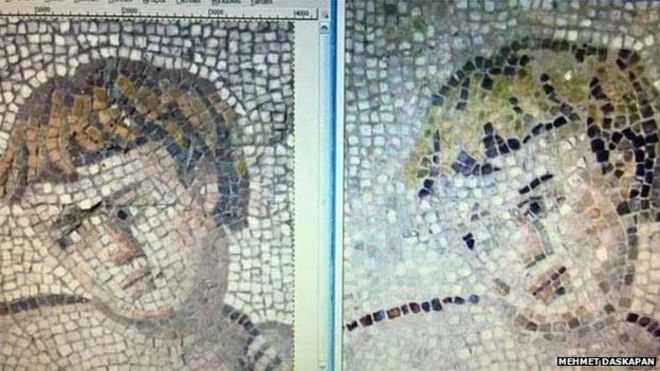
Authorities are looking into the claims of a local craftsman who raised concerns over the condition of at least 10 mosaics at the Hatay Archaeology Museum, the Hurriyet Daily News website reports. Mehmet Daskapan first spoke out in an interview with a local paper in February, but the news was only picked up by mainstream Turkish media on Monday. "Valuable pieces from the Roman period have been ruined," Mr Daskapan told the Antakya Gazetesi website at the time. "They have become caricatures of their former selves. Some are in an especially poor condition and have lost their originality and value."
Before and after photos of the mosaics presented by Mr Daskapan show the "restored" versions looking significantly different to the originals. Some stones appear to have been replaced with different colours and shapes, changing the facial expressions of the characters depicted. A report on the Radikal website has suggested the images could have been Photoshopped, but the site later noted that the region's governor had nonetheless closed off the section housing the mosaics in question.

Read the rest of this article...

Tuesday, May 5, 2015

BULGARIAN ARCHAEOLOGIST FINDS ANCIENT ROMAN JACUZZI HEATER AT ‘LUXURY’ ROAD STATION NEAR SOSTRA FORTRESS

Bulgarian archaeologist Ivan Hristov shows the heater of the Ancient Roman Jacuzzi in the “luxury” Roman road station at the Sostra Fortress located near Bulgaria’s Troyan. 
Photo: InfoTroyan.eu

Bulgarian archaeologist Assoc. Prof. Dr. Ivan Hristov has discovered a heater for an Ancient Roman Jacuzzi during the ongoing excavations of the Roman road station at the Sostra Fortress near the central town of Troyan.

The Roman road station, which was first found by Hristov’s team in the spring of 2014 and is presently being excavated further, has itself been described as a “luxury” Roman motel because of the amenities that it offered for the Roman travelers taking the Via Trajana, the road used by Roman Emperor Trajan (r. 98-117 AD).

The newly found heater for a Roman Jacuzzi consists of a furnace heating up air which is then directed to a shallow pool similar to a modern-day Jacuzzi, reports local news site InfoTroyan.eu.

Read the rest of this article...

Niedergermanischer Limes soll UNESCO-Welterbe werden


Nordrhein-Westfalen, Rheinland-Pfalz und die Niederlande wollen den Niedergermanischen Limes als Welterbe bei der UNESCO anmelden. Das sieht eine Vereinbarung der beiden Bundesländer mit den Niederlanden vor, die im LVR-LandesMuseum Bonn unterzeichnet wurde.

Der Niedergermanische Limes verlief auf 385 Kilometern Länge entlang des Rheins von Remagen in Rheinland-Pfalz bis Katwijk an Zee als Grenzeinrichtung gegenüber dem feindlichen freien Germanien. Der komplette Verlauf entlang eines Flusses und seine besonders lange Existenz unterscheiden ihn von den anderen Limesabschnitten.

Read the rest of this article...

Monday, April 27, 2015

Caesar did not suffer from epilepsy: scientists


    More than 2,000 years since Caesar died - assassinated by his own senators - researchers have claimed the military leader was struck by a debilitating disease in later life.
    Some academics have previously argued that Caesar suffered from epilepsy, a brain condition which causes seizures.
    But writing in the journal Neurological Sciences, researchers Francesco M. Galassi and Hutan Ashrafian have argued that the general suffered from cerebrovascular disease.
    Read the rest of this article...

    Sunday, April 26, 2015

    Cremated human bones in pot found in Crossrail dig suggest gruesome ritual

     A Roman shackle – one of the mass of Roman and medieval objects found during excavations at the Crossrail site near Liverpool Street station. Photograph: Graham Turner for the Guardian

    Almost 2,000 years ago somebody neatly packed cremated human bones into an old cooking pot, put the lid on, and set it by the banks of a smelly little urban river, the Walbrook in London. The discovery has deepened the mystery of scores of Roman skulls found nearby, polished till they gleam by tumbling among the pebbles of the riverbed.
    It had been suggested that the skulls ended up in the river – which vanished into culverts centuries ago – by accident, eroded out of a Roman cemetery and washed downstream until they came to rest at bends in the bank. The new finds suggest a grimmer explanation.
    Jay Carver, Crossrail’s lead archaeologist on the site yards from the bustling commuters at Liverpool Street station, said the thrifty reuse of the old pot, and its deliberate placing by the river, will force archaeologists to look again at the skulls found in this excavation and generations of previous digs around the river.
    Read the rest of this article...

    Monday, April 20, 2015

    Rare Roman owl clasp found on Danish island


    A 2,000-year-old bronze and enamel clasp has been unearthed south of the town of Nexø on the island of Bornholm. Shaped like an owl, the bronze and enamel button has large orange eyes and colourful wings. 


    A rare owl clasp has been found on Bornholm  [Credit: Bornholm's Museum] 

    “There are very few of these types of buttons,” said archaeologist Christina Seehusen from Bornholms Museum. “It is likely that someone travelling to the island carried it there.” 

    The owl was produced in regions along the Roman frontier that ran along the Danube and the Rhine at the time, so it may originate from ancient Cologne or another nearby town. The clasp was usually worn by men to hold their cloaks closed, so it is possible that a man from the island was a Germanic mercenary in the Roman army and brought the owl back to Bornholm with him. 

    Read the rest of this article...

    Saturday, April 18, 2015

    Understanding popular Latin of Roman Hispania through graffiti on pottery

    'Sigillata' pottery, from Roman times, was manufactured with a mould and sometimes stamped with figures and patterns.  Credit: Universitat de València

    Te University of Valencia is studying the popular Latin of Roman Hispania through the graffiti found on 'terra sigillata' ceramic ware. As part of this approach, analyses of the graffiti kept in the Spanish Royal Academy of History have just been started with a recent publication in the journal Lucentum: Anales de la Universidad de Alicante'.

    'Research focuses on the words written on the surface of these everyday ceramic pieces which can provide linguistic data, but also territorial and ethnological information', says the author of the work, Josep Montesinos, professor of Art History at the Faculty of Geography and History. Xaverio Ballester, professor in the Department of Classical Philology at the University of Valencia is also part of the team.

    Read the rest of this article...

    Thursday, April 16, 2015

    Burials from Rockbourne Roman villa re-examined


    Lower jaw deformities from birth, a missing right hand and foot bones, trepanning to exorcise “bad spirits” and a lonely burial were the lot of a middle-aged Saxon or early medieval man found face down in a shallow grave, say archaeologists investigating skeletons found at a Hampshire Roman villa during the 1960s. 


    A reconstruction of the skull of a man found weighed down  in a lonely grave at Hampshire's largest Roman villa  [Credit: © Hampshire Cultural Trust] 

    The latter of two male discoveries at Rockbourne, near the town of Fordingbridge on the River Avon, was originally found in 1965. 

    Analysts believe the community would have buried him in a lonely place and weighed him down with stones after viewing a deformity on the left hand side of his jaw as a sign of his troubles and a potentially evil influence.

    Read the rest of this article...

    Metal detectorist unearths 'exceptional' Roman finds


    Archaeological finds dating back to AD 200 have been discovered in a field near Royston. The artefacts, which form part of a burial, probably of a wealthy and cosmopolitan individual, are a unique find in Britain and experts in ancient finds are already clamouring to study these rare objects. 


    One of the smashed but complete mosaic glass dishes from Alexandria, Egypt  [Credit: North Hertfordshire District Council] 

    Discovered late last year by a local metal detectorist in a field in Kelshall, a complete Roman jug was the first thing to be found. A bronze dish, a larger jug and then a third jug were soon uncovered. Realising this was an important find it was reported and Keith Fitzpatrick-Matthews, North Hertfordshire District Council’s (NHDC) Archaeology and Outreach Officer, decided that it would be a good idea to investigate further.

    Read the rest of this article...

    Julius Caesar may have suffered mini-strokes, study finds


    Roman emperor Julius Caesar may have suffered a series of mini-strokes, explaining his dark mood in later life, according to doctors at London's Imperial College.
    Caesar, who lived from 100 to 44 BC, has long been the focus of medical debate, with the common assumption being that he suffered from epilepsy.
    But  from the London university have reexamined his symptoms, which included vertigo, dizziness and , and concluded that he may have in fact suffered from a cardiovascular complaint.
    "To date, possible cardiovascular explanations have always been ruled out on the grounds that until his death he was supposedly otherwise physically well during both private and stately affairs," said an excerpt of the study written by Francesco Galassi and Hutan Ashrafian.
    Read the rest of this article...

    Sunday, April 12, 2015

    Mummies from Hungary reveal TB's Roman lineage


    Bodies found in a 200 year-old Hungarian crypt have revealed the secrets of how tuberculosis (TB) took hold in 18th century Europe, according to a research team led by the University of Warwick. 


    One of the 265 mummies resting in cardboard boxes in the Hungarian  Natural History Museum in Budapest, Hungary [Credit: AP/Bela Szandelszky] 

    A new study published in Nature Communications details how samples taken from naturally mummified bodies found in an 18th century crypt in the Dominican church of Vác in Hungary have yielded 14 tuberculosis genomes, suggesting that mixed infections were common when TB was at peak prevalence in Europe. 

    The research team included collaborators from the Universities of Warwick and Birmingham, University College London, the Hebrew University in Jerusalem and the Hungarian Natural History Museum in Budapest. Lead author Professor Mark Pallen, from Warwick Medical School, said the discovery was significant for current and future infection control and diagnosis.

    Read the rest of this article...

    Saturday, April 11, 2015

    Tales from the crypt: Mummies reveal TB's Roman lineage

    This photomicrograph reveals Mycobacterium tuberculosis bacteria using acid-fast Ziehl-Neelsen stain; Magnified 1000 X. The acid-fast stains depend on the ability of mycobacteria to retain dye when treated with mineral acid or an acid-alcohol solution such as the Ziehl-Neelsen, or the Kinyoun stains that are carbolfuchsin methods specific for M. tuberculosis. Credit: public domain

    Samples from mummies in a Hungarian crypt have revealed that multiple tuberculosis strains derived from a single Roman ancestor that circulated in 18th-century Europe, scientists said Tuesday.
    Their findings, published in the journal Nature Communications, drew on a remarkable, if gruesome, source.
    In 1994, workers restoring a Dominican church in Vac, Hungary, stumbled upon the remains of more than 200 people whose corpses had become naturally mummified.
    The individuals, many of them wealthy Catholics, had been placed fully clothed in coffins in the church crypt just north of the capital Budapest between 1731 and 1838.
    A microclimate of exceptionally dry air prevented the bodies and garments from rotting.
    Read the rest of this article...

    Small Bronze Harpy Unearthed in England


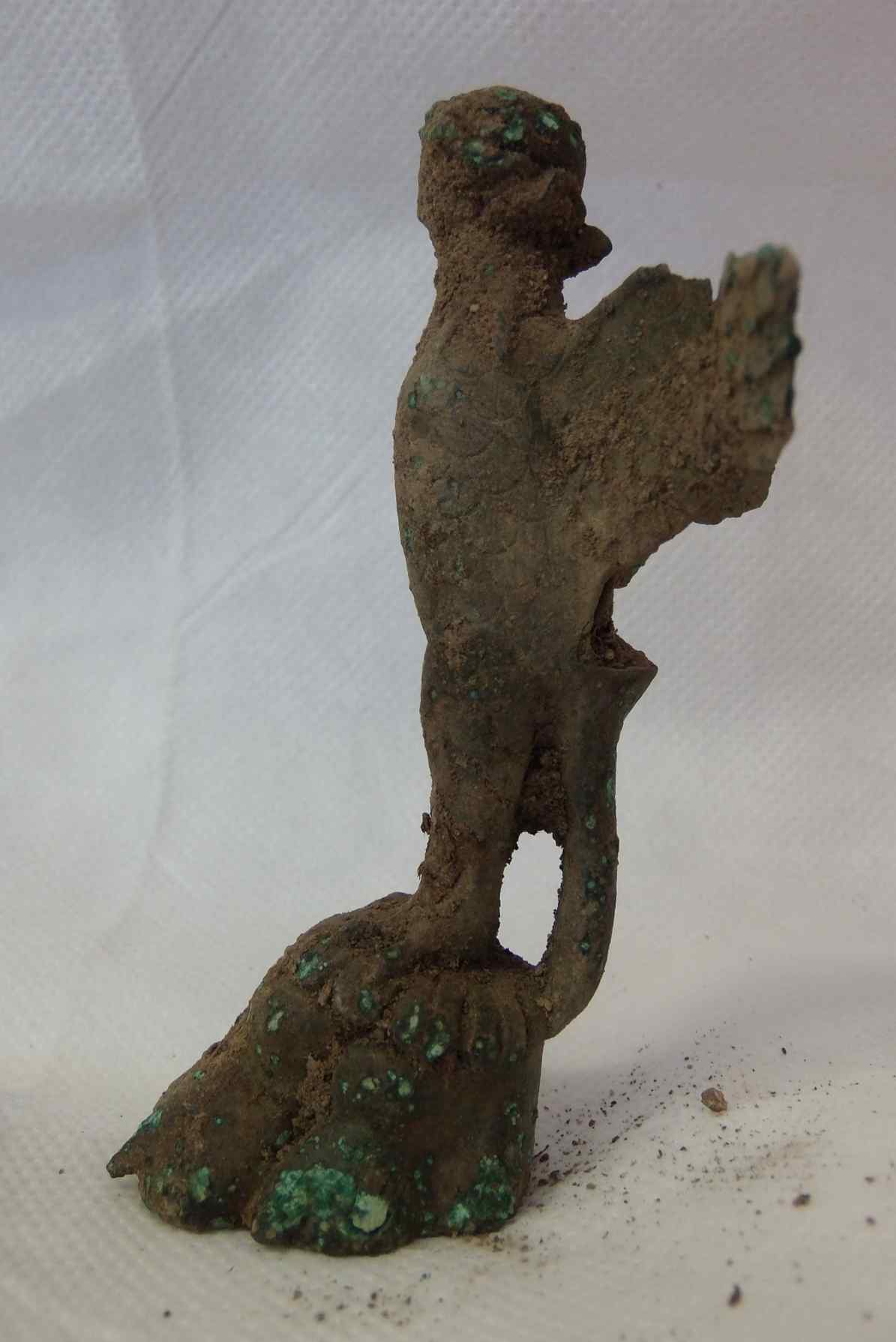
    A small, bronze figurine was discovered along with fragments of Roman pottery and roof tiles at an excavation at Moverons Quarry in southeastern England by archaeologist Ben Holloway of The Colchester Archaeological Trust. The four-inch-tall statue, which has not been cleaned or conserved yet, depicts an upright bird with feathers, talons, and a woman’s head with braided hair. Its small wings are open, and it has a serpent’s tail that functions as a support. The figure is thought to represent a harpy, a creature from Greek and Roman mythology. The three harpies were the daughters of Thaumas and Electra, and were named Aello, Ocypete, and Celaeno.

    Read the rest of this article...

    Thursday, March 26, 2015

    Row over plans to use ancient Spanish amphitheatre as tennis court


    Critics say padel tennis tournament will damage monument in Mérida while official insists plans pose no risk to roman structure


    In Mérida’s roman amphitheatre, built about 8BC, one cannot smoke or wear a rucksack larger than 40cm.
    But in early May, the Unesco world heritage site will be transformed into a padel tennis court, hosting competitors during the World Padel Tour as they volley balls at each other at breakneck speeds. The goal is to combine padel tennis, one of Spain’s most popular outdoor sports, with the rich roman history of Mérida,in the Spanish region of Extremadura. But the idea has provoked widespread opposition.
    Nearly 100,000 people have signed an online petition attacking the idea. Authorities insist the project poses no risk to the monument, said Joaquin Paredes, the creator of the petition. “How can it be that the transfer and installation of courts and bleachers as well as allowing access to thousands of people won’t have any effect on a monument that’s more than 2,000 years old?”
    Read the rest of this article...
    Monday, March 23, 2015

    Romano-British roundhouse unearthed in Devon field


    After a dig launched to culminate years of theorising by Howard Jones, a local archaeologist and former Royal Marine whose suspicions were strengthened by Google Maps, archaeologists are about to compile their findings from a set of four riverside fields near Plymouth which could have been part of one of Devon’s oldest settlements. 


    A drone image of the roundhouse - shown by a ditch curving round - and several  internal post-holes in Spriddlestone [Credit: © One Plymouth Media] 

    A wealth of artefacts from the Roman and medieval periods have already been identified since the two-week initial phase of the dig ended last weekend. Having made his way across the fields in pursuit of convincing preparatory evidence, Jones found receptive allies in the form of rugby club hosts, volunteers from local history and archaeology societies and local newspaper the Western Morning News.

    Read the rest of this article...

    Tuesday, March 17, 2015

    Pompeii's Villa of the Mysteries reopens


    Pompeii's biggest house, the Villa of the Mysteries, is set to reopen in its entirety on March 20, following nearly two years of restoration work that began in May 2013. 


    Aerial view of the Villa of the Mysteries at Pompeii [Credit: AD 79 Eruption] 

    The restoration was funded by the Special Superintendency for the Archaeological Heritage of Naples and Pompeii (SANP) and was conducted in lots so that parts of the Villa were still open to the public throughout the restoration process. 

    The Villa was first discovered in excavations in 1909 and was exceptionally well-preserved despite the eruption of Vesuvius in 79 A.D., which covered it in a layer of over 30 feet of volcanic ash. 

    The recent restoration work, which involved 70 rooms of the Villa, corrected some of the damage inflicted by previous restoration techniques that were found to be harmful to the Villa's frescoes over the years.

    Read the rest of this article...

    Friday, March 13, 2015

    EMAS Study Tour to Southern Bavaria


    EMAS Study Tour to Southern Bavaria

    Guide David Beard MA, FSA

    30 May - 6 June 2015

    This year's spring study tour is to Southern Bavaria. An important part of the area is the 'Roman Limes' - the frontier of the Roman Empire. Today the Limes consist of remains of walls, ditches, forts, fortresses, watchtowers and civilian settlements. Some sections of the line have been excavated, some reconstructed and, sadly, a few destroyed. The two sections of the Limes in Germany cover a length of 550 km from the north-west of the country to the Danube in the south-east. What remains is a now a designated World Heritage Site.

    It is not just Roman archaeology that is on the itinerary. Regensburg and Weißenburg both have many impressive medieval buildings. Indeed, Regensburg has been described as Germany's best-preserved medieval town, and is a World Heritage Site in its own right.

    Further details...

    Thursday, March 12, 2015

    Rufford Abbey 'photo tripod stone' is Roman artefact


    A stone stump used as a photo tripod by country park visitors is an ancient Roman artefact, it has been revealed.
    Archaeologists said the 4ft (1.2m) granite stone at Rufford Abbey, near Ollerton, Nottinghamshire, dates back to about 150AD.
    It formed part of a column at Roman emperor Antoninus Pius' villa, excavated and brought back by 19th Century archaeologist Lord John Savile.
    Visitors to the park had also used the column as a bird feeder.
    Nottinghamshire County Council archaeologist Emily Gillot - who has worked at the 210-acre (85-hectare) country park for 11 years - said it was an exciting discovery.
    Read the rest of this article...

    Monday, February 23, 2015

    Hadrian’s Wall Monuments – 3D Scan No.4


    Today’s blog on the 3D scans of Roman monuments associated with Hadrian’s Wall, products of our recent collaboration with University of Newcastle as part the NU Digital Heritage project (http://www.nu-digitalheritage.com). One of the planned uses of these digital models will be for use as a teaching resource for initiatives such as their free online Massive Online Open Course Hadrian’s Wall: Life on the Roman Frontier. Follow the links to see part one, part two and part three of our blog series. 
     
    Today’s blog is a little bit early as we wanted to put something out on Terminalia, which was celebrated by the Ancient Romans on the 23rd of February in honour of the god Terminus. Terminus was the god of boundaries and Hadrian’s Wall is certainly one of the most significant boundaries in the whole of the Roman Empire! Terminus’ statue was merely a stone or post stuck in the ground to distinguish between properties. To celebrate Terminali the two owners of adjacent properties would crown the ‘statue’ with garlands and raise an altar, on which they offered up some corn, honeycombs, and wine, and sacrificed a lamb or a sucking pig. 

    Read the rest of this article...

    Roman cemetery: Fifteen skeletons found at Ipplepen dig


    A "major" Roman cemetery has been discovered during an archaeological dig in Devon.
    Experts found 15 skeletons during the excavation of a Roman road at Ipplepen, near Exeter.
    Tests on one of the skeletons showed the settlement was in use up to 350 years after the Roman period ended, which has surprised experts.
    Archaeologists said the discoveries were both nationally and regionally important.
    Read the rest of this article...

    Monday, February 2, 2015

    2,200 year old Iberian moat found in Valls


    Students of the bachelor's degree in Archaeology at the University of Barcelona (UB) have discovered the remains of an Iberian construction during the fieldwork of the subject Archaeological Methodology I. On 28 and 29 October, students found a 2,200-year-old moat that defended the Iberian town of Vilar de Valls, the ancient city of Valls, in Tarragona. 


    UB students of Archaeology on a practical sessions developed in the site  [Credit: Universitat de Barcelona] 

    According to the directors of the archaeological excavation, Jaume Noguera, researcher in the Department of Prehistory, Ancient History and Archaeology of the UB, and Jordi López, expert from the Catalan Institute of Classical Archaeology, the site might have been destroyed by Romans during the Second Punic War (218-202 BC) that pitted Roma against Cartago for the hegemony of the Mediterranean. 

    Read the rest of this article...

    Herculaneum scrolls unlocked using photon beams


    A scientific breakthrough could make it possible to read papers from the only library to have survived from the times of ancient Rome.
    The library was in Herculaneum which, like Pompeii, was destroyed by an eruption of Mount Vesuvius in 79 AD.
    Hundreds of charred scrolls were found there but it has been impossible to read them.
    Now scientists in France have found a way to peer inside the charred scrolls, seeing letters and words for the first time in almost 2000 years.

    Read the rest of this article and watch video...

    Sunday, February 1, 2015

    Large Roman necropolis in Poland to be studied


    The largest necropolis from the Roman period in Karczyn in Kujawy is the object of detailed scientific research. Funds received from the Ministry of Culture and National Heritage will allow to complete the analyses, that will determine the diet, kinship and origin of the dead buried in the cemetery. 


    Tomb of a warrior [Credit: Adriana Romańska] 

    Excavations in Karczyn were conducted in 2002-2010 by the Archaeological Expedition of the Institute of Prehistory, Adam Mickiewicz University in Poznań. From the very beginning, scientists understood that they were dealing with a unique place. 

    "It turned out that the necropolis existed continuously for over 300 years, from the first to the fourth century AD - told PAP says Adriana Romańska, head of the excavation. - We have found more than 120 burials with very diverse rites".

    Read the rest of this article...

    Wednesday, January 28, 2015

    Found in Spain: traces of Hannibal's troops


    Spanish archaeology students have discovered a 2,200-year-old moat in what is now the Catalan town of Valls, filled with objects providing evidence of the presence of troops of the Carthaginian general Hannibal in the area.

    The moat, which surrounded the Iberian town of Vilar de Vals, contained coins and lead projectiles, researchers said in a statement.

    It is estimated the moat could have had a width of 40 metres (131 feet), a depth of five metres, and a length of nearly half a kilometre.

    Read the rest of this article...

    Saturday, January 24, 2015

    Scientists use X-rays to decipher charred Vesuvius scrolls

    David Blank, professor of Classics from University of California, left, uses his laptop computer as he studies an ancient papyrus at the Naples' National Library, Italy Photo: AP

    The contents of hundreds of papyrus scrolls that were turned into charcoal during the eruption of Italy's Mount Vesuvius in 79 AD - one of the great natural disasters of antiquity - have long remained a mystery. That soon may change.
    Scientists said on Tuesday a sophisticated form of X-ray technology has enabled them to decipher some of the writing in the charred scrolls from a library once housed in a sumptuous villa in ancient Herculaneum, a city that overlooked the Bay of Naples.
    The library was part of what's called the Villa of the Papyri, which may have belonged to Julius Caesar's father-in-law. Other libraries from antiquity have been discovered but this is the only one that had its scrolls still present.
    Read the rest of this article...

    X-ray technique reads burnt Vesuvius scroll


    For the first time, words have been read from a burnt, rolled-up scroll buried by Mount Vesuvius in AD79.
    The scrolls of Herculaneum, the only classical library still in existence, were blasted by volcanic gas hotter than 300C and are desperately fragile.
    Deep inside one scroll, physicists distinguished the ink from the paper using a 3D X-ray imaging technique sometimes used in breast scans.
    They believe that other scrolls could also be deciphered without unrolling.
    Read the rest of this article...

    Monday, January 19, 2015

    Excavation plans for Exeter's Roman Baths


    A set of "internationally significant" Roman Baths which lay hidden for almost 2,000 years could be opened to the public in a restoration project announced by Exeter Cathedral. 


    The Roman Baths were discovered in 1971 after excavating  a Saxon burial ground [Credit: Exter Cathedral] 

    The site was discovered in 1971 but due to a lack of funds was reburied under the cathedral green to protect it. 

    A bid for £8.7m has now been submitted to the Heritage Lottery Fund (HLF). 

    Roman archaeology specialist Dr Martin Pitts said the site "is of major significance". 

    Read the rest of this article...

    Sunday, January 18, 2015

    Excavation plans for Exeter's Roman Baths

    The Roman Baths were discovered in 1971 after excavating a Saxon burial ground

    A set of "internationally significant" Roman Baths which lay hidden for almost 2,000 years could be opened to the public in a restoration project announced by Exeter Cathedral.
    The site was discovered in 1971 but due to a lack of funds was reburied under the cathedral green to protect it.
    A bid for £8.7m has now been submitted to the Heritage Lottery Fund (HLF).
    Roman archaeology specialist Dr Martin Pitts said the site "is of major significance".
    Read the rest of this article...
    Friday, January 16, 2015

    Bronze figure of Silenus found on Danish island


    A bronze figure representing the Greek figure Silenus, from the time of Rome's first emperor, Augustus, has been found on the south-eastern Danish island of Falster. 


    The 4.5 cm tall Roman bronze figure represents Silenus, a mythological creature based  on the Greek figure of the same name. The bronze figure was found recently on the  island of Falster and can be dated back to the time of the Roman emperor. Augustus. It is unknown how the figure ended up on a Danish island  [Credit: National Museum of Denmark] 

    This find suggests that there was close contact between the Roman empire and Scandinavia, before and after the emperor's reign. 

    A Roman on Falster 

    The tiny bronze figure represents an elderly, bearded, balding man with thick lips and a plump nose. The find, just 4.5 cm tall, was found using a metal detector.

    Read the rest of this article...

    Monday, January 12, 2015

    Ancient Roman fort designed for celestial show


    The gateways of an ancient Roman fort in Britain are roughly aligned with the light from the sun during the summer and winter solstices a design that would have resulted in a striking scene on the shortest and longest days of the year, a researcher says. 


    The fort was constructed during the rule of Roman Emperor Hadrian (reign A.D. 117-138).  It was part of a system of fortifications that protected the frontier of Roman Britain  [Credit: PHB.cz (Richard Semik) | Shutterstock.com] 

    The fort had four gateways facing one another. During the summer solstice, the sun would rise in alignment with the fort's northeastern and southwestern gates, and set in alignment with its northwestern and southeastern gates, the researcher reported in the new study. 

    During the winter solstice, the sun would rise in line with the fort's southeastern and northwestern gates, and set in line with the fort's southwestern and northeastern gates.

    Read the rest of this article...

    Wednesday, December 17, 2014

    Une nécropole antique dans le quartier périphérique occidental de la ville de Saintes : plusieurs individus entravés, dont un enfant


    De septembre à novembre 2014, une équipe d’archéologues de l’Inrap a mené, sur prescription de l’État (Drac Poitou-Charentes), une fouille préventive sur un terrain de 613 m2, dans le cadre de la construction d’une maison individuelle dans le quartier ouest de Saintes. Une première campagne de fouille réalisée en 2013 sur une parcelle contigüe avait mis en évidence la vocation funéraire de cet espace au cours de l’Antiquité. L’opération de cette année a permis la découverte d’une centaine de sépultures. 

    Read the rest of this article...

    Monday, December 8, 2014

    Giant Ancient Roman Water Basin Uncovered


    Italian archaeologists have unearthed the largest Roman water basin ever found, right in the heart of modern Rome.

    Found some 65 feet down near St. John in Lateran Basilica during the excavation of the new metro C line, the huge irrigation basin measures 115 feet by 230 feet.

    “It’s so big that it goes beyond the perimeter of the metro work site. It has not been possible to uncover it completely,” Rossella Rea, the dig’s director, said at a news conference in Rome.

    Photos: Ancient Water Basin Found in Rome

    Rea, who led an all-woman team of archaeologists, noted the basin was lined with hydraulic plaster and most likely extends, still preserved, beyond the work site toward the ancient city walls.

    Read the rest of this article...

    Monday, December 1, 2014

    EMAS Easter Study Tour to North Scotland and the Isle of Skye


    EMAS Easter Study Tour to North Scotland 
    and the Isle of Skye
    2 - 8 April 2015

    The 2015 EMAS Easter Study Tour is to the North of Scotland, including one day on the Isle of Skye.

    We will travel from London Embankment by coach, staying overnight at Carlisle on the 2nd and 7th April.

    We shall be based at a hotel in Inverness, which is a very good central point from which to explore the region.

    The itinerary includes a wide range of prehistoric and medieval sites, including some of the famous Pictish symbol stones.


    Thursday, November 20, 2014

    Vases in Pompeii Reveal Panic Before Eruption


    French and Italian archaeologists digging out a pottery workshop in Pompeii have brought to light 10 raw clay vases, revealing a frozen-in-time picture of the exact moment panicked potters realized they were facing an impending catastrophe.
    The vases were found sealed under a layer of ash and pumice from Mount Vesuvius' devastating eruption of 79 A.D. and it appears they were just ready to be fired.
    Read the rest of this article...

    Tuesday, November 11, 2014

    Magnificent Ancient Roman Silver Treasure Revealed


    Accidentally discovered by a French farmer plowing his field near the village of Berthouville in rural Normandy in 1830, the spectacular hoard of gilt-silver statuettes and vessels known as the Berthouville Treasure was an ancient offering to the Gallo-Roman god Mercury. Following four years of meticulous conservation and research in the J. Paul Getty Museum’s Antiquities Conservation Department, the exhibition Ancient Luxury and the Roman Silver Treasure from Berthouville, on view at the Getty Villa November 19, 2014, to August 17, 2015, will present this unique collection of ancient silver in its full splendor and offer new insights about ancient art, technology, religion, and cultural interaction.

    Read the rest of this article...

    Monday, November 3, 2014

    Archaeologists find fertility genius, godheads and oil lamps in Roman Cumbria


    A fertility genius in “amazing” condition, believed to be a local deity thousands of years ago, and the carved heads of male and female Roman gods have been found by archaeologists digging at a village in Cumbria.

    The vague outline of an altar can be seen below the hand of the genius, unearthed in a 2,500-square metre area at Papcastle, where the 2009 floods gave excavators the first glimpses of Roman remains.

    A cap worn by the male statue comes from thePhrygian kingdom in modern-day Turkey, meaning the figure could be Mithras, who was worshipped in the north between the 1st and 4th centuries AD. Archaeologists are also speculating that he could be the Greek god Attis, which would be likely to identify the female head asCybele – Phrygia's only known goddess.


    Read the rest of this article...