Tuesday, September 26, 2017

Rare tiles found near Basingstoke shed insight on Roman history


Evidence of one of the Roman Empire’s best-known rulers has been discovered near Basingstoke.
A team of archaeologists from the University of Reading has found three tiles bearing the stamp of Emperor Nero at a site in Little London.
The tiles date back almost 2,000 years, and were found earlier this month at the Roman Tile Kiln site.
Only 14 such tiles have ever been found in the UK, including another found at Little London back in 1925 and four discovered within a ritual put at a temple in nearby Silchester.
The University of Reading team is currently excavating a series of Roman kiln structures at the Little London site, which includes some huge brick and tile production facilities.
Read the rest of this article...

Thursday, September 14, 2017

Unearthed near Hadrian’s Wall: lost secrets of first Roman soldiers to fight the barbarians

Dig team stumble across thousands of pristine artefacts at ancient Vindolanda garrison site in Northumberland


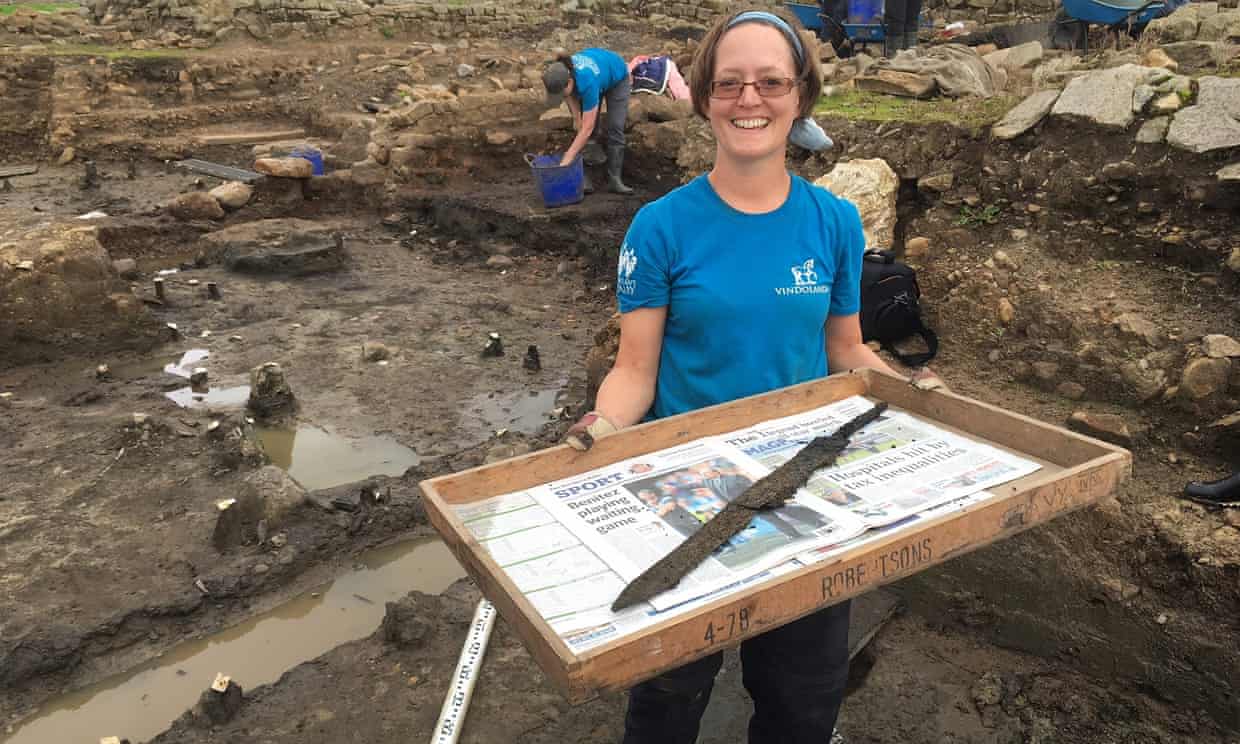
Dig volunteer Sarah Baker with one of the rare cavalry swords. 
Photograph: Sonya Galloway

Archaeologists are likening the discovery to winning the lottery. A Roman cavalry barracks has been unearthed near Hadrian’s Wall, complete with extraordinary military and personal possessions left behind by soldiers and their families almost 2,000 years ago. A treasure trove of thousands of artefacts dating from the early second century has been excavated over the past fortnight.

The find is significant not just because of its size and pristine state, but also for its contribution to the history of Hadrian’s Wall, showing the military build-up that led to its construction in AD122. The barracks pre-dates the wall: the Romans already had a huge military presence in the area, keeping the local population under control.

Read the rest of this article...

Cache of Roman cavalry weapons found at Vindolanda

Swords, arrow heads and ballista bolts amongst a cache of artefacts discovered during cavalry barrack excavations at Roman Vindolanda.


Aerial view of remains of 4th century stone fort at Vindolanda 
[Credit: Sonya Galloway, Vindolanda Trust]

During the past few weeks archaeologists at the Roman fort of Vindolanda have made one remarkable discovery after another in what has been an exceptional year for the research excavations.

Test pit excavations, below the stone foundations of the last stone fortress revealed a layer of black, sweet smelling and perfectly preserved anaerobic, oxygen free, soils in an area where they were completely unexpected. Hidden in this soil were the timber walls and floors, fences, pottery and animal bones, from the abandonment of a Roman cavalry barrack. The excavated rooms included stables for horses, living accommodation, ovens and fireplaces.

While excavating the material from the corner of one of the living rooms a volunteer excavator made an outstanding discovery.

Read the rest of this article...

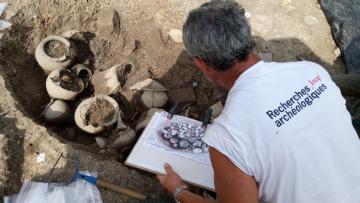
UN VASTE DOMAINE ANTIQUE À CESSON-SÉVIGNÉ


À Cesson-Sévigné (Ille-et-Vilaine), en amont de l’aménagement des ZAC Atalante ViaSilva et Les Pierrins, une prescription de l’État (Drac Bretagne) conduit une équipe de l’Institut national de recherches archéologiques préventives à réaliser une fouille sur une surface de près de 7 hectares.

Cette intervention, démarrée le 26 juin 2017, a actuellement permis de mettre au jour une partie d’un vaste domaine rural gallo-romain, de type villa, ainsi qu’une portion du fossé ceinturant une motte castrale du Moyen Âge. Ces occupations anciennes s’inscrivent dans un espace traversé par un faisceau de voies, depuis la ville antique de Rennes et desservant Avranches, Jublains et Angers.

L’emprise de la fouille permet d’étudier la quasi-intégralité du domaine foncier antique et son insertion dans son environnement naturel. Ces découvertes contribueront ainsi à la compréhension de l’organisation des campagnes à l’époque gallo-romaine et leur mutation durant la période médiévale.

Read the rest of this article...

Friday, August 11, 2017

Christopher Kissane: ‘Historical myopia is to blame for the attacks on Mary Beard’

Recep Tayyip Erdoğan ‘legitimises autocracy with historical myths’.
Photograph: Anadolu Agency/Getty Images
2017 Anadolu Agency

On the 500th anniversary of the Reformation, the historian calls for an end to the trivialisation of the lessons of the past

Five hundred years ago, Martin Luther sparked a movement of Reformation that would leave indelible marks on European history. While some have used this anniversary as an opportunity for reflection, and others a chance to heal old wounds, 2017 finds us in an age of intense historical myopia. Breathless news cycles and furious outrage are shrinking our horizons just as they need to widen. Public debate barely remembers the world of last year, “old news”, let alone that of a decade or few ago.

History’s expertise, and most dangerously its perspective, are being lost in our inability to look beyond the here and now. We stumble into crises of finance and inequality with ignorance of economic history, and forget even the recent background to our current politics. We fail to think in the long term and miss a growing environmental catastrophe. We refuse help to millions of refugees by turning away from our own history. As technology and globalisation bring the world closer together, we have narrowed rather than broadened our perspective. With challenges on many fronts, history needs to be at the heart of how we think about our ever-changing world.

Read the rest of this article...

Tuesday, August 8, 2017

Mary Beard is right – ‘Romans’ could be from anywhere, from Carlisle to Cairo


Mary Beard has faced ‘unnecessary insult, misogyny and language of war’ for defending the BBC cartoon.

The classics professor’s naysayers refuse to believe ancient civilisations could have been anything but Caucasian, but there is evidence that proves them wrong.

The wonderful Mary Beard has been sucked into another Twitter row – where she faced, in her words, “unnecessary insult, misogyny and language of war”. This latest tussle has been about her defence (which, as usual, was measured, graceful and – above all – well-informed) of a BBC cartoon showing a Roman British family with a black father. For some people this was infuriating, disgusting: a politically correct piece of anachronistic nonsense, throwing modern multicultural values back on to the past. And yet, as Prof Beard has pointed out, of course it is perfectly possible, even pretty likely, that such families existed in Roman Britain, and an entirely reasonable thing for the BBC cartoon to have posited.

Read the rest of this article...

Sunday, August 6, 2017

Construction of a Luxury Hotel is Continuing in Sofia Despite the Discovery of an Ancient Roman Necropolis


Work was in full swing at the building site of the first Hyatt hotel in Bulgaria, in the centre of the capital, Sofia, on Monday, Balkaninsight reported. 

While numerous machines laid concrete and strengthened the foundations of the future 190-room five-star hotel, a team of archaeologists with an excavator was carefully digging a rare find out of the ground.

They recently discovered an ancient Roman tomb – part of the eastern side of the necropolis of the Roman city of Serdica, which lies under Bulgaria’s capital – which could soon be buried under the luxury new hotel.

The same fate has already befallen six other tombs discovered at the construction site in April.
They were recently covered up by the construction company, Tera Tour Service, sparkling public outrage.

Read the rest of this article...

Thursday, August 3, 2017

Archaeologists uncover 'little Pompeii' in southeast France

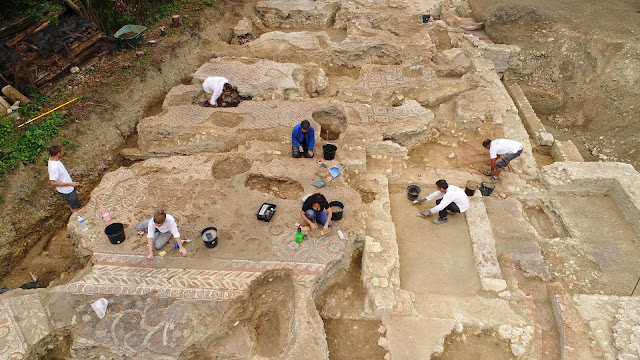
Archaeologists work on a mosaic on July 31, 2017, on the archaeological antiquity site of Sainte-Colombe, near Vienne, eastern France. Remains of an entire neighbourhood of the Roman city of Vienne have been uncovered in Sainte-Colombe, with lavish residences decorated with mosaics, a philosophy school and shops. The dig of the site, discovered prior to housing construction on a parcel of 5000 m2, began in April 2017 and was due to last six months, but have been extended to December 15, 2017, after the site was classified as an "exceptional discovery" by the French Culture Minsitry 
[Credit: Jean-Philippe Ksiazek/AFP]

A "little Pompeii" is how French archaeologists are describing an entire ancient Roman neighbourhood uncovered on the outskirts of the southeastern city of Vienne, featuring remarkably preserved remains of luxury homes and public buildings.

"We're unbelievably lucky. This is undoubtedly the most exceptional excavation of a Roman site in 40 or 50 years," said Benjamin Clement, the archaeologist leading the dig on the banks of the Rhone river, about 30 kilometres (18 miles) south of Lyon.

The city of Vienne -- famous for its Roman theatre and temple -- was an important hub on the route connecting northern Gaul with the Roman province of Gallia Narbonensis in southern France.

Read the rest of this article...

Sunday, July 30, 2017

Malaria already endemic in the Mediterranean by the Roman period

Malaria was already widespread on Sardinia by the Roman period, long before the Middle Ages, as indicated by research at the Institute of Evolutionary Medicine of the University of Zurich with the help of a Roman who died 2,000 years ago.
Even today, Malaria is one of the greatest medical challenges worldwide, killing hundreds of thousands of people every year. In the past, people have adapted to the threat of malaria in various ways. These methods range from interventions in the environment like draining swamps, to genetic adaptations in the human body.

Read the rest of this article...

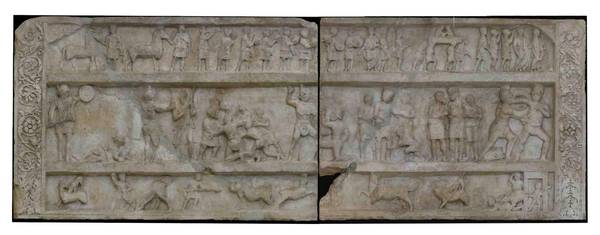
Tomb depicting famous gladiator brawl discovered in Pompeii


A brawl between gladiators that ended in tragedy, narrated by Tacitus, and a mysterious character that probably died in it is a 2,000-year-old mystery of Pompeii brought to light by a marble monumental tomb with the longest funerary epigraph ever found. The excavation was connected with the rehabilitation of state-owned property as part of the Great Pompeii Project in the San Paolino area near Porta Stabia, one of the accesses to the ancient city.

The tombstone was made shortly before the eruption that destroyed Pompeii in 69 AD and was presented on Thursday in the archaeological area. The inscription is over 4 meters long, in seven narrative registers, and though it does not include the deceased's name, it describes in detail the major events in the life of the man buried within it: from the acquisition of the 'toga virilis' to his wedding, and describes the munificent activities that accompanied such events such as public banquets, largess, the holding of gladiatorial games and battling large beasts.


Read the rest of this article...

Fused imaging reveals sixth century Roman Law text in Medieval book binding


16th century copy of Hesiod examined with different imaging techniques by Northwestern researchers 
[Credit: Emeline Pouyet]

After being hidden for centuries, the secrets within medieval manuscripts might soon come to light. By fusing two imaging techniques — visible hyperspectral imaging and x-ray fluorescence — an interdisciplinary team of Northwestern University researchers has developed a new, non-destructive technology that gives access to medieval texts hidden inside of ancient bookbindings.

Between the 15th and 18th centuries, bookbinders recycled the bindings from medieval parchments into new binding materials for printed books. While scholars have long been aware that books from this time period often contain hidden fragments of earlier manuscripts, they never had the means to read them.

“For generations, scholars have thought this information was inaccessible, so they thought, ‘Why bother?’” said Marc Walton, senior scientist at the Northwestern University-Art Institute of Chicago Center for Scientific Studies (NU-ACCESS). “But now computational imaging and signal processing advances open up a whole new way to read these texts.”

Read the rest of this article...

Friday, July 21, 2017

Extremely rare Roman sarcophagus lifted from ancient Southwark burial site

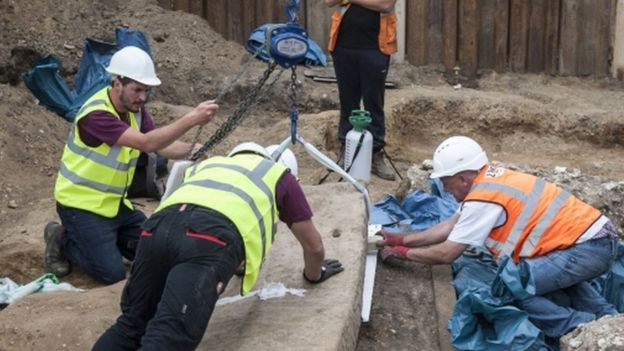
rchaeologists prepare to lift the lid of Roman sarcophagus found in Southwark, London 
[Credit: Lauren Hurley/PA Wire]

This is an exceptional find for London, where only two similar late Roman sarcophagi have been discovered in their original place of burial in recent years: one from St Martin-in-the Fields near Trafalgar Square (2006) and one from Spitalfields in 1999.

The excavation, which began in January this year, revealed a large robber trench around the coffin and found that the lid had been moved, suggesting that the coffin was discovered and robbed in the past. However, it is possible that only the precious items were removed, and the less valuable artefacts, such as the body itself, still remain within the stone sarcophagus.

Southwark and the City of London are remarkable in being the only two London Boroughs that have their own, in-house, dedicated archaeologist. Southwark Council champions archaeology and has dedicated planning policies to ensure that the borough’s ancient history is identified, protected and managed for future generations. The Harper Road excavation is just one of the many archaeological projects that are currently running across Southwark.

Read the rest of this article...

Wednesday, July 19, 2017

More extraordinary Roman writing tablets found at Vindolanda Roman Fort


More ‘Vindolanda writing tablets’ full of visible cursive Latin text have been unearthed at Vindolanda Roman Fort, on Hadrian’s Wall

Archaeologists at Vindolanda Roman Fort on Hadrian’s Wall have discovered a new hoard of around 25 Roman ink documents, known as the Vindolanda writing tablets, as part of an extraordinary excavation season at the archaeological site.

Found during the latest dig at the former Roman Army encampment, the tablets containing letters, lists and personal correspondence were discovered lying in the damp and anaerobic earth where they had been discarded towards the end of the 1st century AD.

Read the rest of this article...

Roman 'domus' with mosaic floors unearthed in Auch, France


Excavation of Roman Imperial-era domus in Auch, France 
[Credit: © Jean-Louis Bellurget, Inrap]

Archaeologists have discovered the ruins of a luxurious 5th-century Roman palace in Auch in the Gers – and they face a race against time to excavate it. 

Abandoned some 16 centuries ago, this aristocratic ‘domus’ possessed private baths and splendid mosaics on the ground. It was close to the centre of the ancient Roman city of Augusta Auscorum, which was the capital of the province of Novempopulanie - and near the centre of the modern town of Auch.

Originally found by the landowner digging foundations to build a house, just 50cm below the surface the impressive 2-metre-deep ruins have been revealed. Since the end of April, l’Institut National de Recherches Archéologiques Préventives (Inrap) has been bringing to light a part of what was once a vast aristocratic home.

Read the rest of this article...

Ancient roman sarcophagus found at London building site


An ancient Roman sarcophagus has been excavated from a building site in central London.
The 1,600-year-old coffin found near Borough Market is thought to contain the remains of a member of nobility.
Archaeologists have been unable to identify the body as the stone coffin has been left filled with soil after being robbed, experts believe.
The sarcophagus will now be taken to the Museum of London's archive for analysis.
The coffin was found several metres underground with its lid slid open, which indicates it was plundered by 18th century thieves.

Read the rest of this article...

Monday, July 17, 2017

Roman coin find in Orkney thrills archaeologists

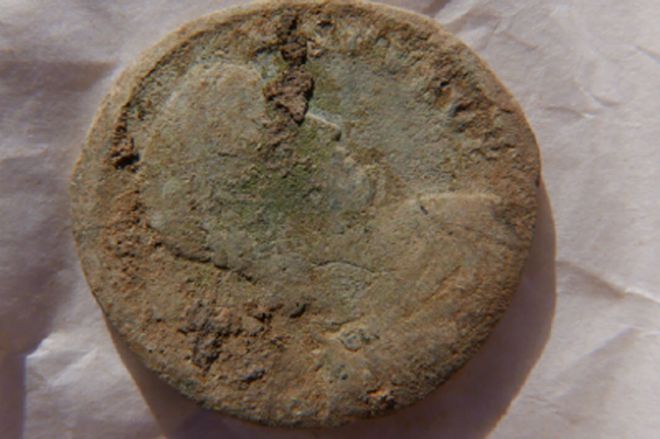
The coin was uncovered in a dig on Rousay in Orkney

Archaeologists are thrilled by the discovery of a Roman coin during the excavation of an archaeological site in Orkney.
The copper alloy coin was found at the Knowe of Swandro, the location of a Neolithic chambered tomb, Iron Age roundhouses and Pictish buildings.
The archaeological site is at risk from coastal erosion.
Roman finds have been made before in Orkney, and other Scottish islands including the Western Isles.
The coin found in the Knowe of Swandro dig on Rousay is believed to date from the mid 4th Century AD.
Read the rest of this article...

Thursday, June 29, 2017

Roman oil and wine pottery found at Ipplepen dig site

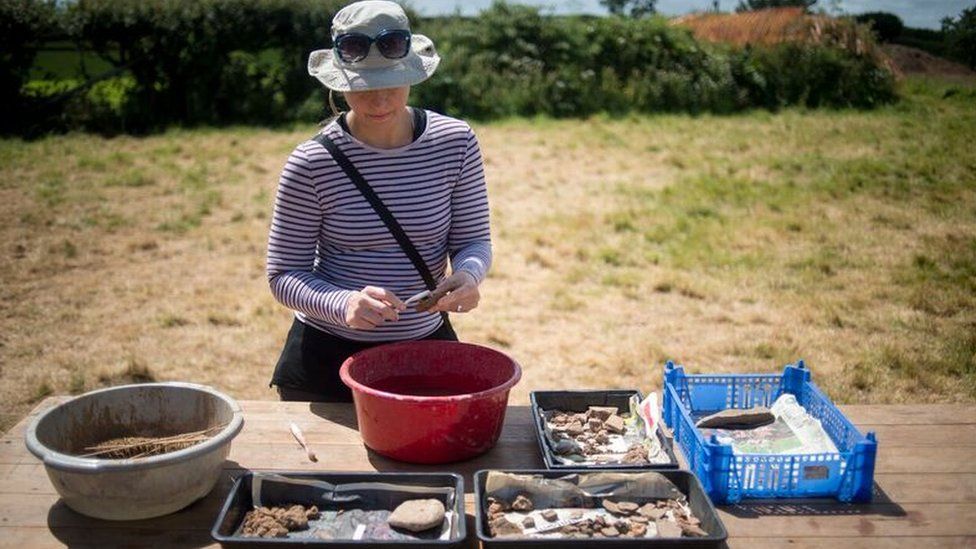
Archaeologists washing evidence of the iron works and pottery

Archaeologists say pre-Roman Britons who lived in a rural location since the 4th Century BC may have enjoyed Mediterranean oil and wine.

Radiocarbon analysis of a dig site showed there was a settlement at Ipplepen, Devon, for about 1200 years longer than previously thought.

The discovery of Roman pottery suggests there was a community trading widely with the Roman world.

University of Exeter archaeologists are digging at the site this month.

Read the rest of this article...

Rome Metro Excavations Unearth 3rd Century 'Pompeii-Like Scene'

Digging for Rome's new subway has unearthed the charred ruins of an early 3rd-century building and the 1,800-year-old skeleton of a crouching dog that apparently perished in the same blaze that collapsed the structure.

A significant discovery was made under Rome’s metro system [Credit: Getty]

Archaeologists on Monday said they made the discovery on May 23 while examining a 10-meter (33-foot) -deep hole bored near the ancient Aurelian Walls as part of construction work for the Metro C line.

"A Pompeii-like scene" was how the Culture Ministry described the findings that evoked comparisons to the inhabitants trapped by the 79 A.D. Vesuvius volcanic explosion and preserved for centuries in the ruins of Pompeii.

Read the rest of this article...

UN ATELIER DE POTIER DU IER SIÈCLE DE NOTRE ÈRE À THONON-LES-BAINS


À Thonon-les-Bains, en Haute-Savoie, une équipe de l’Inrap étudie, sur une surface de 1 400 m²,  un atelier de potier de la seconde moitié du Ier siècle de notre ère qui s’insère dans un quartier artisanal situé au sud-est de l’agglomération antique de Thonon.

Read the rest of this article...
Monday, June 26, 2017

Cyprus reveals rare Roman horse race mosaic in Akaki


Scenes from a chariot race are depicted in a rare Roman mosaic found in rural Cyprus.
Dating from the 4th Century AD, it lies in Akaki, a village not far from Nicosia.
Only nine similar mosaics - showing a hippodrome race - have been found at ancient Roman sites.
The ornate 26-metre-long (85ft) mosaic was probably part of a wealthy man's villa. The excavation is led by archaeologist Fryni Hadjichristofi.

Read the rest of this article...