Sunday, August 2, 2020

New Roman fort uncovered in Lancashire after years of speculation

A Roman fort lies underneath land off Flax Lane, Burscough

Historic England says the lines of the fort’s defences are clearly identifiable on geophysical survey and aerial photos

A 1st Century fort uncovered at a Burscough farm could be the key to understanding Roman activity in Lancashire.

After years of speculation about the presence of such a fort, ruins off Flax Lane have finally received recognition from Historic England.

The ruins comprise a 30,000 sq m fort, roads, and a smaller fortlet and experts believe the find will unlock unknown details of how the Romans settled and travelled around the area. Considered alongside other forts in the region, including those at Wigan and Ribchester, Burscough’s will provide great insight into Roman military strategy. It is believed that the area was occupied multiple times over the course of hundreds of years, a theory which is backed up by the variety of pottery found at the site.

Historic England says the lines of the fort’s defences are clearly identifiable on geophysical survey and aerial photos, but the north-west and south-west corners are also visible as slight earthworks on Lidar, which uses laser light reflections to produce 3D images.

Read the rest of this article...

The Romans Called it ‘Alexandrian Glass.’ Where Was It Really From?

Glass receptacles recovered from Egypt dating to the first or second century A.D., during the Roman occupation.  Credit...Artokoloro, via Alamy

Trace quantities of isotopes hint at the true origin of a kind of glass that was highly prized in the Roman Empire.

Glass was highly valued across the Roman Empire, particularly a colorless, transparent version that resembled rock crystal. But the source of this coveted material — known as Alexandrian glass — has long remained a mystery. Now, by studying trace quantities of the element hafnium within the glass, researchers have shown that this prized commodity really did originate in ancient Egypt.

It was during the time of the Roman Empire that drinks and food were served in glass vessels for the first time on a large scale, said Patrick Degryse, an archaeometrist at KU Leuven in Belgium, who was not involved in the new study. “It was on every table,” he said. Glass was also used in windows and mosaics.

All that glass had to come from somewhere. Between the first and ninth centuries A.D., Roman glassmakers in coastal regions of Egypt and the Levant filled furnaces with sand. The enormous slabs of glass they created tipped the scales at up to nearly 20 tons. That glass was then broken up and distributed to glass workshops, where it was remelted and shaped into final products.

Read the rest of this article...

Archaeological dig on the A1 in North Yorkshire uncovers Roman remains

Archaeologists at work near Scotch Corner

Archaeologists excavating the A1 before the road's major upgrade have discovered fascinating evidence of Roman engineering and repair work.

The dig between Leeming Bar and Barton, near Scotch Corner, revealed that the Romans settled in North Yorkshire at least a decade earlier than previously thought. They produced coins for circulation and built relationships with the local tribes.

The modern A1 partly follows the route of Roman roads between York and Hadrian's Wall that were used mainly for the movements of legions based at the York garrison who were deployed to subdue the border regions.

Highways England, who oversaw the archaeological work ahead of the upgrade of the A1(M), believe the finds in the vicinity of Scotch Corner are among the best discoveries of the past decade, and a book about the excavations has now been published.

Read the rest of this article...

Monday, July 27, 2020

Pompeii's most recent finds reveal new clues to city's destruction


Since its discovery several centuries ago, few archaeological sites have fascinated the world as has the ancient Roman city of Pompeii. After the first major excavations in more than 50 years, Pompeii is revealing a surprising abundance of buried treasures. The new finds are coming from intensive work in a small sector known as Region V that has nevertheless yielded giant insights into the final days of the doomed city.

Along with the complete excavation of two houses—the House of the Garden and the House of Orion—the dig has yielded frescoes, murals, and mosaics of mythological figures in gorgeous colors, skeletons with stories still to be unraveled, coins, amulets, and show horses in the stable of a wealthy landowner.

The new finds are also sparking debate about Pompeii’s tragic story. Just before Vesuvius erupted in A.D. 79 and buried the city under a mantle of ash and rock, a local worker scrawled an inscription on a wall. Along with a joke (roughly translated as “he ate too much”), he wrote the date: October 17. The discovery of this inscription may confirm the view that the eruption took place in October, and not August, as some scholars maintain.

Read the rest of this article...

Sunday, July 26, 2020

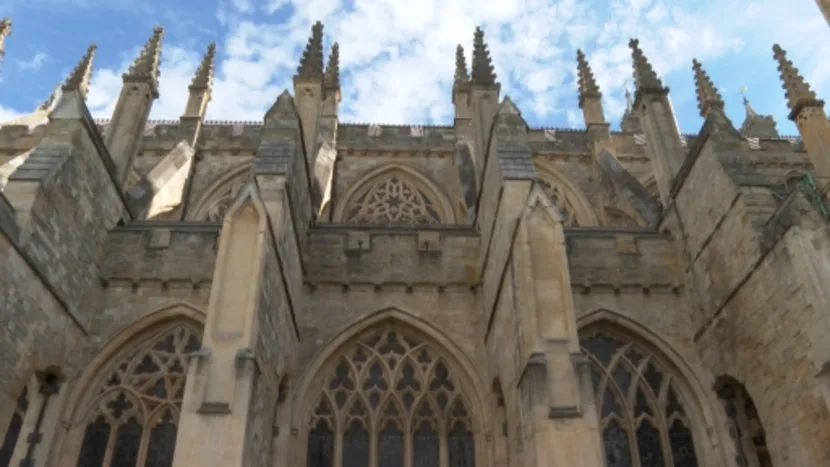
Archaelogical dig starts at Exeter Cathedral


An archaeological dig which has just started at Exeter Cathedral could uncover artefacts as far back as the Romans.

The first stone has been lifted in a six-week investigative dig where a new cloister gallery will ultimately be built.

Archaeologists want to find out what is below the paving slabs and grass which covers the area just outside the cathedral's chapter house, which has never been examined before.

The dig is expected to provide crucial information about the layout of the medieval cloister - which was torn down in 1657 - and the state of its foundations which, if still serviceable, will be reused for the new building.

Read the rest of this article...

Roman jars found in Spanish seafood shop


Authorities conducting a routine inspection of a frozen seafood shop in Spain were surprised to find ancient artefacts decorating the premises.

The owner's son found the objects while fishing, according to local media.

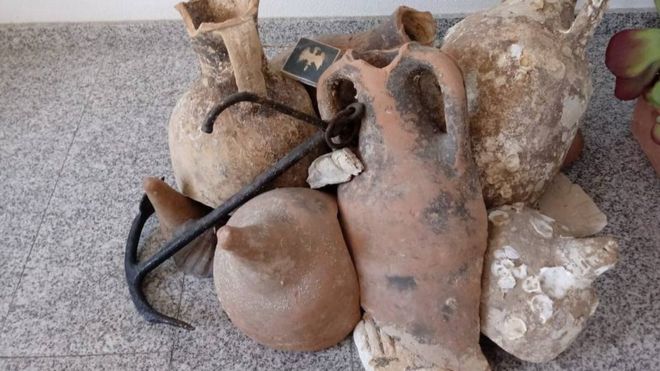
Thirteen jars (amphoras) are believed to date back to the 1st Century AD, while an 18th Century anchor and a limestone plaque were also found.

Both the owner of the business in Alicante and his son are now being investigated.

"The amphoras could come from the looting of shipwrecks," which would be protected as objects of underwater archaeology, a statement by the Civil Guard said on Wednesday.

The artefacts were moved to the Museum of the Sea in Santa Pola, where they underwent preliminary dating.

Read the rest of this article...

UN NOUVEL ÉTABLISSEMENT ANTIQUE DÉCOUVERT DANS LA PLAINE D'ALÉRIA (HAUTE-CORSE)


A Pietroso, dans la plaine d’Aléria au pied du Massif du Monte Incudine, les archéologues de l'Inrap ont mis au jour un vaste établissement rural de l'époque romaine, composé d'un étonnant ensemble de structures hydrauliques.

Une équipe d’archéologues de l’Inrap met actuellement au jour un établissement rural du IIIe siècle de notre ère, sur la commune de Pietroso, au pied du Massif du Monte Incudine à l’extrême ouest de la plaine d’Aleria. Sur prescription de l’État (DRAC de Corse), cette fouille, préalable à la construction d’un habitat résidentiel, est prise en charge à 100% par l’État, par le biais du fonds national pour l’archéologie préventive (Fnap). Elle apporte aujourd’hui d’intéressantes informations sur l’occupation antique en Corse.

Read the rest of this article...

Tuesday, July 21, 2020

Hadrian's Wall warning after man arrested for theft

Newcastle University

Historic England has been working with police after a number of thefts near the Military Road, and 44-year-old man was arrested on suspicion of theft last week.

Don O'Meara from Historic England says people can do untold harm to unique and historic finds.

It's not that one coin or that one brooch, often to get that prestige item they can be digging holes all over protected monuments, they can be disturbing artefacts, throwing away artefacts that they think have no value, and that's the real lost material."

Dean O'Meara

Read the rest of this article...

Tuesday, July 7, 2020

New discoveries at the Underwater Park of Baia

Credit: Parco Archeologico Campi Flegrei

During the research activities that the Archaeological Park of the Phlegrean Fields is carrying out in view of the opening of new routes, a marble table support (trapezoforo) decorated with a feline head was recovered from the seabed this morning.

The operation was carried out by technicians from the Campi Flegrei Archaeological Park supported by the Harbour Master's Office - Locamare di Baia and Naumacos Underwater Archaeology.

Immediately after the recovery operations the find was transported to the laboratories of the Bay Castle for the first preservation measures.

Read the rest of this article...

Sunday, May 31, 2020

Coal Mine in Serbia Gives up New Roman Treasure

An archaeologist looks at parts of a wooden Roman ship dated to the 3rd century AD, at the ancient city of Viminacium, near Kostolac, Serbia, May 28, 2020. REUTERS/Marko DjuricaREUTERS

BELGRADE (REUTERS) - AS the sun sank over a vast opencast coal mine in eastern Serbia earlier this month, a small crane eased the front half of a Roman ship from the steep sides of the pit.

An excavator cutting through the coal rich soil had pulled out some muddy timber weeks before, but coronavirus restrictions had meant the retrieval had to wait.

The ship was part of Viminacium, a sprawling Roman city of 45,000 people with a hippodrome, fortifications, a forum, palace, temples, amphitheatre, aqueducts, baths and workshops.

Lead archaeologist Miomir Korac said the vessel dated from the 3rd century AD when Viminacium was the capital of the Roman province of Moesia Superior and near a tributary of the Danube river.

"A Roman (river) fleet was based here to defend this region from barbarian invasions," he told Reuters. "Such findings of Roman ships are really rare, especially in such a good condition where one could see how the boat was built."

Read the rest of this article...

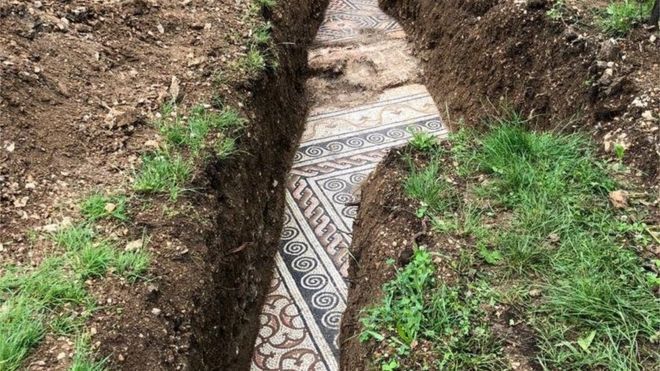
Well-preserved Roman mosaic unearthed in Italian vineyard


SOAVE, Italy (AP) — Archaeologists have briefly revealed a well-preserved mosaic floor of an ancient Roman villa first discovered almost a century ago near the northern Italian city of Verona.

The mosaic in bright shades of red, pink, orange, purple and yellow appeared to be ’’in a good state of conservation,” from what archaeologists observed after gingerly digging a trench between vineyards in the hills of Valpolicella, Gianni de Zuccato, the official in charge of archaeology in Verona province, said Friday.

Mosaics revealing the site of an ancient villa were first discovered in 1922. Archaeologists have been doing partial digs to determine the scale of the original villa and in preparation to transform the area into a museum. The recent discovery of two nearby mosaic floors confirmed the villa extended north and south of the original site.

Read the rest of this article...

Antiques Roadshow presenter stunned to discover ancient Roman site in garden

Antiques Roadshow expert Marc was shocked to make the discovery (Image: SWNS)

Antiques Roadshow expert, Marc Allum is on hand to guide owners through the history of their treasured items and has left many guests stunned with unexpected valuations. But the antiques expert was left speechless himself when he discovered his house had been built on an ancient Roman site after initially having his suspicions that the land may have a connection to King Alfred.

BBC viewers will know Marc as the miscellaneous expert who specialises in all the weird and wonderful items that don’t quite fit into any particular category.

But in an upcoming exclusive interview on The Arts Society Connected, Marc will be giving fans a glimpse into his own collection of antiques.

In an exclusive interview with Express.co.uk, Marc revealed the three items he will be discussing in the lecture while revealing the unlikely discoveries he made in his garden.

Read the rest of this article...

Thursday, May 28, 2020

Roman mosaic floor found under Italian vineyard

Local officials said scholars first found evidence of a villa at the site more than a century ago
COMUNE DI NEGRAR DI VALPOLICELLA

A Roman mosaic floor has been discovered under a vineyard in northern Italy after decades of searching.

Surveyors in the commune of Negrar di Valpolicella north of Verona published images of the well-preserved tiles buried under metres of earth.

According to officials, scholars first found evidence of a Roman villa there more than a century ago.

Technicians are still gently excavating the site to see the full extent of the ancient building.

Images posted online show the pristine mosaic as well as foundations of the villa.

Read the rest of this article...

Monday, May 18, 2020

Historical city travel guide: Rome, 1st century AD

The Roman Forum, study for theatrical scene in Shakespeare's 'Coriolanus'. Hodgkin, 1800-1860. 
Pen and grey ink with watercolour.

Location

Rome in Latium, central Italy, is the capital of the Roman Empire. The great city is said to have been founded by Romulus, who was raised with his brother Remus by a she-wolf. He was a descendant of the prince Aeneas, who escaped his home city of Troy after it was sacked by the Greeks. However, the city’s origins are likely to have been slightly less romantic, developing in the 8th century BC through the merging of several villages.

Spanning seven hills on the left bank of the river Tiber, Rome is located about 22 km (14 miles) inland from the Mediterranean Sea as the crow flies. The area is suitable for farming and characterised by warm weather, but the plains between the hills were originally swampy and subject to flooding. That is why, initially, different villages developed on the hilltops rather than in the Tiber valley.

The city now sits at the centre of an empire which stretches from Spain to Syria and is rapidly growing.

Read the rest of this article...

Sunday, May 17, 2020

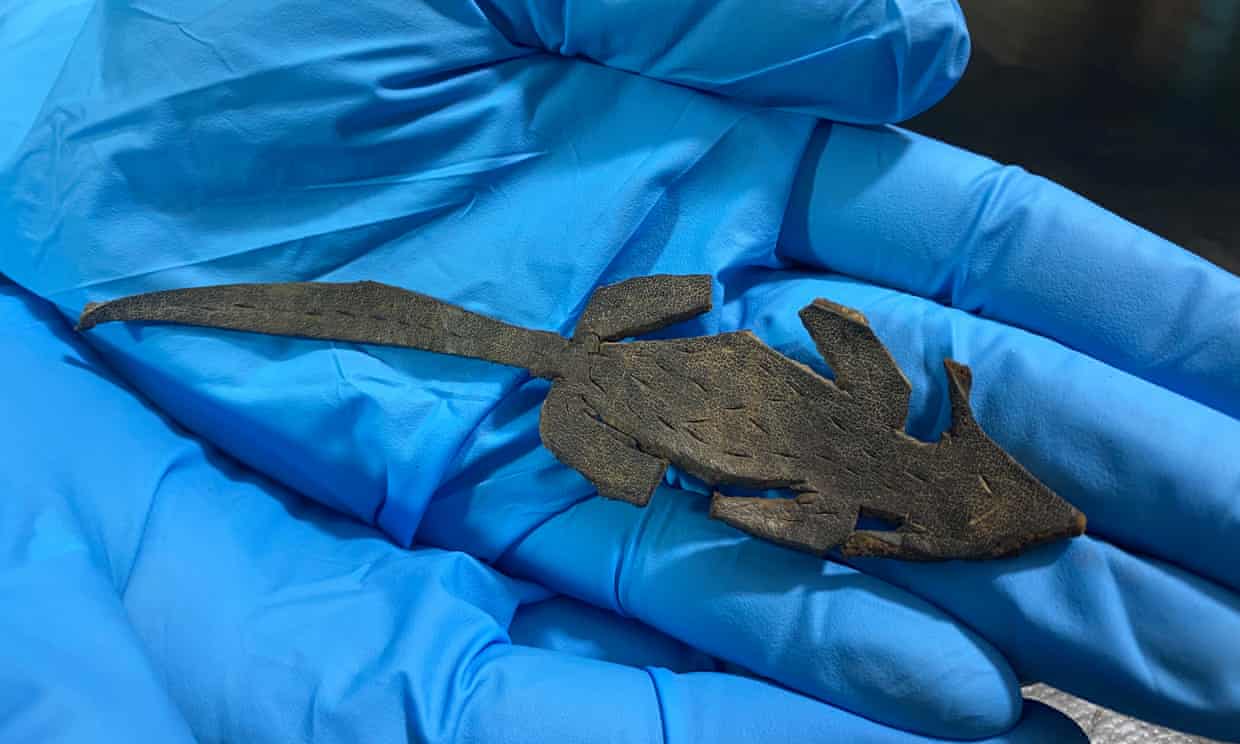
Practical joke or toy? Leather ‘mouse’ shows Romans' playful side

A mouse made out of leather, about 12cm long, has been discovered at the Roman fort of Vindolanda, south of Hadrian’s Wall, in Northumberland. Photograph: The Vindolanda Trust

The Roman author Pliny the Younger advised “kissing the hairy muzzle of a mouse” as a cure for the common cold. His fellow countrymen linked mice to the god Apollo, who could bring deadly plague upon them with his arrows.

So they might not have seen the funny side of a lifelike mouse made out of a strip of leather which has been newly discovered at the Roman fort of Vindolanda, south of Hadrian’s Wall, near Hexham, Northumberland.

About the size of a real rodent and lying unnoticed until now among thousands of leather offcuts held by the Vindolanda Museum since 1993, it looks as if it had been squashed flat after being run over – perhaps by a Roman cart.

Read the rest of this article...

Wednesday, May 13, 2020

Coronavirus: Lockdown boost for archaeology as amateurs uncover Roman remains

The technology can 'strip away' vegetation and modern features to reveal what is underneath

Self-isolating volunteers analyse aerial survey maps to reveal ancient roads and settlements.

Lockdown has given archaeology an unexpected boost with volunteers finding previously unrecorded Roman, prehistoric and medieval sites from the comfort of their own homes.

In a project coordinated by a team at Exeter University, enthusiastic amateurs have been analysing images derived from Lidar (light detection and ranging) data - laser technology used during aerial surveys to produce highly detailed topographical maps.

Modern vegetation and buildings can be digitally removed, allowing archaeologists to look at the shape of the land surface to find the remains of archaeological earthworks.

The data is being systematically examined and cross-referenced with records of known archaeology and historic maps, meaning the total of new discoveries regularly changes.

Read the rest of this article...

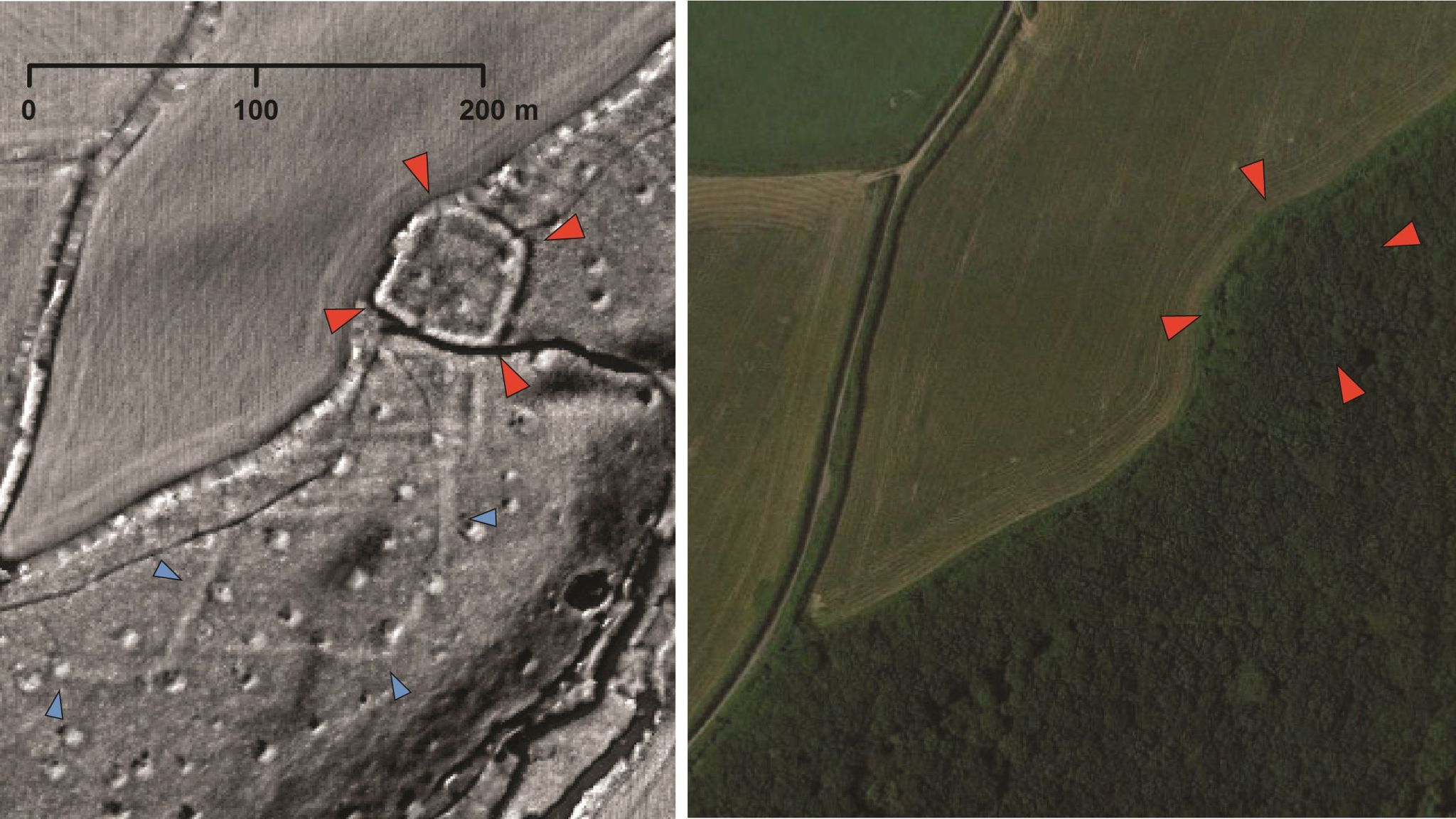
Archeologists discover prehistoric sites – while working from home

A probable Iron Age or Roman enclosed settlement (indicated by red arrows) and an associated field system (inidicated by blue arrows), which is hidden beneath woodland but has been revealed by volunteers using light detection and ranging (LiDAR) data during lockdown. (Credits: PA)

Dozens of previously-unrecorded Roman, prehistoric and medieval sites have been discovered by archaeology volunteers based at home during the coronavirus lockdown. Digging may be on hold due to the pandemic, but the team have found parts of two Roman roads, around 30 prehistoric or Roman large embanked settlement enclosures, and some 20 prehistoric burial mounds, as well as the remains of hundreds of medieval farms, field systems and quarries. 

Those leading the project believe they will make many more discoveries in the coming weeks. 

The team are analysing images derived from LiDAR (light detection and ranging) data.

Read the rest of this article...
Tuesday, May 12, 2020

Roman-Era Burial Mound Excavated in Bulgaria


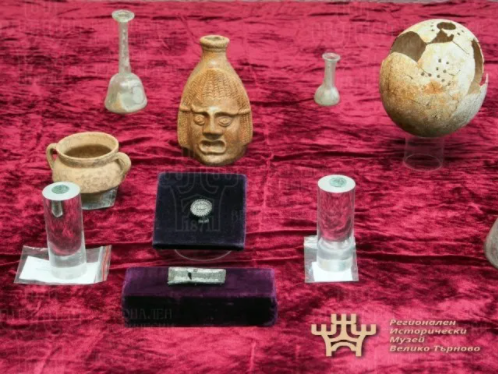
Archaeology in Bulgaria reports that archaeologist Kalin Chakarov of the Regional Museum of History in Veliko Tarnovo and his team conducted a rescue excavation of a Thracian burial mound in north-central Bulgaria. The mound held 19 graves. The cremated dead had been placed in chambers with offerings and personal belongings. The grave in the center of the mound held parts of a vessel made from an ostrich eggshell that was probably imported from Africa or Asia; a gold-plated silver brooch, or fibula, bearing an image of the deity known as the Thracian Horseman; and a ceramic jug decorated with a sculpture resembling a theatrical face mask. “The fibula is extremely expensive,” said museum director Ivan Tsarov. “It was custom-made, probably in the atelier of some Aegean craftsman. 

Read the rest of this article...
Monday, May 11, 2020

1,700-year-old board game found in Norwegian burial mound

The burial cairn site [Credit: UiB]

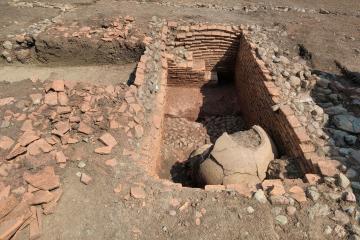
This April, the University Museum of Bergen, excavated the remains of a small Early Iron Age grave cairn at Ytre Fosse, Western Norway. The location is spectacular, overlooking Alversund and the “Indre Skipsleia”, a part of the old shipping lane, Nordvegen, – which gave Norway its name. The whole area is dotted with monumental grave mounds on both sides of Alversund, symbols of an Iron Age political landscape and the power and control of goods and travels along the Norwegian coast. 

The grave turned out to be a cremation patch containing 3 ceramic pots, a bronze pin, burnt glass and 18 gaming pieces and an elongated dice. The dice is of a very rare type, exclusive for Roman Iron Age (AD 1 - 400). In Scandinavia, similar dices are found in the famous Vimose weapon-offering site at Fyn, Denmark.

At Vimose also the gaming board was preserved, giving a unique view into Early Iron Age board games among the Germanic tribes in Scandinavia. Board games, inspired by the Roman game Ludus latrunculorum, seems to have been played amongst the elite in Roman Iron Age Scandinavia. These games are also the forerunner to the more famous Viking Age (AD 750-1050) board game Hnefatafl.

Read the rest of this article...
Archaeologists in Denmark discover huge defensive structure from the Roman Iron Age

Credit: Museum Lolland-Falster

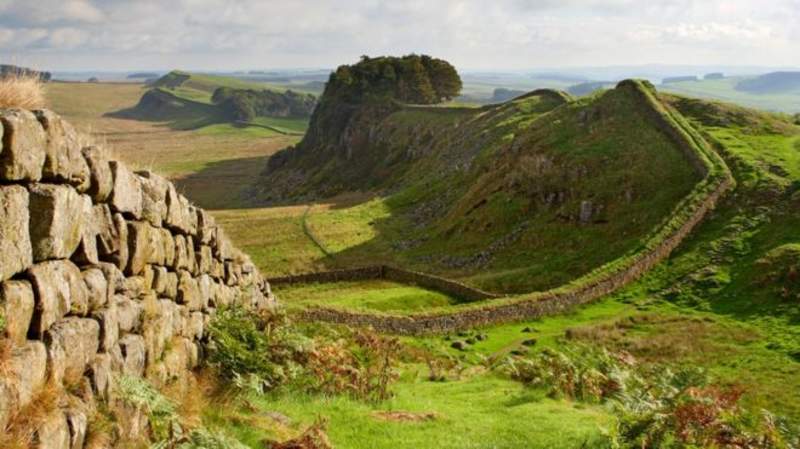
Archaeologists have unearthed a massive structure in Lolland that is believed to have been used to ward off an attacking army back in the Roman Iron Age.  So far, 770 metres of the structure has been detected, but Museum Lolland-Falster estimates it could stretch to twice that.  

“This is a really big structure. It’s taken a lot of work to build,” Bjornar Mage, an archaeologist and curator from Museum Lolland-Falster, told TV2 News. “We believe the structure was built around a kilometre from the coast between two impenetrable wetland areas – in a bid to stop attacking foe from entering Lolland.”  

The structure involved the digging of long lines and rows of holes in the earth – at least 10,000 holes are estimated to have been dug. In similar structures discovered in Jutland, the defensive ‘belt’ was combined with sharpened poles. 

Read the rest of this article...