Monday, May 11, 2020

Section of Theodosian Walls of Constantinople collapses

Credit: Greek City Times

A section of the famous Theodosian Walls (Tower 69) of Constantinople (modern Istanbul), located on Sulukule Street in the Topkapi neighbourhood, has collapsed "due to an unknown reason", Turkish news sources have reported.

The reports state that police and firefighters attended the scene. While there were no dead or injured in the incident, police inspected around the area where the crash occurred, while municipal teams cleared the fallen rubble from the walls.

In their present state, the Theodosian Walls stretch for about 5.7 km from south to north, from the "Marble Tower" (Turkish: Mermer Kule), also known as the "Tower of Basil and Constantine" (Gk. Pyrgos Basileiou kai Konstantinou) on the Propontis coast to the area of the Palace of the Porphyrogenitus (Tr. Tekfur Sarayi) in the Blachernae quarter.

Read the rest of this article...

Saturday, May 9, 2020

Dunwich – The medieval town lost at sea

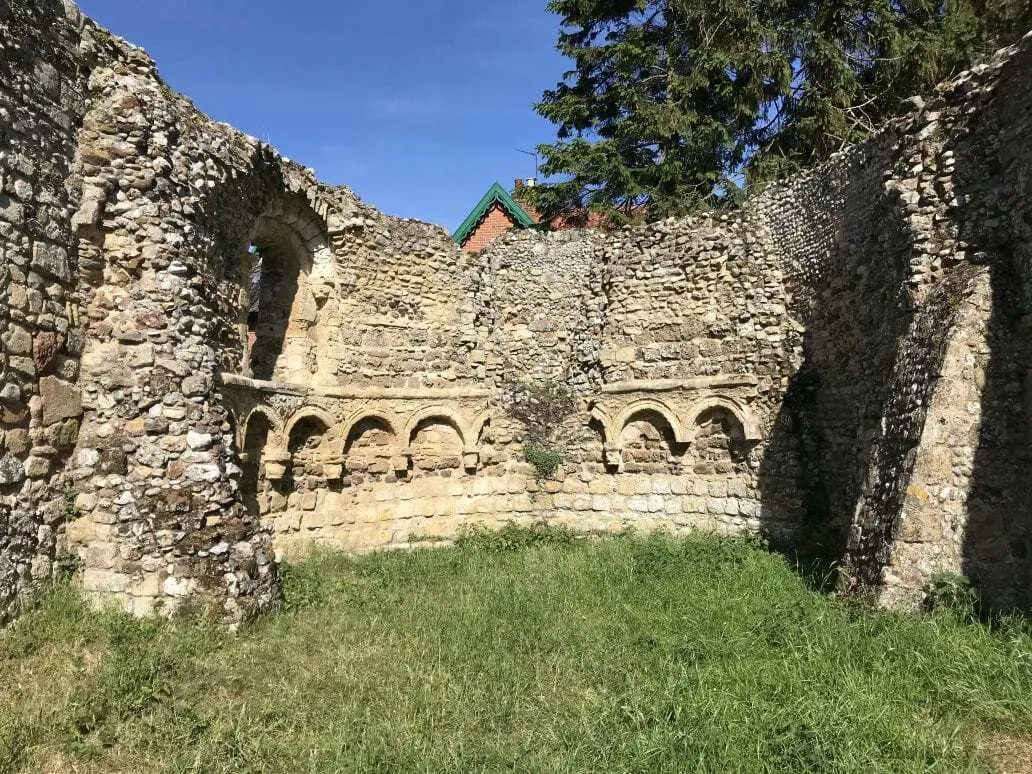
Chapel of St James’ Leper Hospital, Dunwich St James’ Hospital was a C12 leper hospital located just to the west of the medieval coastal town of Dunwich.

Dunwich is a small rural village located on the Suffolk coast in England. Visitors will find a quaint English pub, tea rooms and a pebble beach popular with holiday makers.
At first glance, there’s nothing overly remarkable about this picturesque setting, but beneath the surface Dunwich has a unique story to tell that spans centuries….

The earliest evidence of occupation around the Dunwich area starts in the Roman period, with scant but suggestive evidence of a large settlement. The Anglo-Saxon chronicler Bede referred to “Dunmoc” as a “Civitas”, with archaeological discoveries that includes a Roman tumulus and masonry trawled from the nearby seabed.

The Roman document, ‘Notilia Dignitatum’ even refers to a late Roman fort or station in the area, but due to the continual coastal erosion, any surviving remains of the fort or settlement would be hundreds of metres out to sea.

Read the rest of this article...

Wednesday, May 6, 2020

Rome Sinkhole Makes Extraordinary Archaeological Find


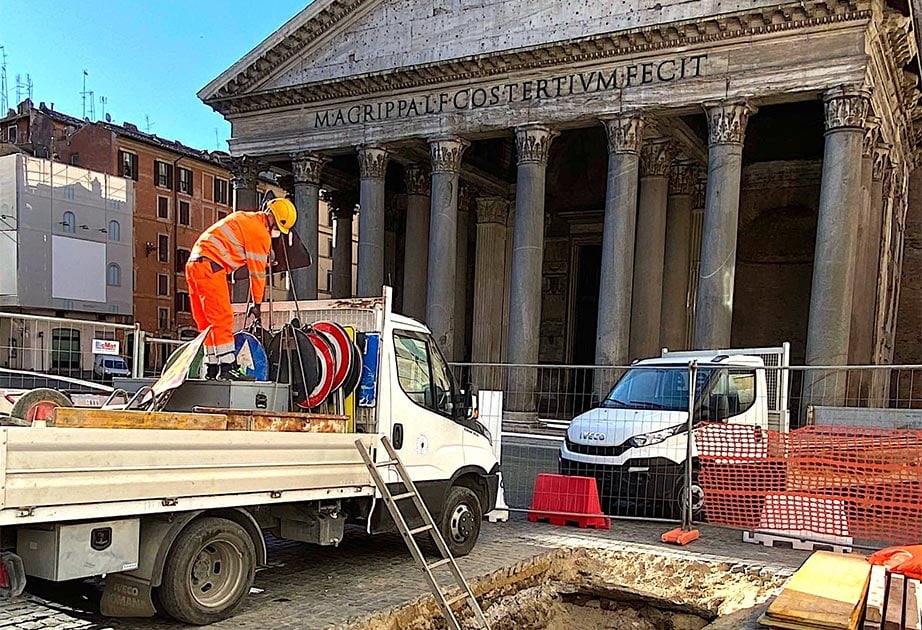
Another Rome sinkhole has appeared, this time, in front of the Pantheon in Piazza della Rotonda and in it, archaeologists have made the unexpected ‘rediscovery’ of an ancient imperial floor consisting of seven travertine slabs.

Built by Agrippa between 27 and 25 BC, the Piazza della Rotonda is a great square which opens out in front of the famous Pantheon, the temple dedicated to all the Roman gods , and this open social space was entirely transformed in the second century AD by the Emperor Hadrian , at which time the level of the piazza was raised and it was all repaved.

Archaeologists have reported finding ancient masonry about 2.5 meters (8.2 feet) beneath the existing level of the piazza, which was first uncovered during works in the 1990s, and after it had been documented by archaeologists at the time it was covered over. But now, more than two decades after its original discovery, the slabs of the ancient floor “emerge intact, protected by a layer of fine pozzolan,” said Daniela Porro, special superintendent of Rome in a Wanted In Rome article.

Read the rest of this article...

Archaeology offers clues to pandemic rebounds from the past


As the COVID-19 pandemic redefines what we think of as "normal," archaeology and ancient history can provide some consolation about the great adaptability of our species.

Flinders University archaeologist and ancient historian Dr. Ania Kotarba points to responses of extreme historical events that have threatened homo sapiens in the past as evidence that society—and the economy—can, and will, spring back again.

Dr. Kotarba researches global connectivity in the past through studying ancient international trade routes and human adaptation to extreme change.

She says the processes of urbanization, population growth and proto-globalization in the ancient world initially allowed outbreaks of infectious diseases and epidemics. These often surprisingly resulted in boosting the economy.

Read the rest of this article...

Everything you wanted to know about Roman Britain – but were afraid to ask


In a recent podcast interview with Dr Miles Russell, we tackled the top questions about the four centuries of Roman rule in Britain…

How long were the Romans in Britain? How did they make their mark? And why did they leave? As part of our recent ‘Everything you need to know’ podcast series, we sat down with historian Dr Miles Russell to find out more about the popular historical period. Tackling questions submitted by our readers, and the top queries posed to the internet, Miles explored everything you ever wanted to know…

Read the rest of this article...

Tuesday, May 5, 2020

Let the Dice Roll! 1,700 Year Old Board Game Found in Early Iron-Age Norwegian Burial Mound

Sensasjonelt funn i Alver. – Dette er statusgjenstander som vitner om kontakt med Romerriket, sier arkeolog.

Board games of this kind indicate broad contacts with the Roman Empire, researchers say.

Game chips and dice have been found in an early Iron Age tomb in northern Hordland in Norway.

The discovery dates from the early Iron Age (circa 300 AD) in a burial mound at Ytre Fosse near Alversund in the municipality of Alver in connection with plot development. A total of 13 whole and five broken game chips were unearthed, complete with a die.

The place is close to the narrow strait Alverstraumen, which was a central point on the maritime way between the north and south, the so-called “Nordvegen”, or “North Way”, which gave Norway its name.

Read the rest of this article...

Saturday, May 2, 2020

Roman Temple of Mithras – London Mithraeum


The London Mithraeum is a Roman Temple of Mithras discovered in 1954 in Walbrook, London, and is one of the most famous 20th-century Roman discoveries in London.

The temple was built in the mid-3rd century and dedicated to Mithras and several other deities popular among Roman soldiers. Much later, it was rededicated to Bacchus in the early fourth century.

Finely detailed third-century white marble likenesses of Minerva, Mercury, Mithras, and Serapis were found during the excavations. Some appear to have been carefully buried within the temple at the time of its rededication.

The quality marble sculptures were imported from other parts of the Roman Empire. There are also several coarser locally-made clay figurines of Venus, combing her hair. These artifacts are on display in the Museum of London.

Read the rest of this article...

Friday, May 1, 2020

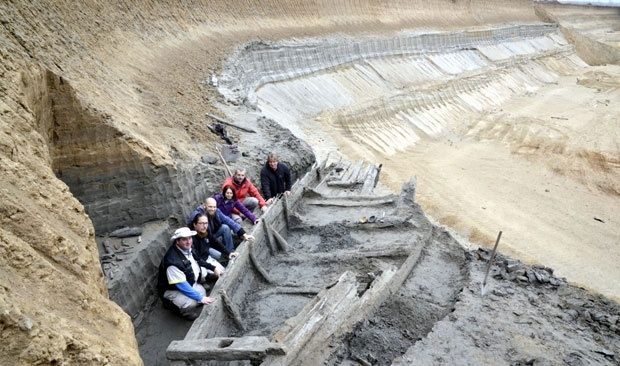
2,000-year-old Roman sewn boat discovered under Poreč waterfront

(Photo: Grad Poreč)

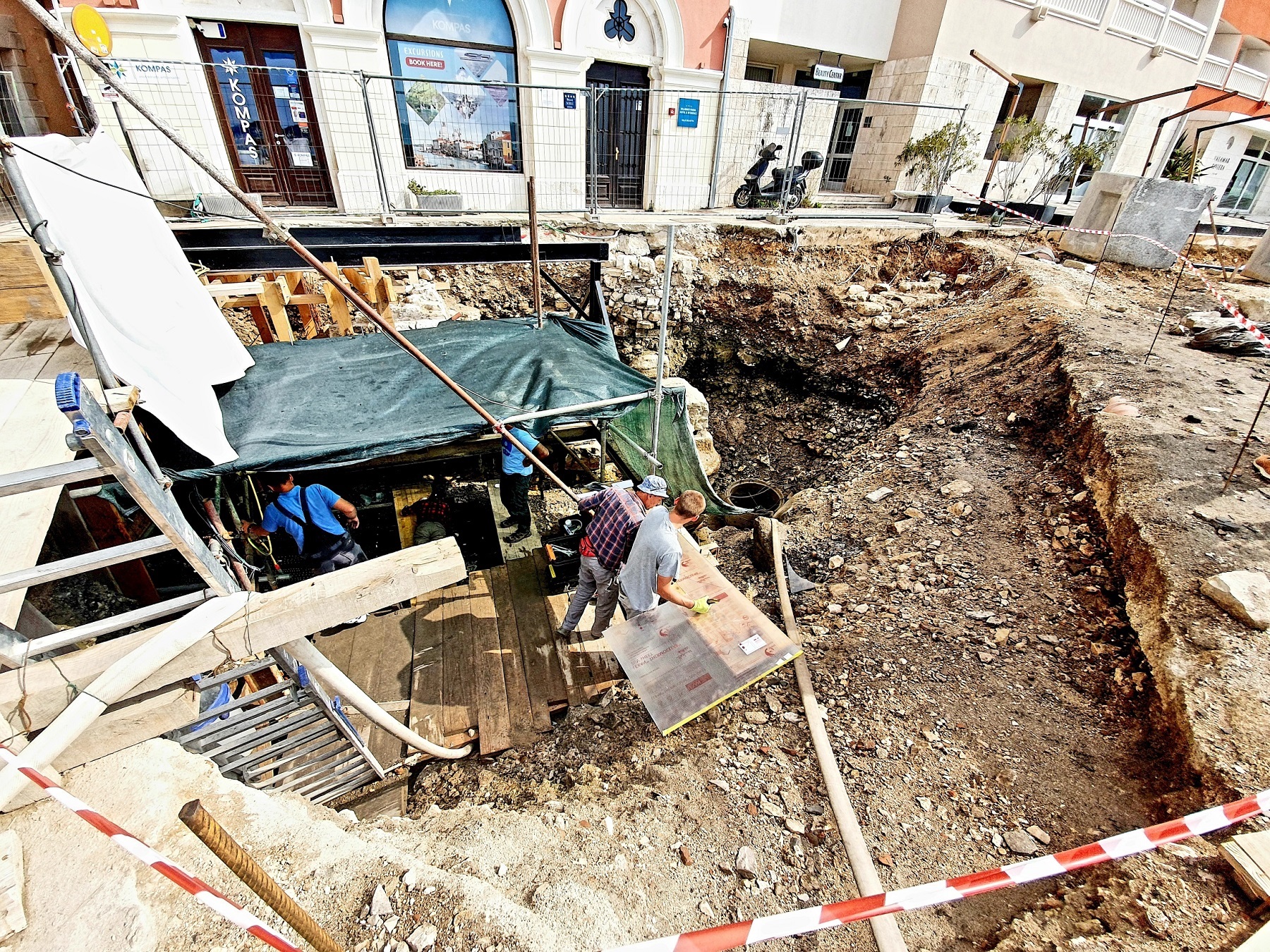
Istrian archaeologists have excavated an ancient wooden boat dating back two thousand years from under the Poreč waterfront.

The archaeological finding, the biggest in the last 30 years, is significant because the boat is well preserved and has many elements that are very rarely seen.

The results of the research were presented on Monday by the director of the National Museum of Poreč Elena Uljančić, archaeologist Klaudia Bartolić Sirotić, the staff of the Local Museum, historian Gaetano Benčić, archeologists Davor Munda, Aleksandra Pajić and Marko Uhač from the Conservation Department of Pula and Mayor Loris Peršurić.

Read the rest of this article...

Deformed 'alien' skulls offer clues about life during the Roman Empire’s collapse

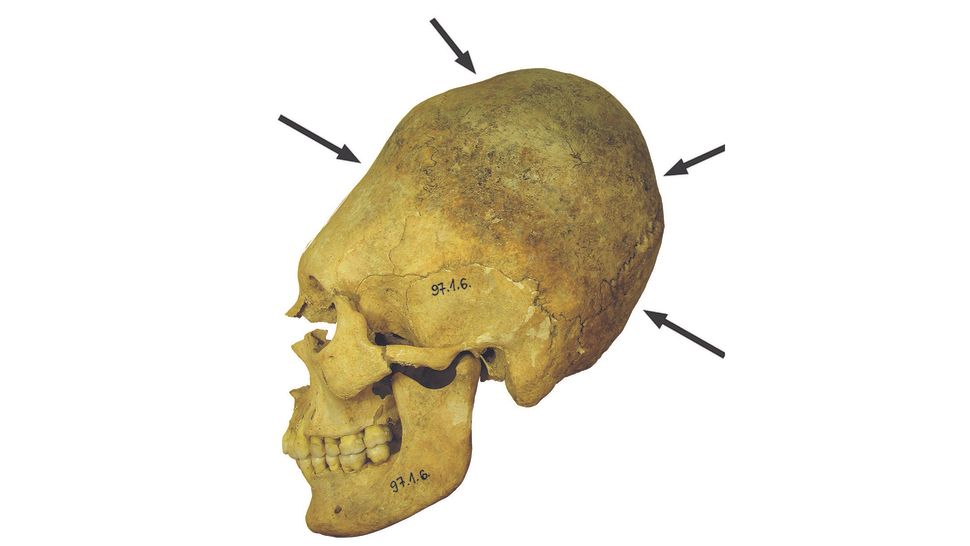
Artificially deformed skull of an adult woman. Permanent binding during childhood caused the elongation of the braincase and depressions in the bone.
(Image: © Balázs G. Mende. Research Centre for the Humanities, Hungarian Academy of Sciences, Budapest, Hungary)

Over decades, dozens of artificially deformed "alien-like" skulls that are more than 1,000 years old have been unearthed in a cemetery in Hungary. Now, these skulls are revealing how the collapse of the Roman Empire unleashed social changes in the region. 

During the fifth century A.D., people in central Europe practiced skull binding, a practice that dramatically elongates head shapes. These altered skulls were so drastically deformed that some have compared them to the heads of sci-fi aliens. The fifth century was also a time of political unrest, as the Roman Empire collapsed and people in Asia and eastern Europe were displaced by invading Huns, a nomadic Asian group. 

Read the rest of this article...

Thursday, April 30, 2020

Drone video shows new excavations at Pompeii


Photography often takes us places we can’t go ourselves. And drone photography takes us even farther than most cameras can. So are we able to get this amazing drone video surveying new excavations in the ancient city of Pompeii.

The drone video provides a wide overview of Regio V of Pompeii, the latest part of the city to be unearthed, over the past two years. It starts off with sweeping vistas over the entire neighborhood. Then it dives down to navigate the ruins of two unique houses, getting close enough that you can see the tiles in floor mosaics.

The archeologists prepared a stunning video tour, narrated in Italian. But English subtitles make the story clear. The tour focuses on the street Vicolo dei Balconi, with houses on either side.

Read the rest of this article...

The British Museum is displaying 4 million items from its collection online

Photograph: The Lewis Chessmen. © The Trustees of the British Museum

Got some browsing time on your hands? Load up the British Museum’s website. Yesterday the museum decided to do an earlier-than-planned unveil of its revamped online collection. It’s now the biggest database of any museum in the world, with more than 4 million objects to click through. 

The collection features the museum’s most famous artefacts, like the Rosetta Stone, the Parthenon Sculptures, along with every item the institution holds from Ancient Egypt. 

But there are some new additions too – including 280,000 new object photographs that are being published for the first time. Among them are images of 73 portraits by Damien Hirst and a watercolour by the Pre-Raphaelite Dante Gabriel Rossetti that until recently had been thought lost. You can also look for works by Kara Walker, William Hogarth and Rembrandt in a digital archive of 75,000 art prints. If you’re more into coins, they have about 50,000 of those – medieval, Tudor, the works. Fill your boots. 

Read the rest of this article...

Wednesday, April 29, 2020

OSTRICH EGG VESSEL, SILVER THRACIAN HORSEMAN FOUND IN ROMAN ERA BURIAL MOUND NEAR BULGARIA’S LYASKOVETS

The extremely intriguing artifacts discovered in the Thracian Roman-Era burial mound near Bulgaria’s Lyaskovets, including the ostrich egg vessel, the silver, gold-plated Thracian fibula, and the ceramic vessel decorated with a human face mask. 
Photo: Veliko Tarnovo Regional Museum of History

A wide range of highly intriguing artifacts such as an ostrich egg turned into a vessel and a gold-plated silver fibula featuring the Thracian Horseman deity have been discovered in rescue excavations of a Thracian burial mound from the Roman Era near Bulgaria’s Lyaskovets.

The burial mound in question is located near the St. Peter and St. Paul Monastery, Lyaskovets Municipality, Veliko Tarnovo District, in Central North Bulgaria.

It was 50 meters in diameter and 1 meter tall, and dates back to the 2nd – 3rd century AD.

All of Ancient Thrace south of the Danube was conquered by the Roman Empire in 46 AD, with the Thracian aristocracy and population becoming well integrated in Roman life.

Read the rest of this article...

Monday, April 27, 2020

Site of battle fought between Carthaginians and Carparthians in 220 BC discovered in Spain

Illustration of a Second Punic War: the Roman general and statesman Publius Cornelius Scipio Africanus meets the Carthaginian leader Hannibal (bearded, on left) before defeating him at the Battle of Zama
[Credit: Getty Images]

The year was 220 B.C. and the young Carthaginian general Hannibal Barca had to return to his winter quarters in Qart Hadasht – now Cartagena in southeast Spain – after taking Helmatica – now Salamanca in the northwest of the country – from the Vettones tribe. It was spring or summer, and the 27-year-old and his troops had to overcome two obstacles to get to their destination: firstly, the wide rivers and high mountains that were difficult for their 40 elephants to cross; the secondly, the hostile local Carpetani, Vettone and Olcade tribes, who sought revenge for the destruction of their crops and cities.

With just 25,000 soldiers, Hannibal managed to defeat 100,000 enemies. Nobody knows where exactly this battle took place, only that it happened somewhere along the banks of the Tagus River, which stretches 1,007 kilometers from the province of Teruel in Spain to Lisbon in Portugal.

Read the rest of this article...

If the Ancient Romans Could Recycle, Then So Can You

A wide shot of the Pompeii archaeological site in Italy.
Photo: Giorgio Cosulich (Getty Images)

A team of researchers at Pompeii recently discovered evidence that Romans were avid recyclers, according to a weekend Guardian report. It figures that the same society that brought us urban planning, indoor heating, and concrete was also ahead of its time with going green too.

Preserved piles of trash, some several meters high, found outside the city walls are believed to have been “staging grounds for cycles of use and reuse,” according to professor Allison Emmerson, an American academic with the University of Cincinnati’s excavation team. While researchers had previously discovered similar garbage heaps around Pompeii, the prevailing theory was that they were created by an earthquake that hit the city nearly two decades before the infamous Mount Vesuvius eruption in 79 AD buried it in volcanic ash.

In fact, many had already been cleared away in the mid-20th century, the Guardian reported. But upon examining a few newly discovered trash heaps, Emmerson and her fellow archaeologists Steven Ellis and Kevin Dicus were able to trace the journey of these bits of plaster, ceramic, and other refuse.

Read the rest of this article...

Sunday, April 26, 2020

Pompeii ruins show that the Romans invented recycling

A reproduction of the market square, from The Houses and Monuments of Pompeii, 
by Fausto and Felice Niccolini, 1854-96. 
Photograph: DEA/G Dagli Orti/De Agostini via Getty

Excavations reveal that rubbish left outside the city walls wasn’t just dumped. It was being collected, sorted and resold

They were expert engineers, way ahead of the curve on underfloor heating, aqueducts and the use of concrete as a building material. Now it turns out that the Romans were also masters at recycling their rubbish.

Researchers at Pompeii, the city buried under a thick carpet of volcanic ash when Vesuvius erupted in 79 AD, have found that huge mounds of refuse apparently dumped outside the city walls were in fact “staging grounds for cycles of use and reuse”.


Professor Allison Emmerson, an American academic who is part of a large team working at Pompeii, said rubbish was piled up along almost the entire external wall on the city’s northern side, among other sites. Some of the mounds were several metres high and included bits of ceramic and plaster, which could be repurposed as construction materials.

Read the rest of this article...

Saturday, April 25, 2020

Museums are showcasing their creepiest objects, and this is how nightmares are made

We're kicking things off with this 3rd/4th century hair bun from the burial of a #Roman lady, still with the jet pins in place...

Museums are having a moment right now. Despite the doors being locked, they’ve managed to use the power of the Internet in fun and creative ways to still engage with art lovers around the world.

Some are providing virtual tours you can take from the comfort of your couch. And now, museums are making headlines once again – this time for challenging each other.

The only difference? You might not be able to sleep afterwards.
It all started on April 17 when the Yorkshire Museum in England took to Twitter.

Read the rest of this article...
Siege Weapons

(Ivo Van der Graaff, Hay Castle Trust)Top: City wall, Pompeii, Italy; 
Above: Medieval catapult stone, Hay-on-Wye, Wales

Some time around 89 B.C.—the exact year is debated—Roman forces led by the general Lucius Cornelius Sulla laid siege to the city of Pompeii, likely in response to its residents’ agitation for full Roman citizenship. The walls on the city’s north side, where fortifications were particularly weak, still bear the impact marks of projectiles fired by the attacking Romans. In a number of areas inside the city walls, archaeologists have found catapult balls, small lead slingshot bullets, and machine-launched arrows known as scorpio bolts, all fired during the siege. “I don’t think anyone at the time was under any illusions that sustained bombardment would actually bring down the walls,” says archaeologist Ivo Van der Graaff of the University of New Hampshire. “It looks like one of the Romans’ tactics was to just fire munitions into the city to cause damage and, perhaps, lower morale.”

Read the rest of this article...

Friday, April 24, 2020

Archaeology breakthrough: 2,000-year-old find changing history of Roman Empire revealed

Five graves are shining light on the Roman Empire (Image: GETTY)

ARCHAEOLOGISTS were stunned by the discovery of five skeletons in Dorset, which is helping shed light on the Roman Empire's stronghold over Britain at the end of the Iron Age and its decline before the Dark Ages.

The Durotriges were one of the Celtic tribes living in Britain, prior to the Roman invasion in 43AD, who resided in modern Dorset, south Wiltshire, south Somerset and Devon. Dr Mike Russell is a senior lecturer in prehistoric and Roman history at Bournemouth University, who is co-director of a project looking into the transition from the Iron Age to the Roman period. In 2015, his team of archaeologists discovered five skeletons at Winterborne Kingston, which gave an incredible insight into life expectancy, religious views and diseases at the time.

Read the rest of this article...

Wednesday, April 15, 2020

Probable Roman shipwrecks unearthed at a Serbian coal mine


Thanks to the pandemic, radiocarbon dating and further excavations are on hold.

Coal miners in Serbia recently dug up an unexpected surprise: three probable Roman-era ships, buried in the mud of an ancient riverbed for at least 1,300 years. The largest is a flat-bottomed river vessel 15 meters (49 feet) long, which seems to have been built with Roman techniques. Two smaller boats, each carved out from a single tree trunk, match ancient descriptions of dugout boats used by Slavic groups to row across the Danube River and attack the Roman frontier.

The Kostolac surface mine lies near the ancient Roman city of Viminacium, once a provincial capital and the base for a squadron of Roman warships on the Danube River. When the Roman Empire ruled most of Southern Europe, the Danube or one of its larger branches flowed across the land now occupied by the mine. The three ships lay atop a 15-meter- (49-foot-) deep layer of gravel, buried under seven meters (23 feet) of silt and clay, which preserved them for centuries in remarkably good condition—or did until the miners' earthmoving equipment dug into the steep slope to excavate for the mine.

Read the rest of this article...

Friday, April 10, 2020

Leap of faith: ancient Britons viewed hares and chickens as gods

The brown hare was considered too special to eat, as were chickens. 
Photograph: Chris Upson/Getty Images/Flickr RF

Iron age research reveals modern Easter festivals not first to celebrate chicks and bunnies

Brown hares and chickens were revered as gods rather than reared for food when they were first introduced to Britain in the iron age, archaeological analysis suggests.

In research that shows modern-day Easter festivals were not the first to celebrate chicks and bunnies, a team of experts from the universities of Exeter, Leicester and Oxford have found evidence that the animals were buried with care and intact in the period that preceded the Roman invasion of Britain.

Historical evidence suggests Britons of the period associated the animals with deities and considered them too special to eat. Commentarii de Bello Gallico, Julius Caesar’s firsthand account of the Gallic wars, says “the Britons consider it contrary to divine law to eat the hare, the chicken or the goose. They raise these, however, for their own amusement or pleasure.”

Read the rest of this article...