The Roman Archaeology Blog is concerned with news reports featuring Roman period archaeology. If you wish to see news reports for general European archaeology, please go to The Archaeology of Europe Weblog.
Tuesday, January 21, 2020
Roman Coin Found in Northern Norway May Redraw Historic Trade Map
The Roman coin was found only 15 centimetres deep in the soil; it dates back to the time of Emperor Marcus Aurelius and is the northernmost find of its kind, signalling that trade contacts in the area date back to the Iron Age.
In just a few days, hobby archaeologist Ben-Harry Johansen found a 2,000-year-old coin and a richly decorated 1,000-year-old Viking sword at Våg in the municipality of Dønna on the Helgeland coast, national broadcaster NRK reported.
“The coin lay only 15 centimetres into the earth, in the so-called plough layer, where people with metal detectors are allowed to search,” Ben-Harry Johansen recalled with excitement.
Read the rest of this article...
Sunday, January 19, 2020
‘Most dramatic find!’ How archaeologist uncovered ancient Roman battleground ‘massacre’
The discovery was made at Maiden Castle (Image: YOUTUBE)
AN ARCHAEOLOGIST uncovered what he believed to be the remains of a Roman massacre of Britons in Dorset, describing it as his “most dramatic find”.
Archaeologist Francis Pryor visited the site during his “Britain BC” series, where he explained the area in more detail.
He said in 2011: “This was a place where things happened, where communities met. Land had acquired a new meaning to ancient Britain and these patches of common land, packed with ancestral bones, became magic.
“What began as a celebration of a new relationship with land became a way of life.
“The people who constructed the hill fort thousands of years later knew they were building on a sacred place.
Read the rest of this article...
Ancient Roman Walls Damaged During Luxury Hotel Construction
Private developers building luxury hotel apartments in England are being taken to task for their part in the collapse of an ancient Roman City wall in Chester, an iconic feature of the city.
The ancient walls of Chester, on the River Dee in England close to the border with Wales, were first built by the Romans between 70 and 80AD. On Thursday night, while private developers Walker and Williams were building luxury apartments, part of the 2000-year-old structure collapsed and the crumbled section of the ancient monument, near Newgate Street, Chester, fell after developers compromised the integrity of the ancient monument.
An Iconic Ancient Monument
According to an article on Chester's Historic Walls the walls comprise “the most complete Roman and medieval defensive town wall system in Britain” and the entire circuit of the walls, together with the towers and gates, is recognized by Historic England as a Scheduled Monument. What’s more, almost every section of the wall is scheduled in the National Heritage List for England as a designated Grade I listed building, regarded by the Secretary of State to be of ‘national importance.’
Read the rest of this article...
Saturday, January 18, 2020
Roman-Era Trade Center Mapped Off Africa’s Northern Coast
A magnetometer survey in Djerba, an island off the coast of Tunisia, has mapped the site of the ancient commercial center of Meninx, according to a statement released by Ludwig Maximilian University. The city was founded in the fourth century B.C., and became a trade power between the first and third centuries A.D. Archaeologist Stefan Ritter and his colleagues investigated the city’s well-protected port, which had a wide, deep channel in its shallow bay, wooden and stone quays, and warehouses for storing goods. The survey also revealed that the city’s streets ran parallel to the island’s coastline. Ritter said he and his colleagues carried out some excavations, and uncovered a private bathhouse with mosaic floors, wall paintings, and statuary. New evidence suggests that the purple dye produced by the city’s residents from the sea snail Murex trunculus was not exported as a raw material, but rather used at Meninx to dye textiles for export. To read about the discovery of a submerged Roman mercantile city, go to "World Roundup: Tunisia."
Read the rest of this article...
Chester's Roman wall collapses after digging work
The council said it was taking the collapse "very seriously"
@LOVELIFELOSSTOM
Cheshire West and Chester Council said a section of the wall fell on Thursday evening, causing the development to be suspended.
"Early indications appear to show that earth was removed from the bottom of the city walls," a spokesman said.
Chester MP Chris Matheson claimed the developers had received safety warnings about digging so close to the wall.
Chester is the only city in Britain that retains the full circuit of its ancient defensive walls.
The city walls, parts of which are almost 2,000 years old, are the oldest, longest and most complete in Britain, according to Visit Cheshire.
Read the rest of this article...
Thursday, January 16, 2020
Gladiator chamber found at the Roman amphitheatre in Cartagena
Credit: Ayuntamiento de Cartagena
As excavation continues at the Roman amphitheatre in Cartagena, a large part of which lies beneath the 19 century bullring, archaeologists have found various fragments of ceramics and an ossuary ground during their dig prior to work to shore up the exterior walls.
This preliminary campaign has now ended and the next phase will be to reinforce the bull ring and the amphitheatre, a project which is co-financed by the Town Hall and the national Ministry of Development.
The campaign began in December and has included the full documentation of all of the structures of the amphitheatre, during which another 'carcer' or service room has come to light: these rooms were used to hold gladiators and animals captive before they were released to do battle in the arena itself.
Read the rest of this article...
Sunday, January 12, 2020
Medieval and Roman artefacts discovered in ancient port city of Caesarea
Aerial view of the Caesarea dig site [Credit: Vanderbilt University]
Over the past two years, Vanderbilt researchers and students working at the ancient port city of Caesarea, on the north coast of modern-day Israel, have unearthed tantalizing clues to life in the city during the medieval Islamic period as well as the best-preserved remains yet discovered of Herod the Great’s Temple of Rome and Augustus. These finds shed light on an oft-overlooked period in Mediterranean history and give scholars a fresh look at a world-famous monument destroyed long ago.
Under the direction of Joseph Rife, director and associate professor of classical and Mediterranean studies, and Phillip Lieberman, associate professor of Jewish Studies and Classical and Mediterranean Studies, an international team of Vanderbilt students, staff, faculty and archaeological specialists have been excavating a 900-square-meter section of the ancient and medieval port city during the Maymester sessions of 2018 and 2019. They work at the site, which is a national park, in collaboration with the Israel Antiquities Authority.
Home to the mercantile elite
“Caesarea is one of the most important sites in the region, dating back to antiquity,” said Lieberman. “It was a huge, cosmopolitan trading center, on par with medieval Baghdad and Damascus and, before that, ancient Alexandria and Antioch.”
Read the rest of this article...
Saturday, January 11, 2020
Roman cemetery found at Somerton new school site
An adult woman skeleton was unearthed in the excavation
WESSEX ARCHAEOLOGY
The skeletal remains of 50 adults and children from the Roman period have been unearthed in Somerset where a new school is being built.
The graves date from the Roman period 43-410 AD and also include items buried with them such as pottery and brooches.
South West Heritage Trust archaeologist Steve Membery said: "The individuals were evidently of some status in native society."
The new school in Somerton will replace King Ina Junior and Infants' schools.
Read the rest of this article...
Pompeii: How archaeologists found ‘ketchup of Roman Empire’ buried for 2,000 years
Archaeologist discovered the Ketchup of the Roman Empire (Image: CHANNEL 5)
ARCHAEOLOGISTS discovered “the ketchup of the Roman world” buried in Pompeii for almost 2,000 years in what has been dubbed “an incredible discovery” during a documentary.
Mount Vesuvius, a stratovolcano in modern-day Italy, erupted in 79AD in one of the deadliest volcanic eruptions ever, sprawling a cloud of superheated tephra and gases to a height of 21 miles. This natural disaster ejected molten rock, pulverised pumice and hot ash at 1.5 million tonnes per second, obliterating Roman settlements and burying thousands under the burning rubble. However, the horrific event also covered the city in a blanket of thick material, leaving the opportunity for discovery to this day.
One such discovery was made in 2014, thanks to the work of archaeologists in Italy, that led to the reproduction of a recipe for a 2,000-year-old sauce called Garum.
Channel 5’s 2019 series “Ancient Mysteries" explained how the discovery was made.
Read the rest of this article...
Thursday, December 19, 2019
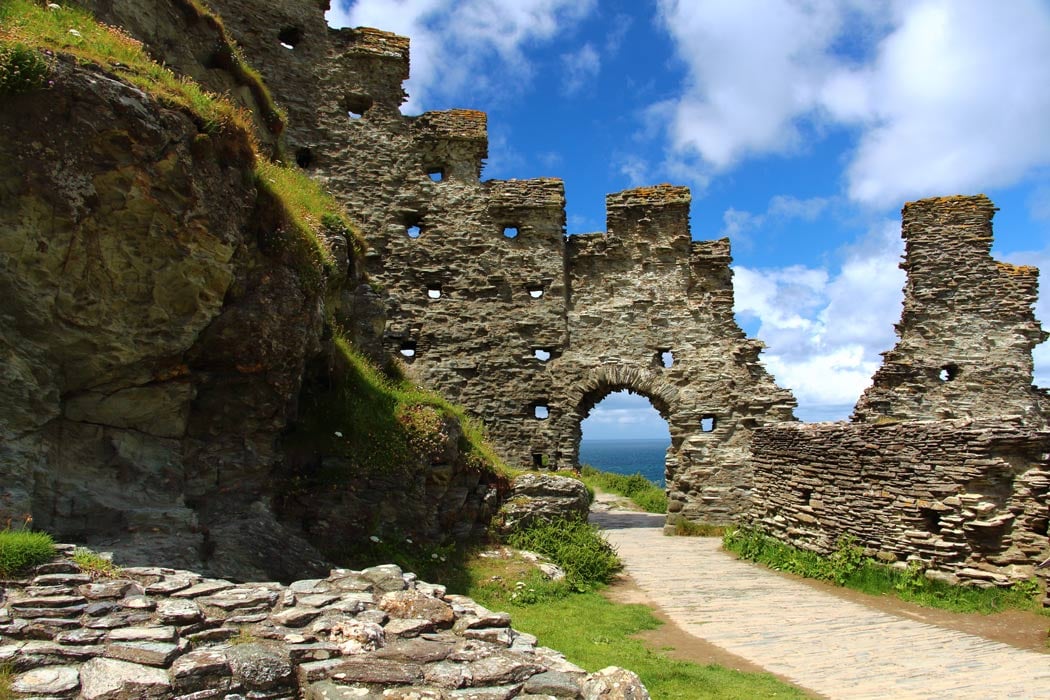
Tintagel Castle: Arthurian Legend Mixes with True History
Tintagel Castle is a site of castle ruins located on Tintagel Island; a peninsula connected to the North Cornwall coast in England by a narrow strip of land. This castle was an important stronghold from around the end of Roman rule in Britain, i.e. the 4th century AD or the 5th century AD until the end of the 7th century AD. Tintagel Castle is best known for the claim that it was the place where the legendary King Arthur was conceived, but the real history of the site is also exciting.
Signs of the Romans at Tintagel Castle
The site where Tintagel Castle stands today is likely to have been occupied during the Roman era, as artifacts dating to this period have been found on the peninsula. Having said that, as structures dating to the Roman period have yet to be discovered, it is not entirely clear if Tintagel Island was inhabited during the Roman period.
It may be said with more certainty that the site was occupied between the end of the Roman period and the 7th century AD. In 2016, geophysical surveys revealed the existence of walls and layers of buildings at the site. Excavations yielded walls, said to belong to a palace, a meter in thickness.
Read the rest of this article...
Here come the sundials! Prof uncovers eight ‘hidden’ sundials in ancient mosaics
Professor Marek Olszewski noticed a previously unknown depiction of sundial in Madaba Map, a great mosaic located in Jordan. The sundial is located next to the gate on the left.
Credit Wikipedia/public domain
A university professor studying ancient mosaics has discovered eight previously unknown sundials in the designs, taking the total number known number to 15.
Professor Marek T. Olszewski from the University of Warsaw was re-examining a number of mosaics dating back to the 2nd century AD when he made his startling discovery.
One of the mosaics from the 6th century AD which was discovered by the Gate of Damascus in Jerusalem, Olszewski noticed that between a richly dressed women, a mysterious object is visible, which scientists at the beginning of the 20th century described as an oil lamp or column.
Olszewski said: ”After careful analysis and comparison with a sundial discovered during excavations, I came to the conclusion that this mosaic and other ones similar to it depict sundials.”
Read the rest of this article...
Dazzling 'Temple of Colored Marbles' Honoring Roman God Discovered in Italy
In this reconstruction of the "Mithraeum of Colored Marbles" the spelaeum, the most important room in the mithraeum, is shown on the bottom level.
(Image: © G. Albertini)
Some 1,600 years ago, ancient Romans would have worshipped the god Mithras, possibly in an altered state of consciousness, within the "Mithraeum of Colored Marbles," said archaeologists who found the remains of this temple in Ostia, Italy.
Artifacts and inscriptions found in the mithraeum suggest that the worshippers venerated both Mithras, a popular god in the Roman Empire, and other gods.
Read the rest of this article...
Israelis find rare Roman fish sauce factory
The site is one of the few in the eastern Mediterranean
Image copyright ISRAEL ANTIQUITY AUTHORITY
Israeli archaeologists have discovered the well-preserved remains of a 2,000-year-old factory for making garum, the fabled fish sauce that the Romans took with them on all their journeys of conquest.
The Israel Antiquities Authority came across the small cetaria, or factory for making the prized sauce, while inspecting the site of a planned sports park on the outskirts of the southern city of Ashkelon, Israel's Kan public broadcaster reports.
The dig was funded by the local authorities, and young people and school children from the Ashkelon area came to help out.
It is one of the very few garum factories found in the eastern Mediterranean, despite the Romans' long presence in the area and the premium they put on the pungent fermented sauce.
Read the rest of this article...
Saturday, December 14, 2019
Roman remains: a walk through history in Snowdonia
Hold that fort … Tomen y Mur was built to control local tribes in AD78
Medieval Welsh mythology and Roman history collide and come to life at the Tomen y Mur hill fort
Wherever you walk in Wales, it turns out that you’re tracking some ancient, mythic storyline or other – and nowhere more so than at Tomen y Mur (“the mound on the wall”), a Roman fort and amphitheatre in Snowdonia national park, which sits beside a crossing of four Roman roads.
Tomen y Mur, surprisingly unsignposted in spite of its significance, sits on the lower slopes of Mynydd Maentwrog, not far from the A470 to the north-east of Llyn Trawsfynydd reservoir. The fort, now a scheduled monument, was constructed under governor Gnaeus Julius Agricola in 78AD, as part of his campaign to control the native Ordovices, a Celtic tribe who resisted Roman rule with some enthusiasm. Agricola’s response was a brutal campaign which, according to Roman chronicler (and Agricola’s son-in-law) Tacitus, almost wiped out the tribe.
Read the rest of this article...
Ancient wonders: five little-known archaeological sites in the UK
Mên-an-Tol, known locally as the Crick Stone, in Cornwall England.
Photograph: Paul Williams/Alamy
Our landscape is studded with reminders of past peoples. An expert in the field chooses her favourite windows into antiquity
Mên-an-Tol, Penwith Moor, near Madron, Cornwall
The name means “stone with a hole” in Cornish and the site is probably about 4,000 years old, dating from the bronze age. There are more stones hidden under the turf. What’s clear is that you’re in an ancient landscape – there’s a neolithic enclosure on the hillside, bronze-age barrow burials and the Boskednan Nine Maidens stone circle nearby. Some 400 metres to the north of the Mên-an-Tol is the Mên Scryfa, probably a bronze-age standing stone that was reused some time between 450-650AD as a grave marker. It’s inscribed with RIALOBRANI CVNOVALI FILI in Roman lettering, meaning “Rialobranus, son of Cunovalus”. Rialobran, or Ryalvran, is a native Cornish name, and may mean “royal raven”.
Thursday, December 12, 2019
Savvy Sonar Tech Uncovers Enormous Roman Shipwreck Off Greece
Sonar technology has been used to identify one of the biggest Roman shipwreck ever found in the Mediterranean Sea. It is believed that the vessel lay at the bottom of the seabed for 2000 years.
The wreck was located off the Greek island of Kefalonia, between 2013 and 2014 during “an underwater natural and cultural heritage assessment survey,” reports the Journal of Archaeological Science . It was found not far from the fishing port of Fiskardo. The shipwreck has been named after the village as it is now called the ‘Fiskardo shipwreck’.
Savvy Sonar Technology
During the survey, side-scan sonar detection technology was used by a Greek team to identify the ancient vessel on the seabed. This form of sonar technology can generate images of the seafloor, and it “works by beaming out high-frequency sound pulses in a wide fan shape from a boat floating on the surface,” reports The Daily Mail . When these pulses strike objects on the floor, they provide data that can be used to create a model of the seabed.
his type of sonar technology can differentiate shipwrecks from other objects and features, even if they have similar sonic signatures, which means that it’s very popular with marine archaeologists. The Greek team also found two World War II wrecks in the same general area, which evidences the effectiveness of the technology used.
Read the rest of this article...
NEWLY FOUND 1ST CENTURY BC ROMAN FORT, CUSTOMS PUSH BACK FOUNDING ALMUS FORTRESS IN BULGARIA’S DANUBE TOWN OF LOM
The first Ancient Roman fortification in Almus, today’s Lom on the Danube, was built in the middle of the 1st century AD, as per the latest discoveries.
Photo: Lom Museum of History Facebook Page
An Early Roman fort from the 1st century AD has been discovered in the Ancient Roman city of Almus in today’s town of Lom on the Danube in Northwest Bulgaria, demonstrating that the first Roman fortifications on the site were built substantially earlier than previously known.
The main Almus Fortress is known to have been built in the 3rd – 4th century, during the reigns of Roman Emperors Diocletian (r. 284-305 AD) and Constantine the Great (r. 306-337 AD).
However, during the 2019 excavations of the Roman city of Almus in the early fall, the Bulgarian archaeologists have discovered archaeological layers dating as early as the second half of the 1st century AD.
In them, they have found part of an Early Roman fortress wall, a street with a canal, a destroyed barracks that housed a contubernium, the smallest unit of soldiers in the Roman army, and a luxury building, which may have been used as customs, reports local news site MediaNews.
Inside the destroyed contubernium barracks, the archaeologists have discovered a gold phalera – an Ancient Roman decoration awarded as a medal to military officers.
Read the rest of this article...
Tuesday, December 10, 2019
The art of the Roman surveyors emerges from newly discovered pavements in Pompeii
IMAGE: PLAN OF THE HOUSE OF ORION, SHOWING THE DISPOSITION OF THE NEWLY DISCOVERED IMAGES (1,2) AND OF THE MOSAICS (3)
The technical skills of the Roman agrimensores - the technicians in charge of the centuriations (division of the lands) and of other surveys such as planning towns and aqueducts - are simply legendary. For instance, extremely accurate projects of centuriations are still visible today in Italy and in other Mediterranean countries. Their work had also religious and symbolic connections being related with the foundation of towns and the Etruscan's tradition.
These technicians were called Gromatics due to their chief working instrument, called Groma. It was based on a cross made of four perpendicular arms each bringing cords with identical weights, acting as plumb-lines. The surveyor could align with extreme precision two opposite, very thin plumb-lines with reference poles held at various distances by assistants or fixed in the terrain, in the same manner as palines (red and white posts) are used in modern theodolite surveying.
Read the rest of this article...
Roman villa unearthed in southern England
Credit: Bournemouth University
A well preserved Roman villa has been rediscovered at the Dorset Wildlife Trust nature reserve, Nunnery Mead, near Frampton.
The dig was carried out by experts from Bournemouth University. Thought to be destroyed in the mid-nineteenth century, the team were delighted to find a well-preserved site.
Dr Miles Russell, Senior Lecturer in Prehistoric and Roman Archaeology Department of Archaeology and Anthropology Faculty of Science and Technology Bournemouth University, said: “The opportunity to survey, record and better understand the Roman villa at Nunnery Mead, Frampton, was one we couldn’t miss, given that the building was thought to have been destroyed in the mid-19th century.
Read the rest of this article...
Roman shipwreck from time of Jesus Christ found with 'exciting' cargo on board
Researchers believe the ship to have been in operation between the first century BC
and the first century AD
A Roman shipwreck dating back to the time of Jesus Christ has been found in a huge archaeological breakthrough.
It was discovered off the coast of a Greek island - and it had some unexpected cargo on board.
The boat was being held down with jugs used to store wine and food, it has been claimed.
The well-preserved containers, known as amphorae, were probably carrying olive oil and grains as well.
The jars have been analysed by experts who determined when they were used by the Greeks and the Romans.
The vessel is understood to measure 34m in length and 13m in width.
Read the rest of this article...
Subscribe to:
Posts (Atom)


