Thursday, September 26, 2019

Roman bronze cauldron unearthed in central Norway burial cairn

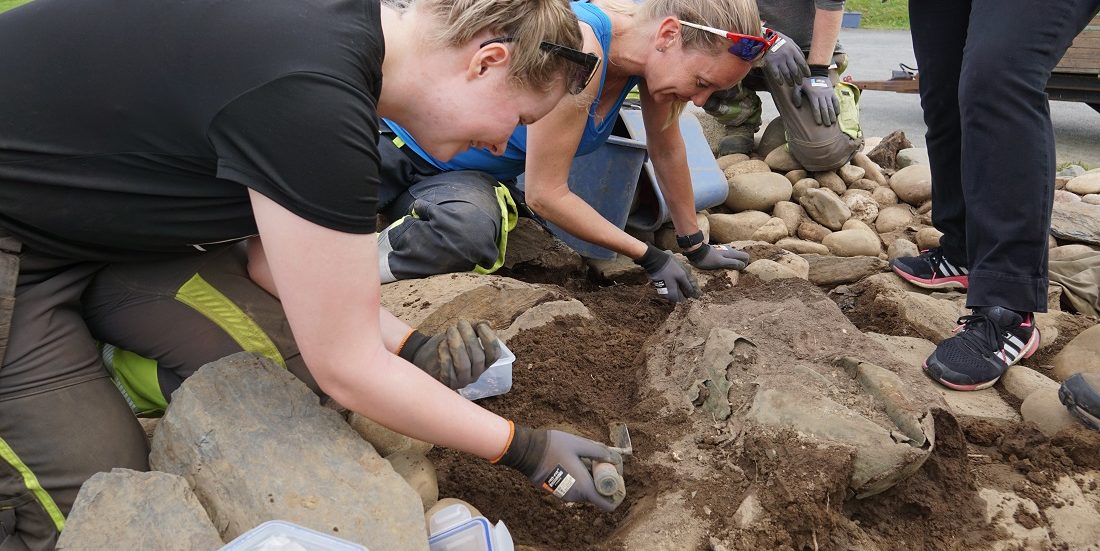
The cauldron has been uncovered, and Heidi Fløttum Westgaard, Ellen Grav Ellingsen 
and Kjell André Brevik carefully clean it off. 
Photo: Astrid Kviseth / NTNU University Museum

“Vessels like these were imported from the Roman Empire and confirm that this was an area of status and wealth during Roman times,” says archaeologist Merete Moe Henriksen.

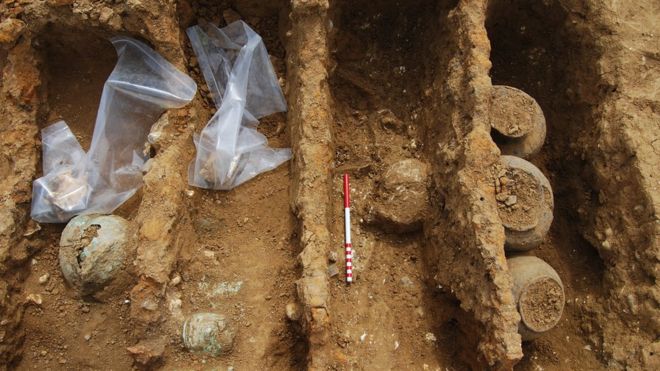
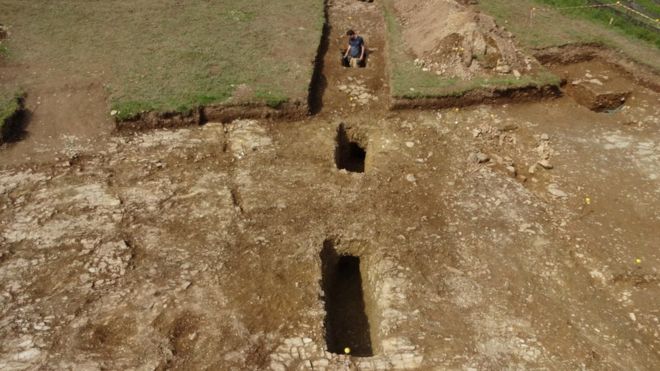
Sometime around 150-300 CE a person died at the place now called Gylland in the Gaula River valley, in southern Trøndelag county. After the body was cremated, the remains were laid in a bronze vessel. This was then covered or wrapped in birch bark before being buried under several hundred kilos of stone.

And there it stayed – until this summer, when archaeologists from the NTNU University Museum lifted a stone slab and almost lost their breath from excitement when they saw what lay below it.

“We’d gone over the spot with the metal detector, and so we knew that there was something under one of the stone slabs in the burial cairn,” says archaeologist Ellen Grav Ellingsen, who filmed the discovery with her mobile phone when the rock was lifted away.

Read the rest of this article...

Monday, September 16, 2019

New finds beef up case for redrawing map of Roman empire

The remains of a high-quality Romano-British butcher’s business and centre for crafts have been unearthed by archaeologists in Devon. Photograph: Handout

Dig at Ipplepen extends Roman realm of influence further south-west in UK than Exeter

The remains of a high-quality Romano-British butcher’s business and centre for crafts have been unearthed by archaeologists in Devon.

Experts believe the fourth-century abattoir was set up to prepare the best cuts of beef that were transported to customers miles away along a Roman road found at the site.

They suggest the butchers at Ipplepen, near Newton Abbot in south Devon, worked alongside a string of talented craftspeople specialising in deer antler, leather and textiles.

Previous digs at Ipplepen have unearthed Roman coins, a stretch of Roman road and the remnants of vessels from France and the Mediterranean once full of wine, olive oil and garum – fish sauce.

Read the rest of this article...

Wednesday, August 14, 2019

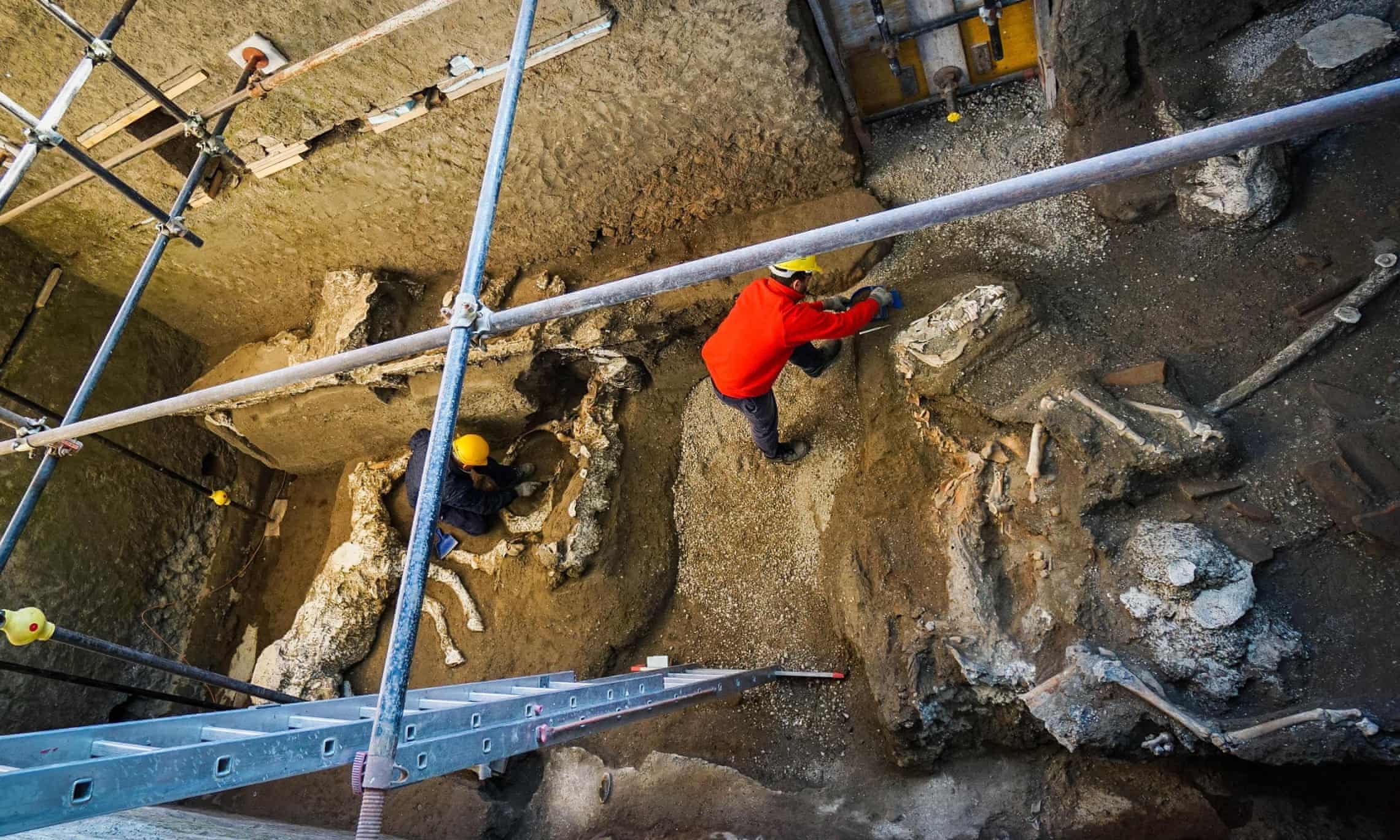
Pompeii archaeologists uncover 'sorcerer's treasure trove'

Artefacts thought to be part of a sorcerer's treasure trove on display in Pompeii (12 August)
Most of the artefacts would have belonged to women - possibly slaves or servants

Archaeologists working in the buried Roman city of Pompeii say they have uncovered a "sorcerer's treasure trove" of artefacts, including good-luck charms, mirrors and glass beads.

Most of the items would have belonged to women, said Massimo Osanna, director of the Archaeological Park of Pompeii.

A room with the bodies of 10 victims, including women and children, was excavated in the same house.

Pompeii was engulfed by a volcanic eruption from Mt Vesuvius in AD 79.

The fatal eruption froze the city and its residents in time, making it a rich source for archaeologists.

Read the rest of this article...

Monday, August 12, 2019

Large Roman tomb unearthed in south Italian town of Ugento

Credit: Telerama News

Just outside the present-day town centre of Ugento in the province of Lecce, Apulia (southern Italy), during the course of excavations arranged by the Superintendence of Archaeology, Fine Arts and Landscape for the provinces of Brindisi, Lecce and Taranto on private property, evidence has come to light that brings new data for the reconstruction of the history of Ugento: in addition to some wall structures probably dating back to the Middle Ages, a burial of great interest for the study of funerary rituals has emerged.

"It was a plain pit in which three individuals had been deposited at successive times", explains the Superintendence. "The grave, probably dating back to the Roman-Republican Age, has yielded 4 coins not yet legible and a grey oil lamp."

"Once the skeletons had been removed, four pits came to light inside which the remains of the earlier inhumations and some accompanying objects had been deposited: in particular, a bowl and an undecorated miniature vase, perhaps belonging to the third century BC, as well as an oinochoe (a container for mixing wine) dating back to the Hellenistic period, had been carefully buried inside one of the pits."

Read the rest of this article...

Monday, August 5, 2019

Roman bath house discovered under former Jack's store in Colchester


A PLETHORA of important archaeological discoveries including a Roman bath house have been made during an excavation.
Several historic artefacts, including the remains of what would have been a large Roman bath house, have been unearthed on St Nicholas Road under the former hardware shop, Jack’s.
The ancient spa-esque facility, used for public bathing, was identifiable by the discovery of essential components, such as the hollow and ceramic flues which would have lined both the walls and floors of the house’s different rooms.
Evidence further confirming the famous Boudican revolt, which caused the destruction of modern Colchester in AD 61, was also discovered.
Read the rest of this article...

Friday, August 2, 2019

I went to Ancient Rome and all I got you was this…

The witty message on the stylus has been deciphered by a classicist and epigrapher. Courtesy MOLA

This humble London-Roman stylus with a witty message is mixing it up with the treasures of Pompeii

Whether as giver or receiver, most people have experienced the deliberately naff holiday present. But few know how this droll practice has a long tradition that stretches back – way beyond the rise of the English seaside town – deep into antiquity.

At the Museum of London, excavations led by MOLA for financial technology and information company Bloomberg’s European headquarters in London, on the bank of the river Walbrook – a now lost tributary of the Thames, have found a roguish example of the token of friendship.

An iron stylus, used to write on wax-filled wooden writing tablets and dating to around AD 70, just a few decades after Roman London was founded, has been found with an inscription, which has been painstakingly examined and translated by classicist and epigrapher Dr Roger Tomlin, reads:

Read the rest of this article...

Thursday, August 1, 2019

Anglesey skeletons: Tests date remains to 4th Century


Tests showed some of the people buried up to 1,600 years ago were from Scandinavia and the Mediterranean  Image copyright ARCHAEOLOGY WALES

Some of the skeletons found in an ancient graveyard on Anglesey date back to the 4th Century, experts have said.

Wales Archaeology, which led the college dig, found the remains of 34 individuals. Some had been buried in stone-lined coffins.

Tests showed some of the people buried up to 1,600 years ago were from Scandinavia and the Mediterranean.

Other remains were from the Welsh borders and four were Brits, said project manager Dr Irene Garcia Rovira.

The findings have been made public following digs carried out during work on the Llangefni link road in 2016 and Coleg Menai's nearby campus the year after.

Read the rest of this article...

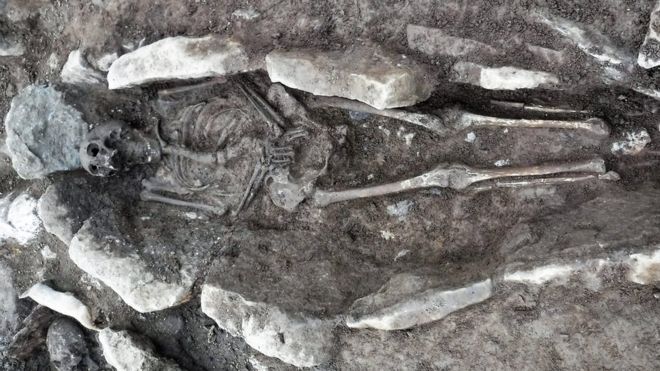
Nearly 100 Roman era skeletons discovered under a North Wales college

Roman era human remains have been found underneath an Anglesey college.

Skeletons buried in dozens of stone-lined 'cist' graves were discovered as part of an archaeological dig under Coleg Menai’s Pencraig Campus in Llangefni 2017.

Two years on, Dr Irene Garcia Rovira of Archaeology Wales has now revealed all about the "astonishing finds" as part of the major excavation.

So far, the remains of 86 people have been discovered at the ancient burial ground, which experts say have remained in "astonishingly good" condition.

They are thought to date back more than 1,600 years.

The archaeologist also says tests reveal how some of the skeletons buried in the cemetery are likely to have grown up hundreds of miles away from Anglesey.


Experts believe the site was used as a cemetery from around the time of the Roman departure from Wales.

Read the rest of this article...

Sunday, July 28, 2019

Rare relics of an Iron Age warrior who fought the Romans

The helmet and crest of the Iron Age warrior. Photo Allan HutchingsPhotography

As the Novium in Chichester prepares to display the late Iron Age Bersted Warrior and his possessions in January 2020, we talk to archaeologist James Kenny about one of the most spectacular warrior burials ever found in Britain

When archaeologists arrived to investigate a grave discovery on the site of a new housing development near Chichester in West Sussex, they had little idea what was awaiting them.

A large scale archaeological excavation had been taking place ahead of the development in 2008 at North Bersted, and when the grave was uncovered Chichester District Council’s archaeologist, James Kenny, was one of the first people to view it.

Read the rest of this article...

Iron Age warrior's remains to go on show in Chichester


The grave contained "significant" artefacts
Chichester District Council

The remains of an Iron Age warrior and his possessions - hailed as a "spectacular discovery" by archaeologists - are to go on display.

Weaponry and other artefacts were found alongside the ancient fighter during excavations at a site near Chichester, West Sussex.

It is thought the grave belonged to someone of high status.

The man, who may have fought alongside a Roman king, will be the centre-piece of an exhibition at a city museum.

A team from Thames Valley Archaeological Services found the grave on land at North Bersted, near Bognor Regis, in 2008.

Read the rest of this article...

Grave of 'real-life Asterix' who fought Caesar found amid trove of weapons and possessions in West Sussex

'Unique find': the artefacts have been carefully studied for the last decade CREDIT: PA

The grave of a real-life Asterix containing what is believed to be an ancient Gallic warrior who came to Britain and fought Julius Caesar has been discovered, archaeologists have announced.

The unique and highly-elaborate resting place was found on a West Sussex building site.

The Iron Age warrior, buried with his glamorous and ornate head-dress, is thought to have been a refugee French Gallic fighter who fled Julius Caesar's legionnaires as they swept across continental Europe in about 50BC.

Archaeologists have described the discovery, which will go on display at Chichester's Novium Museum in January 2020, as "the most elaborately equipped warrior grave ever found in England".

Read the rest of this article...

Tuesday, July 23, 2019

'Important' Iron Age settlement found at Warboys dig

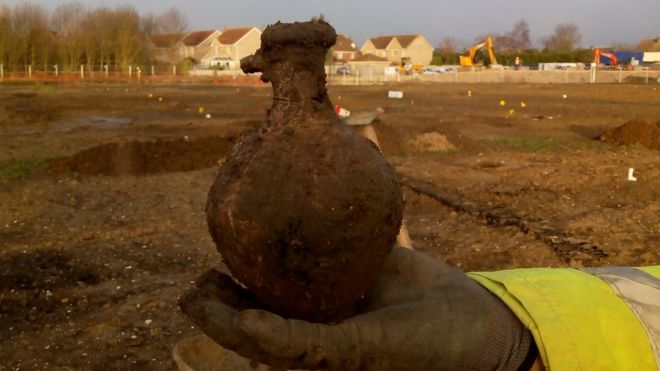
Roman finds include this jug and human remains, including six skeletons
Oxford Archaeology East

Iron Age roundhouses, Roman burials and Saxon pottery have been discovered in a "hugely important and hitherto unknown settlement".

The seven month-long dig in Warboys in Cambridgeshire also uncovered "a rare example" of "early Saxon occupation mingled with the latest Roman remains".

Archaeologist Stephen Macaulay said: "We almost never find actual physical evidence of this."

The settlement reverted to agricultural use after the 7th Century.

"What makes this site really significant is we have evidence of early Saxon occupation mingled with the latest Roman remains," said Mr Macaulay, deputy regional manager for Oxford Archaeology East.

Read the rest of this article...

ootball UK politics Environment Education Society Science Tech Global development Cities Obituaries Archaeology Mystery of Chedworth's 1,800-year-old Roman glass shard solved


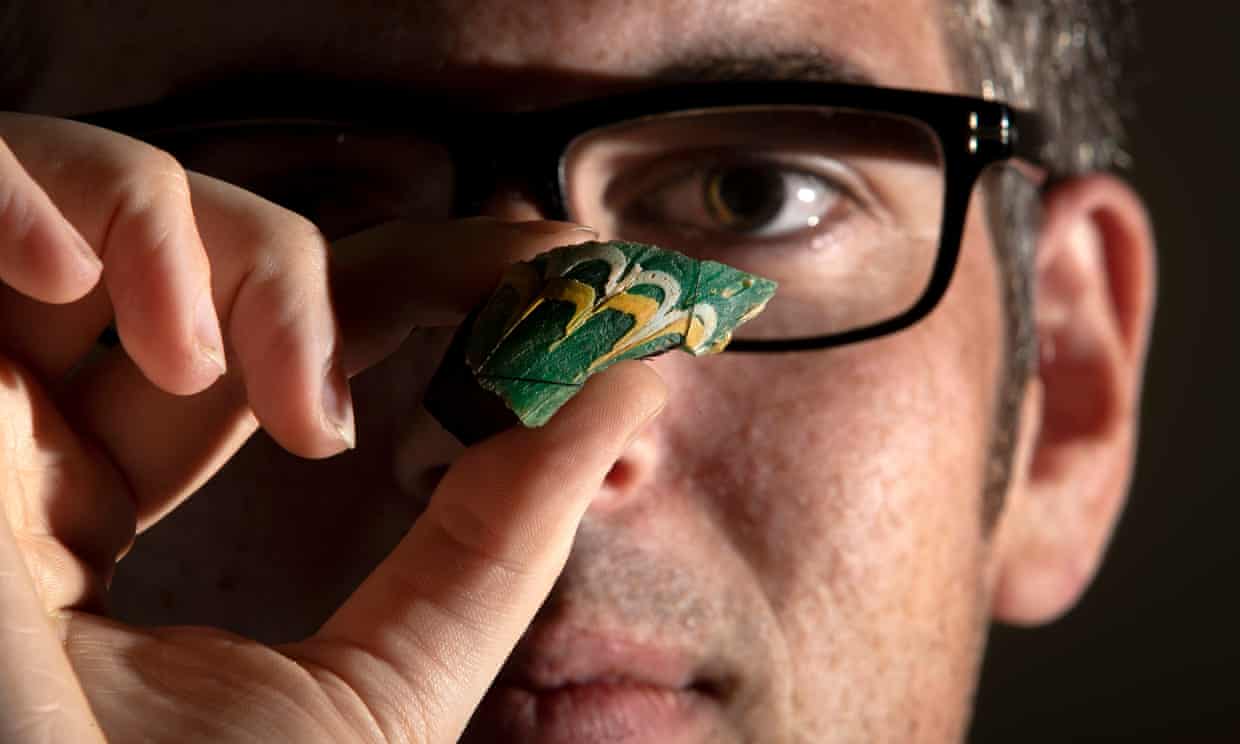
The fragment from the Roman fish bottle, the only one of its type ever discovered in Britain. Photograph: National Trust/Rod Kirkpatrick/F Stop Press 

Find sheds fresh light on wealth and influence of ex-inhabitants of National Trust property
A fragment from a Roman bottle so exceptionally rare that it has taken glass experts from around the world two years to conclusively identify it has been discovered thousands of miles from where it was made.

The discovery at Chedworth Roman Villa in Gloucestershire of the small shard of patterned green glass, part of an 1,800-year-old fish bottle, has astonished archaeologists.

Nothing like it has ever been found in Britain. It would have been made in an area around the Black Sea in what is now Ukraine and was possibly used to hold exotic perfume.

For it to travel all the way from the Black Sea to the Cotswolds sheds new light on the wealth and influence of the people who occupied Chedworth, a National Trust property regarded as one of the grandest Roman villas in Britain.


Read the rest of this article...

Pompeii row erupts between rival scientific factions

 Archaeologists at work in Pompeii. Volcanologists complain they have been barred from accessing certain areas of the world heritage site. Photograph: Cesare Abbate/AP

Volcanologists say excavations by archaeologists are destroying useful clues about lava flow

 
It is one of the most ambitious archaeological missions ever undertaken. The Great Pompeii Project promises remarkable discoveries about life in the Roman empire, including the genetic profiles of the town’s inhabitants, their dining preferences, occupations and health.

But as layers of volcanic rock are chipped away to uncover the secrets that lie below, not everyone is celebrating. Volcanologists say the excavation risks destroying clues about the AD79 eruption that could be crucial for protecting the 600,000 people who live in the shadow of Vesuvius today.


After years of simmering tensions, a row has broken out between the two scientific factions, and volcanologists published an open letter in the journal Nature this month criticising the “alarming” destruction of volcanic deposits.

Read the rest of this article...

Thursday, July 18, 2019

Travel back in time with the 'Google Maps' of Ancient Rome


Summer is now well-underway across Europe and many of us are planning our holiday escape with travel comparison websites and web mapping services.

Low-cost air carriers, fast trains, and cross-national motorways have made travelling across the Old Continent a quick and often cheap affair. But let's imagine that cars, trains and planes haven't been invented yet and that your options are limited to ox or mule cart and ships.

–– ADVERTISEMENT ––
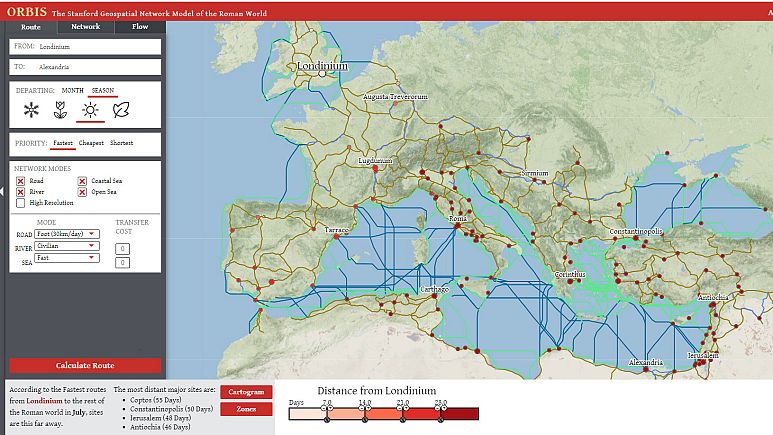
Researchers at Stanford University have used modern technology to answer by creating a web mapping version of Ancient Rome.

Their model, called ORBIS, consists of 632 sites spread across 10 million square kilometres of terrestrial and maritime space, covering most of modern Western Europe and the Mediterranean coast in North Africa and the Middle East.

The tool generates solutions for travel between any two sites depending on specific means and mode of transport and the months of the year, providing different options based on time and expense.

Read the rest of this article...

Ancient Roman port history unveiled

A team of international researchers led by La Trobe University and the University of Melbourne have, for the first time worldwide, applied marine geology techniques at an ancient harbour archaeological site to uncover ancient harbour technologies of the first centuries AD  [Credit: La Trobe University]

Researchers successfully reconstructed anthropic influences on sedimentation, including dredging and canal gates use, in the ancient harbour of Portus - a complex of harbour basins and canals that formed the hub of commerce in the capital of the Roman Empire.

The findings suggest that the Romans were proactively managing their river systems from earlier than previously thought - as early as the 2nd century AD.

The history was reconstructed using a range of high-resolution sediment analysis including piston coring, x-ray scanning, radiocarbon dating, magnetic and physical properties and mineral composition of the ancient harbour sediments.

Read the rest of this article...

Monday, July 15, 2019

Roman coins 'may be linked to Boudiccan revolt'

 The coins dated between 153BC and AD61
Suffolk County Council

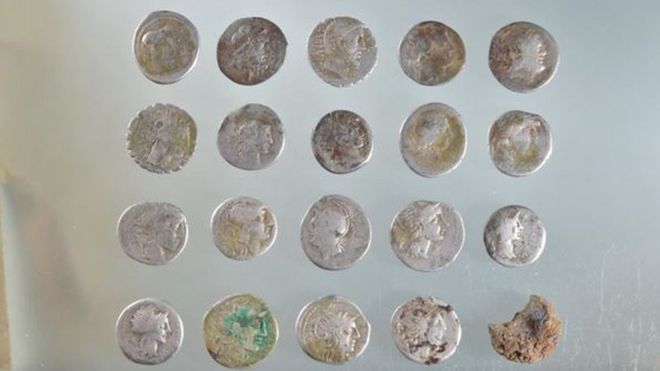
A hoard of Roman coins found in a field may have been hidden there during the Boudiccan revolt, an expert has said.

The trove of 60 denarii, dating between 153BC and AD60-61, was found in a field near Cookley, in Suffolk, by a metal detectorist.

Dr Anna Booth, who examined the find, said there "might be a link with the Boudiccan revolt" and the coins.

Queen Boudicca led the Iceni tribe against the Romans in AD61 which led to the destruction of Colchester.

Most of the coins dated from the Republic era, pre-27BC, but there were also denarii minted during the reigns of emperors Augustus, Tiberius, Caligula and Nero.

Read the rest of this article...

Deux sols de mosaïque antiques au cœur de Poitiers


Située au nord-ouest de l’église Notre-Dame-la-Grande, la fouille se situe dans un secteur particulièrement sensible du point de vue archéologique compte-tenu de la densité importante des vestiges reconnus, notamment pour l’Antiquité. La surface de 230 m²  présente une grande densité de vestiges enchevêtrés et mobilise sept archéologues pendant sept semaines (du 11 juin au 26 juillet). Prescrite par la Drac Nouvelle-Aquitaine, cette fouille est mise en œuvre par la Communauté urbaine de Grand-Poitiers.

Read the rest of this article...

Thursday, July 4, 2019

Calstock Roman dig reveals 'unexpected' mine

Mine workings reveal the Romans were exploiting the mineral-rich area
UNIVERSITY OF EXETER

Archaeologists digging near a Roman fort in Cornwall have unearthed remains of a mine and a Roman road.

The discoveries were made during a new dig near a fort found at Calstock in 2007, one of only three such sites known in the county.

Experts will carry out further analysis of a previously-unknown series of deep pits, connected by arched tunnels.

Dig leader Dr Chris Smart, from the University of Exeter, said the mine was an "unexpected bonus".

Read the rest of this article...

Roman road and possible mine discovered during Cornish dig

View of the possible mining pits looking north [Credit: University of Exeter]

Archaeologists have discovered a Roman road and possible ancient mine during excavations in Cornwall as they work to discover more about the history of the county.

Experts will carry out further analysis of the previously-unknown series of deep pits, which are connected by arched tunnels. It is likely to be yet another mine worked many hundreds of years ago when this area of South East Cornwall and West Devon was famed for having some of the richest mineral deposits in the world.

Archaeologists from the University of Exeter and local volunteers have been digging for the past month near to the site of a previously-found Roman fort at Calstock, in the Tamar Valley. This year’s excavation has focused on an area outside the fort’s west gate, which was at the front of the fort, originally facing hostile territory.

As well as the possible mine they have discovered a Roman road, which would have served regular military traffic in and out of the fort. The excavation has revealed a rare glimpse of timber-built Roman military buildings constructed outside of the fort, as well as a series of rubbish and cess pits, indicating that the Roman army was also active outside of the fort’s defences.

Read the rest of this article...