Sunday, July 7, 2013

Archaeologists unearth carved head of Roman god in ancient rubbish dum

Dr David Petts on site with the Binchester head

An 1,800-year-old carved stone head of what is believed to be a Roman god has been unearthed in an ancient rubbish dump.
Archaeologists made the discovery at Binchester Roman Fort, near Bishop Auckland, in County Durham.
First year Durham University archaeology student Alex Kirton found the artefact, which measures about 20cm by 10cm, in buried late Roman rubbish within what was probably a bath house.
The sandstone head, which dates from the 2nd or 3rd century AD, has been likened to the Celtic deity Antenociticus, thought to have been worshipped as a source of inspiration and intercession in military affairs.
A similar sandstone head, complete with an inscription identifying it as Antenociticus, was found at Benwell, in Newcastle upon Tyne, in 1862.
Read the rest of this article...

Friday, July 5, 2013

Head of Roman god found in ancient rubbish dump


An 1,800-year-old carved stone head of what is believed to be a Roman god has been unearthed in an ancient rubbish dump. Archaeologists made the discovery at Binchester Roman Fort, near Bishop Auckland, in County Durham.

Carved head of Roman god found in ancient rubbish dump
The late Roman stone head was found by Durham University archaeologists at Binchester Fort, County Durham, UK [Credit: Durham University]
First year Durham University archaeology student Alex Kirton found the artefact, which measures about 20cm by 10cm, in buried late Roman rubbish within what was probably a bath house.

The sandstone head, which dates from the 2nd or 3rd century AD, has been likened to the Celtic deity Antenociticus, thought to have been worshipped as a source of inspiration and intercession in military affairs. A similar sandstone head, complete with an inscription identifying it as Antenociticus, was found at Benwell, in Newcastle upon Tyne, in 1862.


Read the rest of this article...

Wednesday, July 3, 2013

Ravenglass Roman fort: Call for volunteers


Archaeologists in Cumbria are calling for volunteers to help them explore the remains of a Roman naval base.
Ravenglass Roman fort was occupied from AD 120 through to the 4th Century.
During the dig, due to begin on 4 September, archaeologists hope to find evidence of a civilian settlement from more than 1,800 years ago.
The £125,000 project received funding from the Heritage Lottery Fund, Lake District National Park Authority and Copeland Community Fund.
Holly Beavitt-Pike, Lake District National Park's archaeology and heritage assistant, said the first dig would end on 28 September and participants would be able to volunteer for a maximum of five days.
Read the rest of this article...

Ancient Anchors from Punic Wars Found Off Sicily


A key episode of the Punic Wars has emerged from the waters near the small Sicilian island of Pantelleria as archaeologists discovered a cluster of more than 30 ancient anchors.
Found at a depth between 160 and 270 feet in Cala Levante, one of the island’s most scenic spots, the anchors date to more than 2,000 years ago.
According to Leonardo Abelli, an archaeologist from the University of Sassari, the anchors are startling evidence of the Romans’ and Carthaginians’ struggle to conquer the Mediterranean during the First Punic War (264 to 241 B.C.).
“They were deliberately abandoned. The Carthaginian ships were hiding from the Romans and could not waste time trying to retrieve heavy anchors at such depths,” Abelli told Discovery News.
Read the rest of this article...

Monday, July 1, 2013

Roman shrine found at Rutland Water nature reserve


Archaeologists have uncovered a Roman shrine at Rutland Water nature reserve.
The team from Northamptonshire Archaeology investigated the site ahead of a 240-acre extension to the reserve by Anglian Water.
They found the remains of an Iron Age farmstead, and Roman shrine dating from about AD100.
Jo Everitt, Anglian Water's environment and heritage assessor, said: "Finding Roman shrines is not the norm, so we were delighted."
Read the rest of this article...

Tuesday, June 25, 2013

SEARCH CONTINUES FOR ROMAN FORT OF THE NORTHERN FRONTIER


Archaeologists will next week begin the search for an elusive Roman fort believed to be located somewhere in the northeast of Scotland.

Dr Birgitta Hoffmann, Co-Director of The Roman Gask Project, based at the University of Liverpool, will lead a team of experienced volunteers in their search for a Roman fort which is believed to exist, but has been ‘missing’ for almost 2,000 years. It’s not certain that a fort actually exists, but if it does, it is likely to lie somewhere between the last known (and most northerly) fort at Stracathro (Brechin) and the northeast coast.

Rome’s first frontier

Locating the fort would be the first such discovery beyond the Antonine Wall in 30 years, and would form another piece of the Gask frontier. The Gask Ridge system was constructed sometime between 70 and 80 CE long before either Hadrian’s Wall (122-130 CE), and the Antonine Wall (142-144 CE). Although the Gask Ridge was not an unbroken defensive wall, it may be Rome’s earliest fortified land frontier based on forts and watchtowers along a military road. Blocking the glens with garrisoned forts disrupted the Caledonian tribes ability to raid the fertile lowlands and effectively created a border between Roman occupied lands and the north and west.
This Roman land frontier stretches from just north of Stirling up to Stracathro. The frontier comprises of a series of Roman forts and watchtowers, with a legionary fortress near Blairgowrie.
Read the rest of this article...

Largest Known Ancient Roman Settlement in the Hadrian's Wall Frontier Under Exploration


Archaeologists under the direction of Stephen Rowland and John Zant of the archaeological research institution, Oxford Archaeology North, U.K, will be excavating and investigating the remains of a large Roman settlement associated with the nearby Roman fort of Alauna near the northwestern U.K. coastal town of Maryport.

While much has already been excavated of the nearby fort (where another key excavation, known as the Roman Temples Project, is currently taking place), much less is known of this settlement site, located just northeast of the fort remains. Geophysical surveys have revealed detailed physical clues, including the tell-tale lines of buildings which archaeologists suggest may possibly have been houses and shops adjacent to both sides of what appears to have been the main street extending from the northeast gate of the fort. Thought to be an ancient civilian settlement, it is considered the largest currently known along the Hadrian's Wall frontier. 
Report the archaeologists, "The excavation should provide an excellent opportunity to examine the date, complexity and uses of these structures, as well as revealing aspects of the daily lives of the people who lived there".
Read the rest of this article...

Teston Roman villa discovery solves 140-year-old mystery


An archaeological mystery that has eluded experts in Kent for 140 years has finally been solved following the rediscovery of the site of a Roman villa.
The remains of a bath house were first unearthed in hop gardens on the banks of the River Medway at Teston in 1872, but after some excavations it was covered over until 1972, when archaeologists reinvestigated the site but failed to locate any trace of ancient remains.
Nearly 20 years later, in 1991 during the emergency renewal of a sewer, Southern Water uncovered Roman building materials and pottery, with archaeologists subsequently revealing the remains of a Roman masonry building.
Read the rest of this article...

Roman townhouse 'underneath Lincoln Castle'

A Roman townhouse is probably located underneath Lincoln Castle, according to archaeologists digging at the site.

Roman townhouse 'underneath Lincoln Castle'
The dig has reached a depth of 3.5m below current ground level [Credit: BBC]
The team have already reached the foundations of the Norman phase of the castle during their work. Archaeologist Cecily Spall said the dig had reached a depth of 3.5m with another half-metre of digging left to complete.

The area is being excavated prior to a revamp of the castle. "We have been working since September - and have reached the level of the Norman castle - from the mid 11th Century," Ms Spall said.

She said they had found evidence of timber-framed buildings which may have been part of a medieval stable block. "We expect we will find a Roman townhouse at about 4m depth below ground level," she added.


Read the rest of this article...

Tuesday, June 18, 2013

Archaeologists Unearth Roman Frontier Fort and Settlement in England


Located near the small coastal town of Maryport in northwestern England, remains of the ancient Roman fort of Alauna were first uncovered by amateur archaeologist Joseph Robinson in the late 19th century. Among the finds were an assemblage of no less that 22 stone altars, some bearing inscriptions, that tell a story of successive Roman commanders who commanded this, one of Imperial Rome's northernmost outposts during the height of the Roman Empire's expanse. The altars now grace the nearby Senhouse Museum, which serves as a popular tourist attraction.  

Now a team of archaeologists and volunteers have returned to the site where the original stone altars were found to uncover more clues about the layout of the fort and its associated settlement, and about the lives of the military officers and soldiers who manned this remote garrison. Led by Newcastle University's Professor Ian Haynes and site director Tony Wilmott, the archaeologists have been here before. 
Says Haynes: "The last two years' excavations focused on the area in which the altars were discovered in 1870.

 This year sees some further work at the 1870 site and the start of a three year project focusing on the place where, in 1880, local bank manager and amateur archaeologist Joseph Robinson uncovered further altars and two possible temples.

 Photographs and other documents from the 1880s indicate that the antiquarian investigation only unearthed part of the site and it is clear that much remains to be discovered."

Read the rest of this article...

Oxfordshire's earliest recorded resident: Roman tombstone goes on display

The tombstone had been smashed into pieces to form part of a wall

It is known that in a long lost town in the Oxfordshire of AD 79 an Italian immigrant died.
The discovery of the tombstone of Lucius Valerius Geminus - a veteran of the Second Augustan Legion - has revealed to archaeologists the first known biography of any person to have lived in the county.
It was discovered in fragments in a field, once the bustling Iron Age town of Alchester, near modern day Bicester. It has been reassembled so it can go on public display.
Dr Chris Ferguson, curator of archaeology at Oxfordshire Museum Service, said: "His biography is probably the earliest for a veteran in the entire province of Britannia, and he is certainly the earliest for this region of Roman Britain."
Read the rest of this article...

Monday, June 17, 2013

Archaeologists Uncover Magnificent Town of Emperor Diocletian in Bulgaria


Good thermal springs are always likely to draw increasing numbers of people who have the means to tap their benefits. More often than not, they become popular resort destinations for the rich and famous. So it was with this location in the outskirts of the Sredna Gora mountain range near the present-day town of Hisarya of central southern Bulgaria.
Archaeological research indicates that this place was inhabited as long ago as 6,000 years BCE, then later by the Thracians. In the 1st century CE it was conquered by the Roman Empire, eventually becoming an affluent 4th century Roman resort, a place that emperor Septimius Severus himself, among others, was recorded to have visited. Today, the archaeological remains bear the unmistakable evidence of palaces, wide stone streets, marble baths, an amphitheater in circus style, and monumental fortification walls. The walls have been preserved in some places up to 14 m in height.  
Now, a team of archaeologists and students have returned to the ancient site to uncover more of the remains, hoping to shed additional light on a major Roman settlement that was likely a popular attraction for the wealthy Roman citizenry during the height of the Roma Empire in Late Antiquity.
Read the rest of this article...

Third season dig begins in Maryport


Archaeologists hope that Maryport will reveal more of its Roman secrets this summer. The third year of excavations at Camp Farm began this week, led by Newcastle University’s Professor Ian Haynes and site director Tony Wilmott.

Third season dig begins in Maryport
Excavations on site at Maryport set to resume again this summer
[Credit: Newcastle University]
The Temples Project is the start of a new phase in the five year excavation which will take the team back to an 1880 excavation where amateur archaeologist Joe Robinson discovered altars and two possible temples.

Professor Haynes said: “Photographs and other documents from the 1880s indicate that the antiquarian investigation only unearthed part of the site and much remains to be discovered.”

The excavation, funded by the Senhouse Roman Museum Trust, will continue until summer 2015.

Rachel Newman of the Senhouse Museum Trust said: “Any finds will be included in the museum’s collections.”


Read the rest of this article...

Monday, June 10, 2013

The Secrets of Roman Concrete

130604135409-large

An international team of researchers has examined Roman concrete to learn why it has proven to be so durable. A sample of Roman concrete taken from the ancient port of Baiae in Pozzuloi Bay revealed that by mixing lime and volcanic ash for underwater structures, the Romans used the seawater to trigger a chemical reaction that hydrated the lime and mixed with the ash to form a glue that is stronger than what holds modern concrete together. Plus, the ingredients of Roman concrete can be formed at lower temperatures, using less fuel and releasing less carbon into the atmosphere.

Read the rest of this article...

Tuesday, June 4, 2013

Caernarfon dig finds Roman construction site and medieval cemetery

Aerial view of the site

A dig on a piece of land in Gwynedd destined for a new school has resulted in the first discovery in Wales of a Roman construction camp.
The Caernarfon dig was carried out before the new Ysgol yr Hendre school was built, but the results of detailed analysis have only been released.
An early medieval cemetery was also unearthed from a later, lesser known period of Caernarfon's history.
The Romans had a fort called Segontium near Caernarfon from AD77 until AD393.
Read the rest of this article...
Tuesday, May 14, 2013

Plague Helped Bring Down Roman Empire


New evidence suggests the Black Death bacterium caused the Justinianic Plague of the sixth to eighth centuries. The pandemic, named after the Byzantine emperor Justinian I (shown here), killed more than 100 million people.


Plague may have helped finish off the Roman Empire, researchers now reveal.

Plague is a fatal disease so infamous that it has become synonymous with any dangerous, widespread contagion. It was linked to one of the first known examples of biological warfare, when Mongols catapulted plague victims into cities.

The bacterium that causes plague, Yersinia pestis, has been linked with at least two of the most devastating pandemics in recorded history. One, the Great Plague, which lasted from the 14th to 17th centuries, included the infamous epidemic known as the Black Death, which may have killed nearly two-thirds of Europe in the mid-1300s. Another, the Modern Plague, struck around the world in the 19th and 20th centuries, beginning in China in the mid-1800s and spreading to Africa, the Americas, Australia, Europe and other parts of Asia.


Read the rest of this article...

High-tech dig finds Roman farmstead


A high-tech research park is going to be built on land that once housed a Roman farmstead. An archaeological dig on the site of what will become the Haverhill Research Park has revealed traces of activity from the Iron Age through to the 1840s.
High-tech dig finds Roman farmstead
James Newboult said the size of the dig helped reveal the site's extensive history [Credit: BBC]
An Anglo Saxon hall and several pieces of jewellery were also found during the excavation, which covered 4.5 hectares.

Headland Archaeology said the dig had provided a "really interesting window" into Haverhill's history. The research park is being built on the A1307, the main road to Cambridge from Haverhill, and will also include a hotel and housing.


Read the rest of this article...

Tuesday, May 7, 2013

Ancient Milan church yields tombs, coins from 4th century


A small church on the outskirts of Milan containing archaeological finds from early Christendom has been declared a heritage site.

Excavations of the Church of Saints James and Philip, which began in March, led to discoveries that are especially important to the history of the Lombardy region and its earliest inhabitants.

Findings related to the community, once known as Nocetum, include tombs of an infant and an adult, and coins dating from the time of Roman emperor Magnentius, usurper of the empire from 350 to 353.


Read the rest of this article...

Ancient Roman Cemetery Discovered Beneath Parking Lot


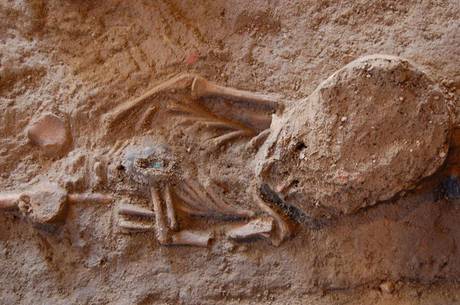
The Roman cemetery unearthed in Leicester, England, included pagan and Christian burials, Here, a Christian burial being excavated.
CREDIT: University of Leicester Archaeological Services

Hidden beneath a parking lot in Leicester, England, archaeologists have discovered a 1,700-year-old Roman cemetery that seemed to show no religious bias.
The new discovery, found at the junction of Newarke and Oxford Streets, includes numerous burials and skeletal remains from 13 individuals, both male and female of various ages. The cemetery is estimated to date back to around A.D. 300, according to University of Leicester archaeologists who led the dig.
"We have literally only just finished the excavation and the finds are currently in the process of being cleaned and catalogued so that they can then be analyzed by the various specialists," John Thomas, archaeological project officer, told LiveScience in an email. [See Images of the Ancient Roman Cemetery]


Read the rest of this article...

Monday, May 6, 2013

Moles unearth Roman artefacts at Epiacum's ancient fort


Epiacum Roman fort remains

Epiacum's impressive earthwork defences are still visible to this day


Epiacum is a site full of buried treasure, which no-one can reach - no-one human at least.
Near Alston in Cumbria, close to the Northumberland border, where now there are fields, there was once a thriving Roman fort.
Unfortunately for archaeologists, they cannot access any of the historic artefacts beneath the ground - because the site is a scheduled ancient monument.
Moles, however, pay no heed to the land's protected status.
The velvety creatures have not only been digging up the earth, but doing their bit for archaeology by inadvertently pushing ancient objects to the surface.

Read the rest of this article...