Monday, May 6, 2013

Roman cemetery found under UK carpark


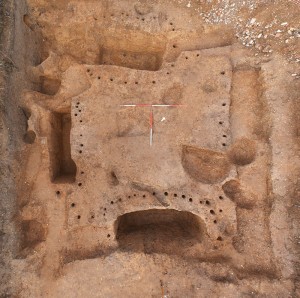
The University of Leicester archaeological unit that discovered King Richard III has spearheaded another dig and discovered a 1,700-old- Roman cemetery – under another car park in Leicester. The latest dig follows the historic discovery of King Richard III by colleagues from the same unit.
Roman cemetery found under UK carpark
Archaeologists uncover burials dating back to 300AD at Oxford Street car park,
Leicester [Credit: University of Leicester]
The find has revealed remains thought to date back to 300AD – and includes personal items such as hairpins, rings, belt buckles and remains of shoes.

In addition, the team has found a jet ring with a curious symbol etched onto it, apparently showing the letters IX overlain.  Opinion as to its meaning is divided; it may just be an attractive design but it is also reminiscent of an early Christian symbol known as an IX (Iota-Chi) monogram taken from the initials of Jesus Christ in Greek.


Read the rest of this article...

Friday, April 26, 2013

Online Courses in Archaeology


University of Oxford Online Courses in Archaeology
Cave paintings, castles and pyramids, Neanderthals, Romans and Vikings - archaeology is about the excitement of discovery, finding out about our ancestors, exploring landscape through time, piecing together puzzles of the past from material remains.
These courses enable you to experience all this through online archaeological resources based on primary evidence from excavations and artefacts and from complex scientific processes and current thinking. Together with guided reading, discussion and activities you can experience how archaeologists work today to increase our knowledge of people and societies from the past.
The following courses are available:

Sewer workers in Bath reveal part of Roman city's walls


Roman walls, Bath
Tool marks on the stone found in Burton Street suggest it was worked in Roman times


Engineers carrying out sewer repairs in Bath have uncovered part of the Roman city walls.
The discovery in Burton Street was made when a large stone block was uncovered nearly 3ft (90cm) below the pavement, a Wessex Water spokesman said.
Further investigations revealed the block was part of the stone wall which dates back to the 4th Century.
"This is a very significant discovery," said Natalie Doran, an environmental scientist with Wessex Water.

Read the rest of this article...

Tuesday, April 23, 2013

The birth of Rome celebrated across the city - in pictures


Romans march in front of the Colosseum during a parade to mark the anniversary of the foundation of the city in 753 BC

The birth of Rome: Men belonging to historical groups march dressed as ancient Romans

Men belonging to historical groups march, dressed as ancient Romans, in front of the Colosseum to mark the anniversary of the legendary foundation of the eternal city in 753 B.C


View the photos...

The Latest Threat to Pompeii’s Treasures: Italy’s Red Tape


Pompeii Falling From Grace: Pompeii’s ruins are a Unesco World Heritage site, but despite money from the European Union, the Italian government is struggling to maintain them.


POMPEII, Italy — Destroyed by the eruption of Mount Vesuvius in A.D. 79, Pompeii survived excavation starting in the 18th century and has stoically borne the wear and tear of millions of modern-day tourists.


But now, its deep-hued frescoes, brick walls and elegant tile mosaics appear to be at risk from an even greater threat: the bureaucracy of the Italian state.
In recent years, collapses at the site have alarmed conservationists, who warn that this ancient Roman city is dangerously exposed to the elements — and is poorly served by the red tape, the lack of strategic planning and the limited personnel of the site’s troubled management.

Read the rest of this article...

Friday, April 19, 2013

Reconstructing how the Romans made glass


Man has been making glass since the third millennium BC and during the manufacture of ancient glass, antimony, in a metal or mineral form, was added to make it colourless or opaque.


Different antimony ores have slightly different antimony isotope ratios and researchers in Belgium and the UK have developed an inductively-coupled plasma mass spectrometry (ICP-MS) method to detect and quantify these tiny differences. 

By analysing samples of Roman glass, the team hope to uncover clues about how the glass was made and the geographical provenance of the raw materials.

Initial results suggest antimony ores from at least two locations were used to make the Roman glass being analysed. 


Read the rest of this article...

Thursday, April 18, 2013

Officials, police inspect Pompeii excavations


The Italian government's anti-mafia directorate and police on Tuesday carried out raids at the world-famous archaeological site of Pompeii, which Rome and the European Union has granted 105 million euros to restore.

Officials, police inspect Pompeii excavations

The checks were ordered by the government's top representative in nearby Naples, Francesco Musolino, to inspect progress on restoration of the House of the Guilt Cupids, the House of the Great Fountain and the Fullonica of Stephanus laundry.

Italian authorities fear that the EU's pricey 'Grand Plan for Pompeii' initiative to prevent the Unesco World Heritage site from crumbling could be infilitrated by organised crime groups and subject to fraud.


Read the rest of this article...

Friday, April 12, 2013

'Pompeii of north' being unearthed in Londo


Archaeologists working on a site in London are calling it "the Pompeii of the north" after they have managed to find Roman artefacts dating back nearly 2,000 years.
Just yards from the River Thames, in what is now the capital's financial district, archaeologists have found coins, pottery, shoes, lucky charms and an amber gladiator amulet.
Sonja Jessup has been finding out the secret to their remarkable survival.

Watch the video...

Murmillo magic


Amber amulet in the shape of a gladiator’s helmet. Amber was an expensive imported material and was thought to have magical powers. The Roman author Pliny describes how amber amulets could protect children from illness and the symbolism of the gladiator may also be protective  Image: MOLA
Amber amulet in the shape of a gladiator’s helmet. Amber was an expensive imported material and was thought to have magical powers. The Roman author Pliny describes how amber amulets could protect children from illness and the symbolism of the gladiator may also be protective
Image: MOLA
A tiny amber amulet shaped like a gladiator’s helmet has been discovered in the Walbrook area by Museum of London Archaeology (MOLA).
Measuring just over 1cm across, the object was found amongst the remains of a demolished Roman building, together with large amounts of pottery and animal bone. It is hoped that analysis of these will narrow down a possible date for the artefact.
Its distinctive visor and high crest marks it out as depicting part of the equipment of a murmillo, who wore a large enclosing helmet with a grille covering the face. Armed with a short sword or gladius and a rectangular shield called a scutum, he was normally paired against a thraex (Thracian).


Read the rest of this article...

'Entire streets' of Roman London uncovered


An archaeological dig in the heart of the City "will transform our understanding" of Roman London, experts claim.

About 10,000 finds have been discovered, including writing tablets and good luck charms.The area has been dubbed the "Pompeii of the north" due to the perfect preservation of organic artefacts such as leather and wood.One expert said: "This is the site that we have been dreaming of for 20 years."
'Entire streets' of Roman London uncovered
The site is providing fresh insight into the religious and mystical practices of London's early residents. Amber was an expensive imported material and was thought to have magical powers and this amulet, in the shape of a gladiator’s helmet, may have been used to protect children from illness [Credit: Museum of London Archseology]
Archaeologists expect the finds, at the three-acre site, to provide the earliest foundation date for Roman London, currently AD 47. The site will house media corporation Bloomberg's European headquarters.

It contains the bed of the Walbrook, one of the "lost" rivers of London, and features built-up soil waterfronts and timber structures, including a complex Roman drainage system used to discharge waste from industrial buildings.

Read the rest of this article...

Terahertz scanner reveals hidden fresco at Louvre


Fresco (Trois hommes armes de lances) and terahertz scan

#A technique based on the same kind of technology used in airport scanners has revealed images beneath a fresco held at the Louvre museum in Paris.
Trois Hommes Armes de Lances was known to be a fresco forged by Giampetro Campana on a wall from Roman times.
The new research suggests that under that forgery lies a real Roman fresco.
The discovery was announced at the American Chemical Society meeting by Bianca Jackson of the University of Rochester in the US.
Terahertz waves are known for their ability to penetrate materials without damaging them, and have in recent years been added to the suite of tools used to examine items of cultural heritage.

Read the rest of this article...

Tuesday, March 19, 2013

Roman artefact discovered in Sudeley Castle cupboard

Experts say the sculpture reveals more about the worship of local gods

A Roman sculpture of a Cotswold god has been found in a castle cupboard after being missing for over 100 years.

The artefact, dated 150-350AD, was first found during an archaeological dig on the estate of Sudeley Castle in 1875.

But when historians found records of the discovery in the 1960s, there was no trace of the sculpture.

The Roman altar God has now been found in a basement cupboard during a clear out at the Gloucestershire castle.

The engraved figure, found earlier this month, wears a conical cap, tunic and cloak and holds a bow and arrow. 

It has been identified by historians as Cotswold deity Apollo the Hound Prince or Apollo Cunomaglos.
Experts believe there are only seven other known depictions, four from the Cotswolds and three from London, and say the discovery is a significant find.

Read the rest of this article...

Friday, March 15, 2013

Cirencester Roman cockerel 'best find' in 40 years


Conservation work on the figurine has taken four months to complete


A restored Roman cockerel figurine is the best result from a Cirencester dig in decades, archaeologists have said.
The enamelled object, which dates back as far as AD100, was unearthed during a dig in 2011 at a Roman burial site in the town.
It has now returned from conservation work and finders Cotswold Archaeology said it "looks absolutely fantastic".
The 12.5cm bronze figure was discovered inside a child's grave and is thought to have been a message to the gods.

Read the rest of this article...

Bronze Age settlement unearthed in SW England


Wick Barrow beakers [Credit: Somerset County Council]


Excavations at the Hinkley C site have revealed the remains of a 3,000-year-old Bronze Age settlement.

Archaeologists have also discovered the first Saxon grub hut to be found in Somerset, and a number of Roman features and artefacts, including a grain drier, quern stones, a stone anchor, fishing net weights, jewellery and graves.

The work was funded by EDF Energy as part of its site preparations and carried out by Somerset County Council.

Read the rest of this article...

Saturday, March 9, 2013

Remarkable ringfenced burials from Roman Colchester


 recently-completed cemetery excavation close to Colchester’s Roman circus has revealed that some of Camulodunum’s citizens marked their grave plots with ditches and wooden fences. It had previously been speculated that, during the Roman period, those unable to afford stone monuments might have used wooden markers or mounds of earth to distinguish individual burials. Now a four-month investigation by Colchester Archaeological Trust has unearthed clusters of inhumations dated by grave goods and other finds  to the 2nd and 3rdcentury and surrounded in some cases by lines of small post-holes up to about 20cm in diameter.
‘This is certainly extremely unusual – I have never seen anything like it before,’ said CAT chief archaeologist Philip Crummy. ‘We have excavated about 400 inhumations and cremations here with much that is unusual. For example, we found areas of fenced burials at either end of the site, 80m apart, and it seems we are dealing not with one great cemetery area but a collection little plots used by different groups or families.’

Read the rest of this article...

SCRAP OF WOOL UNRAVELS CHRISTIAN CHURCH FIND


MARYPORT DIG: Site director Tony Wilmott, left, and Professor Ian Haynes last summer


A tiny scrap of wool found during an archaeological dig in Maryport has unlocked a piece of history.

Archaeologists revealed this week that the dig at Camp Farm last summer has unearthed what appears to be a Christian church, dating back to the 5th or 6th century.

Experts believe the possible church, built in an east-west direction, was positioned so it could be seen at Whithorn, the cradle of Christianity in Scotland, on the other side of the Solway Firth.

They revealed their findings exclusively to a Maryport audience crowded into the town’s Senhouse museum on Tuesday night.

Tony Wilmott, site director, said that volunteers on the dig had discovered what appeared to be Christian long cist graves. In one they found fragments of bone and a tooth.


Read the rest of this article...

Wednesday, March 6, 2013

Temple of Jupiter Stator discovered in Rome


The ruins of the temple identified by Italian archaeologists as the one built by Romulus in 750 BC, after winning the battle against the Sabines [Credit: Archeologia Viva]

The temple built by Romulus to celebrate the hand of Jupiter giving Roman troops their unstoppable force has been found at the foot of the Palatine Hill, Italian archaeologists say. 

The ruins of the shrine to Jupiter Stator (Jupiter the Stayer), believed to date to 750 BC, were found by a Rome University team led by Andrea Carandini. 

"We believe this is the temple that legend says Romulus erected to the king of the gods after the Romans held their ground against the furious Sabines fighting to get their women back after the famous Rape (abduction)," Carandini said in the Archeologia Viva journal. 


Read the rest of this article...

Sunday, March 3, 2013

So, what did the Romans do for us? New digs reveal truth about Hadrian's Wall


Stretching the breadth of northern England, Hadrian's Wall is a majestic reminder of the ambition and might of the Roman Empire's conquest in Britain. Now, new archaeological evidence has suggested, contrary to previous belief, that the Romans far from co-existing peacefully with the locals, ejected them by force in order to build the 73-mile divide.

The Unesco World Heritage Site stretches from the Solway Firth in the west to Wallsend on the river Tyne in the east. Construction was ordered by the Emperor Hadrian and started in AD122. It was Roman Britain's most ambitious building project, designed primarily to mark the northern limit of the Empire.

For decades, archaeologists struggled to date the indigenous communities around the wall because the site yielded very few artefacts. The only way of dating these Roman and pre-Roman Iron Age settlements was to excavate what little there was. Since the 1970s, when serious excavation began, experts believed the local population living in the shadow of the wall had actually flourished under the Roman invaders. But the new evidence suggests the Roman legions actually cleared a 10-mile stretch in front of the wall by force.


Read the rest of this article...

Most Ancient Romans Ate Like Animals


Ancient Romans are known for eating well, with mosaics from the empire portraying sumptuous displays of fruits, vegetables, cakes — and, of course, wine. But the 98 percent of Romans who were non-elite and whose feasts weren't preserved in art may have been stuck eating birdseed.
Common people in ancient Rome ate millet, a grain looked down upon by the wealthy as fit only for livestock, according to a new study published in the March issue of the Journal of Anthropological Archaeology. And consumption of millet may have been linked to overall social status, with relatively poorer suburbanites eating more of the grain than did wealthier city dwellers.
The results come from an analysis of anonymous skeletons in the ancient city's cemeteries.
"We don't know anything about their lives, which is why we're trying to use biochemical analysis to study them," said study leaderKristina Killgrove, an anthropologist at the University of West Florida.


Read the rest of this article...

Neue Grabungen im Römerlager Haltern


Das Team der Grabungshelfer bereitet die Fläche des Halterner Hauptlagers für die Ausgrabung vor. Vor allem die Holz-Erde-Mauer und die Gräben werden im Fokus der Untersuchungen stehen. (Foto: LWL/Burgemeister)

In Vorbereitung des geplanten "Römerparks Aliso" finden derzeit in Haltern am See neue Ausgrabungen statt. Bis in den Mai hinein nehmen die Archäologen des Landschaftsverbandes Westfalen-Lippe (LWL) Einblick in die Beschaffenheit der Holz-Erde-Mauer des römischen Lagers, um die wissenschaftliche Basis für die geplanten Rekonstruktionen zu fundamentieren.

Read the rest of this article...