Wednesday, December 12, 2012

Roman road uncovered in York

This is the 10,000th post on the 
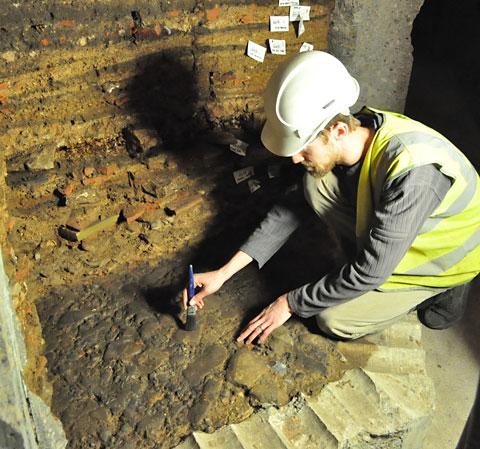

Ian Milstead Lead Archaeologist from YAT cleaning Roman Road beneath York Minster.

A SECTION of Roman Road has been discovered beneath York Minster. 

Archaeologists from York Archaeological Trust unearthed it during construction work on the new visitor development in the Undercroft, a Minster spokeswoman said today. 

The archaeologists believe the road was a backstreet, part of the Via Quintana, and believe it ran behind the Roman basilica that once stood on the Minster site. 

A Minster spokeswoman said: "The backstreet was used for hundreds of years and was frequently patched and repaired, falling into disuse at the same time as the Basilica itself."

Read the rest of this article...

Saturday, December 8, 2012

Lottery grant could help buy Bath Roman coin hoard

A coin from 32 BC similar to the one pictured was the oldest identified so far

A £50,000 lottery grant could help keep a hoard of Roman coins in Bath.

The Beau Street Hoard of 20,000 silver coins was discovered by archaeologists in 2007 and is thought to be the fifth largest find of its kind in the UK.

Some of the coins date back as far as 32BC and are currently being cleaned at the British Museum.

The initial support from the Heritage Lottery Fund could lead to a further £480,000 grant in 2013.

Bath and North East Somerset Council said it wanted to develop learning and community activities around the hoard.

Read the rest of this article...

Classics professor unearths archaeological clues about ancient Roman vineyards

They may not look like much to the untrained eye, but these ancient Roman grape seeds, believed to back to the 1st century A.D., could provide “a real breakthrough” in the understanding of the history of Chianti vineyards in the area, de Grummond says. (Phys.org)—Call it a toast to the past. A Florida State University classics professor whose decades of archaeological work on a remote hilltop in Italy have dramatically increased understanding of the ancient Etruscan culture is celebrating yet another find.

Read more at: http://phys.org/news/2012-12-classics-professor-unearths-archaeological-clues.html#jCp
They may not look like much to the untrained eye, but these ancient Roman grape seeds, believed to back to the 1st century A.D., could provide “a real breakthrough” in the understanding of the history of Chianti vineyards in the area, de Grummond says.

Read more at: http://phys.org/news/2012-12-classics-professor-unearths-archaeological-clues.html#jCp
They may not look like much to the untrained eye, but these ancient Roman grape seeds, believed to back to the 1st century A.D., could provide “a real breakthrough” in the understanding of the history of Chianti vineyards in the area, de Grummond says. 

(Phys.org)—Call it a toast to the past. A Florida State University classics professor whose decades of archaeological work on a remote hilltop in Italy have dramatically increased understanding of the ancient Etruscan culture is celebrating yet another find. 

 This time around it's not the usual shards of pottery and vessels, remnants of building foundations or other ancient artifacts unearthed in past years, but rather a treasure that's far more earthy: grape seeds. 

Actually, Nancy Thomson de Grummond has discovered some 150 waterlogged grape seeds that have some experts in vineyard-grape DNA sequencing very excited.

Read the rest of this article...

Resurrecting the ancient city of Laodicea


Cranes, excavators, teams of workmen in hard-hats and foremen shouting into their mobile phones are a ubiquitous feature of today's Turkey, a country where, in spite of a global economic slowdown, new buildings continue to be erected at a staggering rate. Take a trip to Laodicea, however, and you'll see a “building site” with a twist. For here a long abandoned Greek-Roman city is being resurrected wholesale from its ruins by … construction cranes and teams of workmen in hard-hats!

Sprawling across a low hill between the prosperous textile town of Denizli and the iconic travertine formations of Pamukkale in western Turkey, ancient Laodicea is generally overlooked by the vast majority of visitors, who tend to be drawn instead to Pamukkale and its associated site of Hierapolis, or the wonderful remains at Aphrodisias, not too much further away. Only bible groups, attracted to Laodicea because it is one of the Seven Churches mentioned in the New Testament's Revelation of John, buck the trend.

That Laodicea is relatively little visited is hardly surprising given its press. The current edition of Lonely Planet Turkey says “there's not much of interest left,” the Rough Guide to Turkey doesn't even mention the site. A late 1980s version of the more specialist, archaeology and history-orientated Blue Guide writes of Laodicea, “Much of its worked stone has been removed for building purposes and, unfortunately, little is being done to preserve its remaining structures from further damage.”


Read the rest of this article...

Norwich Castle Museum set to acquire 'curious' treasure


A gold earring disc, found in Norfolk by a metal detector enthusiast, has left treasure experts baffled as to the exact meaning of its decoration.

Discovered in Keswick, near Norwich, the disc "is an unusual find for the Roman period", said a Norwich Castle Museum spokesman.

It features a scorpion, phallus, snake and crab, but the meaning of the combination "is lost" an expert said.
The Norwich museum hopes to acquire the disc for its collection.

The value of the item will now be determined by experts at the British Museum.

Read the rest of this article...

Thursday, December 6, 2012

Gladiator's Tomb to Be Reburied


The tomb of the ancient Roman hero believed to have inspired the Russell Crowe blockbuster "Gladiator," might be returned to oblivion four years after its discovery in Rome.

A lack of fundings is forcing Italian archaeologists to bury again the large marble monument of Marcus Nonius Macrinus, a general and consul who achieved major victories in military campaigns for Antoninus Pius, the Roman emperor from 138 to 161 A.D., and Marcus Aurelius, emperor from 161 to 180 A.D.

Unearthed in 2008 on the banks of the Tiber near the via Flaminia, north of Rome, the tomb, complete with the dedicatory inscription, was hailed as "the most important ancient Roman monument to come to light for 20 or 30 years."

Read the rest of this article...

Tuesday, December 4, 2012

'First tartan' on Roman statue


The Caledonian warrior on the bronze statue appears to be wearing tartan trews
 
Remnants of a Roman statue in North Africa could be the "first-ever depiction of tartan", according to a BBC Scotland documentary.

A piece of a bronze statue of the Emperor Caracalla contains the small figure of a Caledonian warrior wearing what appears to be tartan trews.

The third century Roman emperor Caracalla styled himself as the conqueror of the Caledonians.
A statue marking his achievements stood in the Moroccan city of Volubilis.
Read the rest of this article...

Monday, December 3, 2012

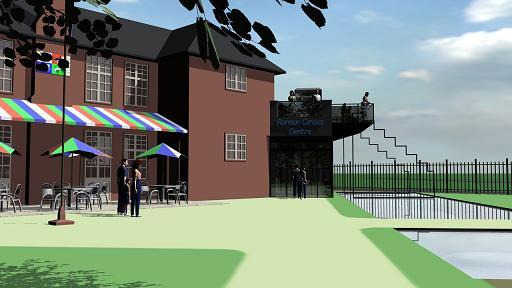
New Roman Circus visitor centre plans unveiled


THESE are the first images of what Colchester’s Roman Circus visitor centre could look like.
Colchester Archaeological Trust has submitted new and more ambitious £1.3million plans to the Heritage Lottery Fund. 

They include recreating the circus’s entrance gates, a roof top viewing platform and a tea room at Roman Circus House in Circular Road North, Colchester. 

Displays inside the heritage centre will feature giant models of the circus and the Roman town.
Philip Crummy, trust director, said: “We are very excited about the project."

Read the rest of this article...

Main excavations completed at 8-10 Moorgate


MOLA has completed the main excavation in the central part of the 8-10 Moorgate site in the City of London and the discoveries have proven to be even more exciting than our initial investigations in 2010! The redevelopment of the site by Stanhope and Mitsui Fudosan has provided MOLA with an exciting opportunity to investigate a large area on the banks of the Walbrook stream, a tributary of the Thames that flowed through the heart of the Roman City. 

The buildings uncovered date from the 1st century (the time when the Roman city was founded) to the 3rd century and include both masonry, and clay and timber buildings as well as circular wattle structures; thought to be animal pens. 
 
In addition to the main buildings, fences, gravel alleyways and wells have been discovered, creating a vivid picture of a community living and working at the eastern edge of the Walbrook stream.

Read the rest of this article...
Sunday, December 2, 2012

Wall at Pompeii collapses after heavy rain


A photo taken in September 2012 shows a cordonned-off area after the collapse of a roofing beam at the Pompeii archaeological site. A Roman wall at the site has collapsed, local archaeologists said Friday, in the latest in a series of accidents at the ancient city buried by a volcanic explosion 2,000 years ago [Credit: AFP]

A Roman wall at Pompeii in southern Italy has collapsed, local archaeologists said Friday, in the latest in a series of accidents at the ancient city buried by a volcanic explosion 2,000 years ago.

The section of wall some two metres (seven feet)long was part of the ruins of a house at the sprawling site near Naples. The area has seen heavy rain in recent weeks, and previous collapses have been linked to bad weather.

The area was already closed to the public because it was believed to be at risk. It was scheduled for restoration as part of the "Great Pompeii Project".


Read the rest of this article...

Thursday, November 29, 2012

Digs reveal evolution of Paphos theatre


Fragments of marble sculptures from a monument consecrated to the nymphs of ancient Greek and Roman mythology have been uncovered during on-going excavations at Paphos' ancient theatre, the archaeological team in charge of the dig have announced.

The 15th season of excavations into one of Cyprus’ largest ancient theatres unearthed a number of significant finds, including fragments of carved marble adornments from the stage and from a monument to the nymphs or nymphaeum.

Paphos was the capital of Cyprus in Greek and Roman times and its ancient archaeological remains are on the World Heritage List.


Read the rest of this article...

Bulgaria Unearths Ancient 'Millionaire's' Treasure


Bulgarian archaeologists have unearthed 40 silver coins during excavations in the second largest city of Plovdiv.

The coins, dating from the 3rd century A.C., have images of a number of Roman Emperors or different Gods.

They are extremely well-preserved, meaning they have not been in circulation, experts say.

The coins were located in an ancient hiding place and were a real treasure for this period with their owner being a very wealthy man, they further explain, adding the hiding place in the floor showed the said owner had intentions to get them back at some point, but was prevented, most likely because he was killed.

Read the rest of this article...

Tuesday, November 27, 2012

Winchester Palace Roman Wall Painting Website


Sadly, the erstwhile conservator for the Department of Greater London Archaeology, Sean A. MacKenna (Tony MacKenna), Tony died in October 2012.

The most important project of his career was the excavation and restoration of the Winchester Palace Roman wall painting.  Tony had published a detailed account of the work on his own website, but that website will not remain.

The material has, therefore, been transferred to the Archaeology in Europe website.  You can find it at:

www.archeurope.com/index.php?page=winchester-palace-roman-wall-paintings


The work is sure to be of considerable interest to Romanists and Conservators alike.

Go to the website...


Weitere Spuren römischer Besiedlung in Liechtenstein


Im Oktober entdeckte das Team der Landesarchäologie im Winkel in Balzers weitere Spuren der römischen Siedlung. Dabei handelt es sich um die letzten Reste eines Gebäudes, das vermutlich von den unberechenbaren Fluten des Rheins zerstört worden ist.

Bei Aushubarbeiten kamen in einer Kiesschicht ca. 1,5 Meter unter der Oberfläche römische Funde ans Tageslicht. Das eingestürzte Mauerwerk mit Resten eines rötlichen Verputzes und die Dachziegelfragmente dürften von einem Gebäude stammen. Sie werden genau gleich wie die Keramikscherben in das 2./3. Jahrhundert n. Chr. datiert.

Read the rest of this article...
Thursday, November 22, 2012

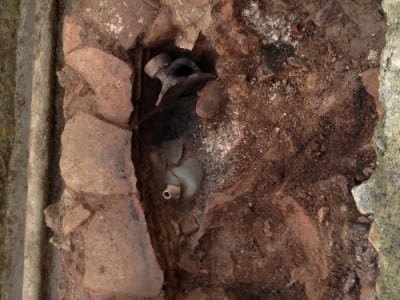
Roman jug found behind Estepona high street


A ROMAN jug has been unearthed behind Estepona high street.

A team of archaeologists discovered the ancient artifact yesterday morning close to the town’s shopping area.

Sailing instructor Tomas Reyes spotted the organised dig outside his house and took the snap above.

“It was very interesting, it must be at least 2,000 years old.

“I asked if I could take a picture as they found it,” said Reyes.

Romans used the containers to transport liquids such as water, wine, oil and honey.

Read the rest of this article...

Excavating a Roman Floor


Not only have our archaeologists have been hard at work carefully excavating the heart of Roman Londinium, they’ve been given a chance to play with some new kit. And now we have a chance to take you out on site with us through the power of time-lapse video! In a series of videos we recorded the whole process of uncovering, recording and lifting a Roman tessellated floor!  The first video follows our archaeologists (and our friendly McGee site labourers) uncovering the tessellated floor by removing the trampled material that lay on top. 

So here is the first in our series of videos featuring our lovely archaeologists, a massive Roman tessellated floor, and some homegrown rock and roll for good measure:

Watch the video...

Wednesday, November 21, 2012

Ancient tunnels in Rome reopen to the public


The network of underground passageways beneath the Baths of Caracalla is also home to the largest temple of Mithra in the Roman Empire
Few people have ever visited the long network of underground tunnels under the public baths of Caracalla, which date back to the third century AD and are considered by many archaeologists to be the grandest public baths in Rome. This underground network, which is due to be reopened in December, is also home to a separate structure, the largest Mithraeum in the Roman Empire, according to its director Marina Piranomonte. The Mithraeum has just reopened after a year of restoration work which cost the city’s archaeological authorities around €360,000. 

To celebrate the reopening, Michelangelo Pistoletto has installed his conceptual work Il Terzo Paradiso (the third heaven), which he first presented at the 2005 Venice Biennale, in the gardens surrounding the public baths. The work, made of ancient stone fragments and pieces of columns arranged in a triple loop, represents the harmonious union of the natural and technological worlds, according to the artist. It will be on view until 6 January 2013.
Read the rest of this article...

Monday, November 19, 2012

Water mains work unearths Roman cemetery in Somerset

Several Roman human remains were discovered at Banwell in Somerset

A Roman cemetery containing several human burials has been found during work on a new water mains in Somerset.

The finds were made by archaeologists during the laying of a four-mile (7km) long mains between Banwell and Hutton. 

Among the skeletons, which have been exhumed for further study, there was one in a partially-preserved coffin.

A Bristol Water spokesman said the excavation had been described as "potentially the most important for 100 years in North Somerset".

The cemetery was discovered "isolated from the surrounding landscape" in a curved water-filled ditch.
Roman cemeteries, according to Neil Shurety from Border Archaeology, are generally sited outside settlements and away from areas of human habitation.

Read the rest of this article...
Sunday, November 18, 2012

Summer Courses in Archaeology

Oxford Experience Archaeology Courses

The Oxford Experience Summer School offers weekly introductory courses in the Sciences and Humanities.  Participants stay in Christ Church, the largest and one of the most beautiful Oxford Colleges.


You can find out more about the Oxford Experience here...

Pompeii collapses 'exaggerated' by media, site chief says


Paestum, November 16 - Recent collapses at the ancient city of Pompeii had been exaggerated by the media and efforts to protect the site are progressing, according to the Special Archaeological Superintendent for Naples and Pompeii, Teresa Elena Cinquantaquattro.

Cinquantaquattro was speaking along with other senior archaeological officials from the culture ministry at the 15th annual Mediterranean Archaeological Tourism Exchange in Paestum on how to conserve sites in southern Italy in a climate of shrinking government funds. "Problems exist at Pompeii but they have been exaggerated by negative journalists," Cinquantaquattro told ANSA.


After recent falls of structures in the past two years there has been growing concern about Italy's ability to protect the 2,000-year-old site from further degradation and the impact of the local mafia, the Camorra. In April this year a wall surrounding an ancient villa at Pompeii collapsed just two weeks after the Italian government launched a joint 105-million-euro project with the European Union to save the UNESCO World Heritage site.


Read the rest of this article...

Thursday, November 15, 2012

Escaping the Shadow of Pompeii


HERCULANEUM, Italy — They are poignant snapshots of sudden death: huddled clusters of skeletal remains in what were once beachfront warehouses, immortalized for eternity when Mount Vesuvius smothered this ancient Roman town in A.D. 79. 

“They died of thermal shock as they were waiting to be saved via the sea,” Domenico Camardo, an archaeologist, said recently as he surveyed dozens of modern-day skeletal casts of long-ago denizens. They carried with them jewelry, coins, even “20 keys, because they were hoping to return home,” Mr. Camardo added. “They didn’t understand that it was all about to end.” 

First excavated by archaeologists some 30 years ago, the warehouses were recently outfitted with walkways and gates to provide access to these chilling tableaus and will soon be open to the public on special occasions.

Read the rest of this article...

Saving the ruins of Herculaneum


HERCULANEUM, Italy

They are poignant snapshots of sudden death: Huddled clusters of skeletal remains in what were once beachfront warehouses, preserved when Mount Vesuvius smothered this ancient Roman town in A.D. 79.
”They died of thermal shock as they were waiting to be saved via the sea,” Domenico Camardo, an archaeologist, said recently as he surveyed dozens of modern-day skeletal casts of long-ago denizens. 

They carried with them jewellery, coins, even “20 keys, because they were hoping to return home,” Camardo added. “They didn’t understand that it was all about to end.”
First excavated by archaeologists some 30 years ago, the warehouses were recently outfitted with walkways and gates to provide access to these chilling tableaus and will soon be open to the public on special occasions.

Read the rest of this article...

Tuesday, November 13, 2012

A Point of View: Why the rich look down on the poor


In the ancient world, the rich held themselves to very different standards from the poor. Not much has changed, argues classical historian Mary Beard.

Low life in ancient Rome could be very low indeed. 

There were gangs of ne'er-do-wells and down-and-outs who spent all night in cheap bars, drowning their sorrows. Apart from talk about the top chariot racers (the ancient equivalent of footballers), the only entertainment on offer was brawling and gambling. 

They would sit hunched over their gaming tables, making horrible snorting sounds through their quivering nostrils. 

(The Greeks and Romans seem to have been particularly sensitive to odd nasal noises. One pundit in the early 2nd Century - the aptly named Dio the Golden Mouth - gave a whole lecture to the people of the city of Tarsus, urging them to control their snorting. It must count as one of the most curious works of ancient literature to have come down to us.)

Read the rest of this article...

Monday, November 12, 2012

Were Roman slaves hungry?


What was it like to be a slave in the Roman Empire? The answer, according to the latest excavations at Vagnari, is that slaves were rather better looked after than one might expect:  they ate quite well, they suffered less from childhood starvation than did the population in general, and when they died, the grave goods they were buried with suggested that they were certainly  not living in abject poverty.

This at least was the implication of research that was revealed in a recent conference held at Edinburgh University organised by Alastair Small on 26th – 28th October 2012,  when Alistair Small and his associates told us about their latest work at Vagnari.

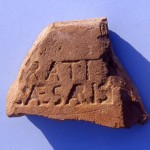
Vagnari is the name of an abandoned farmstead – you will not find it on any map, but it lies just outside the town of Gravina, near Bari in Apulia.  Here Professor Small has been excavating for nearly 40 years, at first in the nearby hillfort of Botromagno, and subsequently doing field surveys over the whole area which revealed an interesting site at Vagnari: we have already covered the whole history in Current Archaeology 45.  But in the Roman imperial period, it appears to have been an imperial estate, centred round a tile works, and one of the tiles was found stamped with the name of Grati Caesaris,  which means the work of Gratus, slave of Caesar.
Read the rest of this article...

Saturday, November 10, 2012

Blackbird Leys nunnery dig uncovers Bronze Age arrowhead

Archaeologists said the arrowhead was found among a small group of prehistoric worked flints

An archaeology dig at a medieval nunnery in Oxford has unearthed a 4,000-year-old Bronze Age arrowhead.

The five-week dig by the Archaeology of East Oxford Community Project (Archeox) also revealed prehistoric worked flints, medieval and roman pottery.

The excavation at Littlemore Priory was a collaboration between volunteers and the University of Oxford.

More than 500 volunteers gave up their free time to take part in the project near the Kassam Stadium.

Read the rest of this article...

Ancient Roman Giant Found—Oldest Complete Skeleton With Gigantism

The giant's tibia, or shinbone, compared with that of a normal Roman male of the same period.

It's no tall tale—the first complete ancient skeleton of a person with gigantism has been discovered near Rome, a new study says.

At 6 feet, 8 inches (202 centimeters) tall, the man would have been a giant in third-century A.D. Rome, where men averaged about 5 and a half feet (167 centimeters) tall. By contrast, today's tallest man measures 8 feet, 3 inches (251 centimeters).

Finding such skeletons is rare, because gigantism itself is extremely rare, today affecting about three people in a million worldwide. The condition begins in childhood, when a malfunctioning pituitary gland causes abnormally growth.

Two partial skeletons, one from Poland and another from Egypt, have previously been identified as "probable" cases of gigantism, but the Roman specimen is the first clear case from the ancient past, study leader Simona Minozzi, a paleopathologist at Italy's University of Pisa, said by email.

Read the rest of this article...

Monday, October 22, 2012

Tomb raiders lead to new archaeological find


Votive offerings to Juno from 4th to 2nd century BC

Rome, October 19 - Investigations into the activities of four tomb raiders in the Alban hills near Rome have led to the discovery of a previously unknown site containing ancient Roman votive offerings. The ex-votos date from the fourth to the second century BC and include life-sized statues and depictions of parts of the human anatomy in terracotta offered to the ancient Roman goddess Juno. Police caught the tomb robbers in action as they were stealing the devotional objects from a natural cavity in a tufa wall near Lanuvio and Genzano that did not appear on archaeological maps of the area.

Read the rest of this article...

Ancient sundial found in northern Greece

The ancient sundial dating from the Greco-Roman period found in Polichrono in Chalkidiki [Credit: Greek Reporter]

One of the rarest sundials dating from the Greco-Roman period was found in Polichrono in Chalkidiki, northern Greece. This sundial is not a usual one as it shows the correct time at any given place.

It is noteworthy that in the Ancient Greek world, sundials consisted of a gnomon (indicator) in the form of a vertical post or peg set in a flat surface, upon which the shadow of the gnomon served to indicate the time.

This sundial has a surface which is separated in 12 parts representing 12 hours of the day. More particularly, the sundial consists of a hyperbola tracing the shadow’s path at the winter solstice, a second one for the summer solstice, and a straight east-west line in between marking the equinoctial shadows.


Read the rest of this article...
Friday, October 19, 2012

Cat discovers 2,000-year-old Roman catacomb

An aerial view of Rome: residents of the city are often underwhelmed and sometimes irritated to find they are living on top of priceless Roman remains. Photograph: Alessandro Bianchi/REUTERS
 
Rome may not exactly be short of catacombs, but one discovered this week is more deserving of the name than the city's countless other subterranean burial chambers. For Mirko Curti stumbled into a 2,000-year-old tomb piled with bones while chasing a wayward moggy yards from his apartment building.

Curti and a friend were following the cat at 10pm on Tuesday when it scampered towards a low tufa rock cliff close to his home near Via di Pietralata in a residential area of the city. "The cat managed to get into a grotto and we followed the sound of its miaowing," he said.

Inside the small opening in the cliff the two men found themselves surrounded by niches dug into the rock similar to those used by the Romans to hold funeral urns, while what appeared to be human bones littered the floor.

Read the rest of this article...

Archaeologists Uncover Roman Mosaic in Downtown Sofia

Sofia Mayor, Yordanka Fandakova, visited archaeological works in the center of the city; the St. Joseph catholic cathedral is seen behind. Photo by livenews.com 

Archaeologists have discovered colorful floor mosaic from the Roman era near the so-called West Gate of Serdica in downtown Sofia.

The news was announced Monday by the Mayor of Sofia, Yordanka Fandakova, who visited the archaeological excavations in the company of her Deputy in charge of Culture, Todor Chobanov.

The mosaic has an area of 40 square meters and is located in the ruins of a Roman building discovered for the first time between 1975 and 1980 when archaeologists began exploring the site. The works were later abandoned and remained unfinished.

Read the rest of this article...

Monday, October 15, 2012

Burial Customs


In the first century A.D. Roman army veterans arrived in what is now northern Macedonia and settled near the small village of Scupi. The veterans had been given the land by the emperor Domitian as a reward for their service, as was customary. They soon began to enlarge the site, and around A.D. 85, the town was granted the status of a Roman colony and named Colonia Flavia Scupinorum. (“Flavia” refers to the Flavian Dynasty of which Domitian was a member.) Over the next several centuries Scupi grew at a rapid pace. In the late third century and well into the fourth, Scupi experienced a period of great prosperity. The colony became the area’s principal religious, cultural, economic, and administrative center and one of the locations from which, through military action and settlement, the Romans colonized the region. 

Scupi, which gives its name to Skopje, the nearby capital of the Republic of Macedonia, has been excavated regularly since 1966. Since that time archaeologists have uncovered an impressive amount of evidence, including many of the buildings that characterize a Roman city— a theater, a basilica, public baths, a granary, and a sumptuous urban villa, as well as remains of the city walls and part of the gridded street plan. Recently, however, due to the threat from construction, they have focused their work on one of the city’s necropolises, situated on both sides of a 20-foot-wide state-of-the art ancient road.

Read the rest of this article...

Heritage sites added to East Midlands 'at risk' register


A Roman arch over a road in Lincoln is one of 20 sites in the East Midlands to appear on the 2012 English Heritage at Risk Register.

Other sites include Taylor's Bell Foundry in Loughborough and the Chapel of St John the Baptist in Derbyshire.

English Heritage (EH) has included Grade II listed buildings for the first time in a bid to attract support.
It said being on the list meant a greater chance of securing grants.

Read the rest of this article...

Thursday, October 11, 2012

Archaeology Summer Courses in Oxford


The Oxford Experience, Christ Church, Oxford

The Oxford Experience summer school offers one-week introductory classes in the humanities and sciences, including a number of archaeology courses.

You can find details of the Oxford Experience summer school here...

You can find a list of the archaeology courses here...

CSIC researchers find the exact spot where Julius Caesar was stabbed


A concrete structure of three meters wide and over two meters high, placed by order of Augustus (adoptive son and successor of Julius Caesar) to condemn the assassination of his father, has given the key to the scientists. This finding confirms that the General was stabbed right at the bottom of the Curia of Pompey while he was presiding, sitting on a chair, over a meeting of the Senate. Currently, the remains of this building are located in the archaeological area of Torre Argentina, right in the historic centre of the Roman capital. 

Antonio Monterroso, CSIC researcher from the Institute of History of the Center for Humanities and Social Sciences (CCHS-CSIC), states: "We always knew that Julius Caesar was killed in the Curia of Pompey on March 15th 44 BC because the classical texts pass on so, but so far no material evidence of this fact, so often depicted in historicist painting and cinema, had been recovered". 

Classical sources refer to the closure (years after the murder) of the Curia, a place that would become a chapel-memory. CSIC researcher explains: "We know for sure that the place where Julius Caesar presided over that session of the Senate, and where he fell stabbed, was closed with a rectangular structure organized under four walls delimiting a Roman concrete filling. However, we don't know if this closure also involved that the building ceased to be totally accessible".
Read the rest of this article...

Tuesday, October 9, 2012

Two Roman wrecks found off Turkish coast


Two ancient Roman shipwrecks, complete with their cargo, have been discovered by Italian archaeologists off the coast of Turkey near the the ancient Roman city of Elaiussa Sebaste.

The ships, one dating from the Roman Imperial period and the other from about the sixth century AD, have been found with cargoes of amphorae and marble, say researchers from the Italian Archaeological Mission of Rome's University La Sapienza.

Both ships were discovered near Elaiussa Sebaste, on the Aegean coast of Turkey near Mersin, according to a statement issued by the Italian embassy in Ankara.


Read the rest of this article...

Thursday, October 4, 2012

Oxford Experience on Facebook


The Oxford Experience - an Oxford University summer school that offers many courses in archaeology and history - now has a Facebook site.

You can find the site at: www.facebook.com/OxfordExperience


You can find out more about the Oxford Experience here...

Methane Emissions Can Be Traced Back to Roman Times


The isotope curve shows that the emissions of the greenhouse gas methane had several peaks in the last 2,100 years. 1: During Roman times, where a lot of wood was burned for heating and for the processing of metals. 2: During the warm Middle Ages, where forests caught on fire. 3: In the "Little Ice Age", which was a very cold and dry period. 4: The methane concentration has increased dramatically since approx. the year 1800, when industrialization took off and triggered energy and food production, for example, rice fields. (Credit: NBI)

 Emissions of the greenhouse gas methane into the atmosphere can be traced back thousands of years in the Greenland ice sheet. Using special analytical methods, researchers from the Niels Bohr Institute, among others, have determined how much methane originates from natural sources and how much is due to human activity. The results go all the way back to Roman times and up to the present, where more than half of the emissions are now human-made.

The results are published in the scientific journal, Nature.

Methane is an important greenhouse gas, which today is partly emitted from natural sources and partly from human activities. The emissions from natural sources varies due to the climate variations. For example, bacteria in wetlands release methane and less is emitted in dry periods as the wetlands shrink.

Read the rest of this article...

Monday, October 1, 2012

Der römische Denar: ein Euro des Altertums?


Der römische Denar war vor 2000 Jahren weiter verbreitet als der Euro. Um 120 n. Chr., als das Römische Reich seine größte Ausdehnung hatte, konnte man von Britannia bis Kleinasien und von Nord-Afrika bis zum Rhein reisen, ohne Geld wechseln zu müssen. Was aus heutiger Sicht noch erstaunlicher erscheint: Das Denarsystem war über 500 Jahre stabil. In der aktuellen Ausgabe von "Forschung Frankfurt", dem Wissenschaftsmagazin der Goethe-Universität, erklärt Junior-Professorin Dr. Fleur Kemmers, wie dieses System organisiert war und warum es zusammenbrach.

Read the rest of this article...

Friday, September 28, 2012

Ireland in a Roman World


Ireland in a Roman World
an international and interdisciplinary conference
20-21 October 2012
The Robert Emmet Theatre
Trinity College Dublin

Further details and poster...

Thursday, September 20, 2012

Archaeologists probe police HQ for Bannockburn and Roman remains


Archaeologists are searching the grounds of a police headquarters for historic evidence of the Battle of Bannockburn and a Roman road.

Experts believe they are located at Central Scotland Police headquarters in Randolphfield, Stirling. Archaeologists from Stirling Council believe the land is of historical importance.

A geophysical survey is being carried out over an area surrounding two standing stones in front of the building. The stones are said to commemorate or may have been used in a skirmish during the Battle of Bannockburn in 1314.

Thomas Randolph, the Earl of Moray, led 500 Scottish horsemen into battle against a troop of English cavalry, under the command of Sir Robert Clifford. The skirmish was won by Randolph and the area, Randolphfield, was named after him.

Read the rest of this article...

Gigantic Roman bathtime-fun mosaic found under Turkish field


Bone-bothering boffins have uncovered a massive Roman mosaic in southern Turkey, proving that the ancient Empire's influence reached far into the area.

The humungous mosaic, uncovered by a farmer in his field next to a still-standing bathing structure, is 1,600 square feet of meticulously crafted workmanship. It was built at the height of the Roman Empire's power in the third and fourth centuries AD.

"This region is not well understood in terms of history and archaeology," says University of Nebraska-Lincoln prof Michael Hoff.

"It's not a place in which archaeologists have spent a lot of time, so everything we find adds more evidence to our understanding of this area of the Roman Empire.

Read the rest of this article...

Monday, September 10, 2012

Crosby Garrett Helmet to be part of Royal Academy exhibition


A Roman cavalry helmet bought for £2.2m at auction after it was discovered in a Cumbrian field is to go on public display for the first time.

The Crosby Garrett Helmet, named after the village near where it was found, is to feature as part of a Royal Academy show called Bronze.

A private collector outbid a Carlisle museum at the auction in 2010.

Bronze co-curator David Ekserdjian said the helmet, which is almost 2,000 years old, was a "masterpiece".

He said: "Even if this helmet had been known about for as long as anybody can remember, we'd still want it in the show because it's a fantastic work of art.

Ale, Caesar! Romans and Caledonian tribes went to pub together


ARCHAEOLOGISTS surveying the world’s most northerly Roman fort have found an ancient pub.

The discovery, outside the walls of the fort at Stracathro, near Brechin, Angus, could challenge the long-held assumption that Caledonian tribes would never have rubbed shoulders with the Roman invaders. 

Indeed, it lends support to the existence of a more complicated and convivial relationship than previously envisaged, akin to that enjoyed with his patrician masters by the wine-swilling slave Lurcio, played by comedy ­legend Frankie Howerd, in the classic late 1970s television show Up Pompeii!.

Stracathro Fort was at the end of the Gask Ridge, a line of forts and watchtowers stretching from Doune, near Stirling.

The system is thought to be the earliest Roman land frontier, built around AD70 – 50 years before Hadrian’s Wall.

How Romans made marble statues 'real'


The Romans have a reputation for being brilliant engineers and soldiers, but what isn't as well known is that they also gave us wonderful artistic treasures. 

The latest scientific techniques suggest that marble statues in the ancient world were not as monochromatic as we may imagine. 

Alastair Sooke looks at the Treu Head in the British Museum, an important and rare marble head from the mid-second century AD, which would have been painted to make her look "like a real person".

Buried Roman town mapped by researchers


An image of the theatre at Interamna Lirenas, in Southern Lazio, which emerged from the latest study. The grey background shows the magnetrometry image which revealed that a large building was on that spot. The white square is taken from a Ground Penetrating Radar survey (GPR) which showed the shape and dimensions of the building in more detail. This revealed it to be a Roman theatre, marked in yellow [Credit: University of Cambridge]

An ancient Italian town, which disappeared after its abandonment 1,500 years ago and now lies buried underground, has been mapped by researchers, revealing the location of its theatre, marketplace and other buildings.

Originally founded as a Roman colony in the 4th century BCE, the site of Interamna Lirenas lies in the Liri Valley in Southern Lazio, about 50 miles south of Rome itself. After it was abandoned around the year 500 CE, it was scavenged for building materials and, over time, its remains were completely lost from view. Today, the site is an uninterrupted stretch of farmland, with no recognisable archaeological features.