Monday, April 2, 2012

Archeology: EU, Italy to spend 105 mln to save Pompeii


The European Union has given the green light to a plan to join forces with Italy to jointly spend 105 million euros to keep Pompeii from crumbling.

"We gave our approval to this important restoration work that is not only in the interest of Italy, but for all of Europe's historic patrimony," said European Union Commissioner for Regional Policy, Johannes Hahn, on Thursday.

Hahn's commission and Italy from 2000 to 2006 together spent 7.7 million euros on 22 restoration projects at Pompeii. 

Highly-publicised collapses of ancient buildings at the UNESCO World Heritage site has prompted an outcry that Italy is neglecting the world's largest archeological site.

Mixed Martial Arts Celebrity Recruited for Ancient Roman Army


Millennia before modern-day military recruiters talked up potential soldiers in shopping malls or put up posters, one Roman city took a rather different approach to recruiting soldiers for the emperor's army.

A newly translated inscription, dating back about 1,800 years, reveals that Oinoanda, a Roman city in southwest Turkey, turned to a mixed martial art champion to recruit for the Roman army and bring the new soldiers to a city named Hierapolis, located hundreds of miles to the east, in Syria.

His name was Lucius Septimius Flavianus Flavillianus and he was a champion at wrestling and pankration, the latter a bloody, and at times lethal, mixed martial art where contestants would try to pound each other unconscious or into submission.

Tuesday, March 27, 2012

Hoard of Roman coins found in England


One of the largest collections of Roman coins -- over 30,000 silver pieces -- has been recovered in England from the building site of a new hotel in Bath, just 450 feet from the historic Roman Baths.

Known as the Beau Street Hoard, from the street where they have been unearthed, the coins date to 270 A.D., a time of great upheaval when the western Roman empire was threatened by civil war and barbarian invasion.

Aware of the difficult times, the owner might have just decided to hide away the treasure.

Tuesday, March 20, 2012

Roman mysteries uncovered in Chippenham


The secrets locked in five historic Roman burial urns are being uncovered at the Wiltshire and Swindon History Centre in Chippenham.

Kelly Abbott, contract conservator with Wiltshire Council Conservation Service, said the dusting away of years of history from the urns has uncovered bones that could be human.

The ancient urns, that date back to the Roman conquest, were found at the site of Linden Homes’ King Harry Lane development in St Albans


Roman mosaics preserved after £3m Chedworth project


One of the country's finest examples of Roman archaeology is being shown to members of the public following an 18-month conservation project.

Some of the mosaics at Chedworth Roman Villa in Gloucestershire have not been on display for more than 150 years but a new building has now been built to protect and better display them for years to come.

Rome's Lost Aqueduct


Searching for the source of one of the city’s greatest engineering achievements
Archaeologist Katherine Rinne
stands beside a large ancient
Roman springhouse

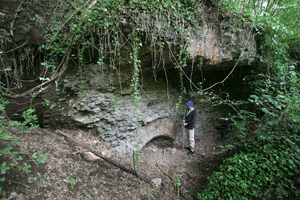
Archaeologist Katherine Rinne stands beside a large ancient Roman springhouse that may belong to the lost “Carestia” spring, one of the possible sources of the Aqua Traiana.
(Courtesy Rabun Taylor)


Few monuments that survive from antiquity better represent Roman pragmatism, ingenuity, and the desire to impress than the aqueducts built to fulfill the Romans’ seemingly unslakable need for water. Around the turn of the second century A.D., the emperor Trajan began construction on a new aqueduct for the city of Rome. At the time, demands on the city’s water supply were enormous. In addition to satisfying the utilitarian needs of Rome’s one million inhabitants, as well as that of wealthy residents in their rural and suburban villas, water fed impressive public baths and monumental fountains throughout the city. Although the system was already sufficient, the desire to build aqueducts was often more a matter of ideology than absolute need.

Whether responding to genuine necessity or not, a new aqueduct itself was a statement of a city’s power, grandeur, and influence in an age when such things mattered greatly. Its creation also glorified its sponsor. Trajan—provoked, in part, by the unfinished projects of his grandiose predecessor, Domitian—seized the opportunity to build his own monumental legacy in the capital: the Aqua Traiana (“Aqueduct of Trajan” in Latin).


Roman remains found at Arla


A Roman burial site, an ancient parish boundary and Iron Age artefacts have been discovered on the site soon to house the world’s biggest dairy. 

Arla site dig near Aston Clinton [Vredit: Buck Herald]
Archaeologists have now completed a 12-week study at the site of Arla’s new dairy at Aston Clinton. 

Among the artefacts discovered on site were the remains of the last occupants of the Roman settlement. These will now be reinterred at Buckland Cemetery once they have been analysed. 

Other items found were quantities of pottery, including high status Samian ware and animal bone. 


Monday, March 19, 2012

Was St Patrick a slave-trading Roman official who fled to Ireland?


The classic account of St Patrick’s life tells us that he was abducted from Western Britain in his teens and forced into slavery in Ireland for six years before escaping, during which time his faith developed.

However, a new article looking at Patrick’s own writings in their historical context argues that the saint may have in fact fled to Ireland deliberately to avoid becoming a ‘Decurion’ – a Roman official responsible for tax collection.

“In the troubled era in which Patrick lived, which saw the demise and eventual collapse of Roman government in Britain in 410, discharging the obligations of a Decurion, especially tax-collecting, would not only have been difficult but also very risky,” says Dr Roy Flechner of the University of Cambridge.

Read the rest of this article...

Walkways open above mosaics at Chedworth Roman Villa


Suspended walkways overlooking 4th Century mosaics at a Roman Villa at Chedworth in Gloucestershire have been opened to visitors.

It is part of a £3m project which has seen Victorian buildings replaced, a new cafe built and a refurbished visitor centre opened at the villa.

A National Trust spokesman said the new walkways give "much better access".

Excavation work is also currently under way at the villa to uncover previously hidden mosaics.

Read the rest of this article...

Thursday, March 15, 2012

Roman kiln unearthed by builders at Norton Primary School


The remains of a Roman kiln have been discovered by builders working at a school in North Yorkshire.

The discovery was made during construction of a £1.5m extension at Norton Primary School near Malton.

North Yorkshire County Council said the kiln was the first major find in the area since the 1940s.

The kiln was found along with fragments of pottery. Archaeologists also uncovered ditches believed to be of a Romano-British date.

Read the rest of this article...

Burial urns dating back to Roman conquest discovered on housing site


Experts from Wiltshire Council have been unlocking the secrets in five Roman burial urns which have been discovered at a housing development in Hertfordshire.

Kelly Abbott, contract conservator with the Wiltshire Council Conservation Service, said the dusting away of years of history from the urns has uncovered bones which could be human.

The five ancient burial urns dating back to the Roman conquest were found at the site of Linden Homes’ King Harry Lane development in St Albans.

Read the rest of this article...

High Weald hoard of Roman coins on display in Sussex


Nearly 3,000 silver Roman coins found four years ago by a metal detector enthusiast in Sussex are to go on display in the county.

The High Weald hoard, discovered by Tim Symonds about 30 miles north of Brighton, has been bought by Brighton's Royal Pavilion and Museums.

The coins, worth about £40,000, were bought with help from the Heritage Lottery Fund.

They will go on display at Brighton Museum this summer and tour next year.

Read the rest of this article...

Secrets of St Albans' Roman burial urns unlocked


CT scanners are being used to help unlock the secrets of five Roman burial urns that were discovered at a housing development in Hertfordshire.

Conservators at the Wiltshire and Swindon History Centre were called in by archaeologists excavating at King Harry Lane in St Albans.

Work is being done to discover whether the remains inside the cremation urns belong to adults or children.

The urns were found at the entrance to a late Iron Age defended settlement.

Read the rest of this article...

Monday, March 12, 2012

CALL FOR PAPERS: PAGANS AND CHRISTIANS IN LATE ANTIQUE ROME:


PAGANS AND CHRISTIANS IN LATE ANTIQUE ROME:

INTERPRETING THE EVIDENCE

Rome, 20-21 September 2012

Palazzo Falconieri, Accademia dell’Ungheria, Via Giulia 1, Roma

An International Conference

with the support of the

Accademia dell’Ungheria di Roma

Department of Medieval Studies, Central European University, Budapest


Further details...

CFP: International Workshop Roman Sarcophagi, University of Graz,10.10.-13.10.2012


The Department of Archaeology & Numismatics of the Universalmnuseum Joanneum and the Institute of Archaeology of the University of Graz will host a conference on Roman sarcophagi in October 2012.

In addition to analytical and synthetic contributions the topics are methodology, production and distribution in the Danube provinces, and the integrative analysis of epigraphy and sarcophagi.

Please note that reports about new finds or the history of collections will only be accepted for the poster session.

Abstracts of no more than 800 words on the above topics will be accepted until March 31st 2012.

Further details...

Using burial sites to gauge the effect of Roman conquest on Iron Age Britons


Britain was first invaded by the Romans during the reign of Caesar in 54-55 BCE, which began the gradual inevitable process of incorporation into the Empire. However, it wasn’t until 43 CE, with the conquest of what is now England under Claudius that social, political and economic changes were enforced in the native populations.

Archaeological investigations show a break in the continuity of Iron Age trends with Roman conquest, especially apparent in burial and mortuary patterns. One important facet of understanding what affect ‘Romanization’ had on the Britons is looking at changes in health patterns, at both a national and regional levels, comparing the effects on different classes and age groups of society. Two studies done by Redfern and DeWitte (2011a, 2011b) and Redfern, Millard and Hamlin (2012) assess the health in the Iron Age and Roman periods of Dorset, England in order to understand how changes connected with conquest affected health. Previous studies by Redfern et al. (2010) on these pre- and post-conquest communities in Dorset showed that there was; increased consumption of marine resources; increased prevalence of dental disease; infectious and metabolic diseases; decreased evidence for trauma; decline in subadult growth; and average male stature did not increase. These more recent studies look closer into demography and mortality, as well as class and age differences in health.

Read the rest of this article...

Kirkton water works reveal Roman artefacts at fort site


A series of Roman artefacts has been found during works to install a water main through a former fort site.

The discovery was made as work was carried out at Wellington Bridge near Kirkton in Dumfries and Galloway.

Archaeologists supervised the Scottish Water works through the site of the Carzield Roman Fort.

Items discovered included Roman tiles, clay fragments and pieces of cast iron metalwork which will now be taken for analysis and carbon dating.

Read the rest of this article...

Thursday, March 8, 2012

Archaeology: Roman slabstone, early-Ottoman column discovered after Bisser disaster


Several archaeological finds have been unearthed as work continues on clearing the debris following the flooding of the village of Bisser in southern Bulgaria, public broadcaster Bulgarian National Television (BNT) said.

At least eight people died and dozens had to be evacuated as the village was flooded because of a burst wall in the nearby Ivanovo dam. The flood destroyed several houses.

It was unclear whether the finds had been unearthed by the water flow or carried by the water, archaeologists from the Harmanli historical museum said.

The stone slab appeared to be part of a Roman-era public building, while the hexagonal column was specific for the early Ottoman era. A similar column had been found near the village in the 1960s, BNT said.


Read the rest of this article...

Tuesday, March 6, 2012

More ancient roads discovered under Monmouth


Excavations for the replacement of gas mains by Amec have been continuing for some weeks and have now reached the Monk Street/Dixton Road traffic lights. 


The work is being monitored by members of Monmouth Archaeology (the professional wing of Monmouth Archaeological Society) who have been recording a series of ancient roads as well as features associated with the town's northern medieval defences. 

The most interesting revelations have been the sequence of medieval and later road surfaces which lie over a stone cobbled road at one metre below the modern road surface and which may be Roman – possibly part of the Roman town of ‘Blestium’ or of the middle 1st century Roman Fort. 

The lowest road was superseded by another which was composed of bloomery iron slag.

Read the rest of this article...

Monday, March 5, 2012

Falcons will be brought in to scare away birds pecking at the Colosseum


Falcons are to be introduced in the skies over the ancient Roman Colosseum in a bid to scare away birds that are pecking away at the 2,000-year-old stone facade.

Seagulls, ravens and blackbirds are thought to have been the cause of several recent incidents at the iconic arena where masonry has fallen away, narrowly missing passers-by and tourists.
Officials are already in talks with several pest control firms to bring in the falcons, which are seen as the most effective way to reduce the number of birds which nest in the nooks and crannies of the Colosseum.
In recent months the numbers of birds flying above the Roman monument has increased considerably. Many are using it as a nesting ground and also peck away at the stone work and hideaway stores of seeds and food.

Read the rest of this article...

The Story of Wales: Creating a CGI Roman amphitheatre from ruins


Caerleon, near Newport in south Wales, is one of Wales' best known and loved Roman sites.

In its heyday, this open-air arena would have seated up to 6,000 people and been the scene of gladiatorial games against men and beasts.

Computer graphics from the BBC Wales history series, The Story of Wales, helped to bring that scale and structure to life.

But how do you go about turning shots of stone ruins into a virtual amphitheatre from around AD90?

Watch the video...

Sunday, March 4, 2012

Kirkton water works reveal Roman artefacts at fort site


A series of Roman artefacts has been found during works to install a water main through a former fort site.

The discovery was made as work was carried out at Wellington Bridge near Kirkton in Dumfries and Galloway.

Archaeologists supervised the Scottish Water works through the site of the Carzield Roman Fort.

Items discovered included Roman tiles, clay fragments and pieces of cast iron metalwork which will now be taken for analysis and carbon dating.

Read the rest of this article...

Blue versus Green: Rocking the Byzantine Empire


“Bread and circuses,” the poet Juvenal wrote scathingly. “That’s all the common people want.” Food and entertainment. Or to put it another way, basic sustenance and bloodshed, because the most popular entertainments offered by the circuses of Rome were the gladiators and chariot racing, the latter often as deadly as the former. As many as 12 four-horse teams raced one another seven times around the confines of the greatest arenas—the Circus Maximus in Rome was 2,000 feet long, but its track was not more than 150 feet wide—and rules were few, collisions all but inevitable, and hideous injuries to the charioteers extremely commonplace. Ancient inscriptions frequently record the deaths of famous racers in their early 20s, crushed against the stone spina that ran down the center of the race track or dragged behind their horses after their chariots were smashed.

Charioteers, who generally started out as slaves, took these risks because there were fortunes to be won. Successful racers who survived could grow enormously wealthy—another Roman poet, Martial, grumbled in the first century A.D. that it was possible to make as much as 15 bags of gold for winning a single race. Diocles, the most successful charioteer of them all, earned an estimated 36 million sesterces in the course of his glittering career, a sum sufficient to feed the whole city of Rome for a year. Spectators, too, wagered and won substantial sums, enough for the races to be plagued by all manner of dirty tricks; there is evidence that the fans sometimes hurled nail-studded curse tablets onto the track in an attempt to disable their rivals.

Read the rest of this article...

Saturday, February 25, 2012

Lead poisoning in Rome: The skeletal evidence

A recent article in the online publication io9, “The First Artificial Sweetener Poisoned Lots of Romans“  provided a (very) brief look at some of the uses of lead (Pb) in the Roman world, including the tired old hypothesis that it was rampant lead poisoning that led to the downfall of Rome -  along with gonorrhoea, Christianity, slavery, and the kitchen sink.

The fact the Romans loved their lead is not in question, with plenty of textual and archaeological sources that inform us of the uses of lead – as cosmetics, ballistics, sarcophagi, pipes, jewellery, curse tablets, utensils and cooking pots, and, of course sapa and defrutum (wine boiled down in lead pots) – but what almost all news articles regarding the use of lead in ancient Rome seem to ignore is data from osteological evidence.

Contemporary medical knowledge allows us to understand that metabolic disorders can be caused by a lack of nutrients: a lack of vitamin C causes scurvy; and a lack of vitamin D can lead to rickets; but they can also be caused by an abundance of something, like too much fluoride, too much mercury, too much arsenic, or too much lead.

Read the rest of the article...

So what have the Romans ever done for us?


Ireland’s links with the Roman empire are being investigated in a new archaeological project in which science plays a large part writes ANTHONY KING 

FIRST CENTURY AD. The Roman General Agricola reportedly says he can take and hold Ireland with a single legion. Some archaeologists have claimed the Romans did campaign in Ireland, but most see no evidence for an invasion. Imperial Rome and this island on its far western perimeter did share interesting links, however.

The Discovery Programme, a Dublin-based public institution for advanced research in archaeology, is to investigate Ireland’s interactions with the empire and with Roman Britain, aiming to fill gaps in the story of the Irish iron age, the first 500 years after the birth of Christ.

Read the rest of this article...

Wednesday, February 15, 2012

Suffolk Roman gold and silver coins declared treasure


The discovery of Roman gold and silver coins on farmland in Suffolk suggests "relatively high status people" lived in the area, an archaeologist has said.

Fifteen silver coins and one gold coin were found by a father and son on farmland, near Mildenhall, on 12 October last year.

A treasure trove inquest in Bury St Edmunds heard they dated to between 355 and around 402.

Coroner Dr Peter Dean recorded the discovery as treasure.

Read the rest of this article...

The Seedy, Scandalous History of Valentine's Day


Forget roses, chocolates and candlelight dinners. On Valentine's Day, that's rather boring stuff -- at least according to ancient Roman standards.

Imagine half-naked men running through the streets, whipping young women with bloodied thongs made from freshly cut goat skins. Although it might sound like some sort of perverted sadomasochistic ritual, this is what the Romans did until A.D. 496.

Mid-February was Lupercalia (Wolf Festival) time. Celebrated on Feb. 15 at the foot of the Palatine Hill beside the cave where, according to tradition, the she-wolf had suckled Romulus and Remus, the festival was essentially a purification and fertility rite.

Read the rest of this article...

Snow damages Colosseum


Rome - Heavy snow has caused extensive damage to the mediaeval walled town of Urbino and further deteriorated the Colosseum in Rome, already badly in need of repair, Italian newspapers reported on Tuesday.

Partial collapses have been reported at the convents of San Francesco and San Bernardino in Urbino and the roof of the Church of the Capuchins outside the town centre has completely caved in, La Repubblica reported.

There is also water damage in the town's 12th-century Duomo cathedral.

Read the rest of this article...

Tuesday, February 14, 2012

Firm helps protect Roman ruins


Gallagher Group have helped preserve some Roman walls dug up by archaeologists – by burying them again.
After being recorded by Maidstone Archaeology Group, the walls of the Roman building near East Farleigh were due to be back-filled anyway, but fears they could be damaged by frost meant the job needed to be done quickly.

The Maidstone-based building, civil engineering, quarrying and property business provided a digger and staff for a day to get the job done.

Linda Weeks, Honorary Secretary of the Maidstone Area Archaeological Group, thanked everyone who helped out, adding: “We were concerned that the ragstone walls of the Roman buildings would have been damaged by the winter frosts, but Gallagher’s timely intervention has meant these walls have now been preserved.”

Read the rest of this article...

Monday, February 13, 2012

Archaeology: More details emerge about Roman ruins in Bulgaria’s Bourgas


More details have emerged about the archaeological find of Roman ruins at a spot near Bourgas on Bulgaria’s Black Sea coast – including the fact that they have been found before and funding already has been allocated to investigate them.

The ruins emerged after huge seas scoured the Black Sea coast earlier in February 2012, prompting speculation whether this represented a hitherto unknown Roman settlement or just a small sewerage or sanitation installation.

Bourgas mayor Dimitar Nikolov went to see for himself and trumpeted the find, which hit national headlines amid the bitter winter weather chaos.

But it turned out that the existence of the ruins was well-known to archaeologists and 120 000 leva (about 60 000 euro) already had earmarked to investigate the site.

Read the rest of this article...

Friday, February 10, 2012

Time Team: Mary-Ann Ochota quits Channel 4 archaeological show


Time Team has been thrown into disarray after Mary-Ann Ochota became the second presenter to leave the Channel 4 archaeological programme. 

Mary-Ann Ochota, 30, who holds a master’s degree in archaeology and anthropology from Cambridge University, has left the show after a row with Prof Mick Aston, the archaeologist.
Her leaving the show comes after Prof Aston, 65, also quit the show after producers hired Ms Ochota, a former model, as the programme’s co-presenter with Tony Robinson.
Prof Ashton, who has been on the show for 19 years, said he had been left “really angry” by changes which led to the introduction of co-presenter and some archaeologists being axed.

Read the rest of this article...

Thursday, February 9, 2012

Reply to my complaint to Channel 4 concerning Time Team Changes


As expected, a wishy-washy response - but the more people who write in, the better!

"Dear Mr Beard,

Thank you for contacting Channel 4 Viewer Enquiries regarding TIME TEAM.

We are sorry to hear that you are unhappy with the new format of the show and that Prof. Mick Aston has decided to leave. We are saddened by Mick 's decision to leave, he has been a fantastic member of the Time Team team and we wish him well in the future.

Please be assured your complaint has been logged and noted for the information of those responsible for our programming.

Thank you again for taking the time to contact us. We appreciate all feedback from our viewers; complimentary or otherwise.

Regards,

Doug Masterson

Channel 4 Viewer Enquiries"

Please take the time to send your own comments to Channel 4.  Use the link here...

See the original story " Mick Aston quits Time Team after producers hire former model co-presenter"...

Wednesday, February 8, 2012

Mick Aston quits Time Team after producers hire former model co-presenter


Mick Aston, the archeologist, has quit Time Team after producers hired a former model as the programme’s co-presenter. 

The 65-year-old, who has been on the show for 19 years, said he had been left “really angry” by changes which led to the introduction of co-presenter Mary-Ann Ochota and some archaeologists being axed.
In an interview with the magazine British Archaeology, Prof Aston, the show’s former site director, said: “The time had come to leave. I never made any money out of it, but a lot of my soul went into it. I feel really, really angry about it.”
He was responding to changes first proposed by producers at Channel 4 in late 2010, which included a new presenter to join Tony Robinson and decisions to “cut down the informative stuff about the archaeology”.

Read the rest of this article...

Click here to contact Channel 4 to tell them what you think of their decision.

Monday, January 30, 2012

Find Roman history and Anglo Saxon remains under your feet


BUDDING archaeologists need to pick up a trowel and get digging in their back gardens.

A new project, funded by a £40,800 grant from the Heritage Lottery Fund, has been launched to uncover the history hidden underfoot in Kingsholm.

At the launch of History on Your Doorstep on Saturday, Jean Ashmead, of Dean's Way, said she barely has to scrape the surface of her garden to uncover Roman relics. She arrived at the event laden with Roman pottery and an unidentifiable animal's jaw.

Read the rest of this article...

Le Port englouti de Constantinople


ARTE has a superb documentary about the excavations of the Theodosian port in Constantinople, discovered during the building of the Istanbul metro under the Bosphorus.

The documentary makes excellent use of augmented and virual reality.  Soundtrack is available in either French or German.

Watch the video...

Friday, January 27, 2012

Archaeology Courses at the Oxford Experience 2012


The Oxford Experience Summer School

1 July to 11 August 2012

The 2012 Oxford Experience Programme is now online.

The Oxford Experience is a residential summer school held at the college of Christ Church, University of Oxford.

The programme consists of 6 weeks of courses and participants attend for one or more weeks.
It offers a choice of twelve seminars each week over a period of five weeks. Participants do not need any formal qualifications to take part, just an interest in their chosen subject and a desire to meet like-minded people.

You can also find details of the various archaeology courses offered at Oxford Experience here...

Bones on Milton Keynes building site 'could be Roman'


A set of bones discovered on a building site in Milton Keynes could be Roman, said a council archaeologist.

The remains of more than one person have now been discovered at the Taylor Wimpey development in Oakridge Park.

The bones of one skeleton were first unearthed by workers on the site two weeks ago.

Forensic archaeologists established that the remains were not of recent origin and therefore not of police interest.

Read the rest of this article...

Thursday, January 26, 2012

Latest building found at Roman town near Norwich looks like a spaceship


The Roman town of Venta Icenorum, meaning market of the Iceni people, was discovered during the 1929-35 excavations and has been a popular place of both local and national interest, with the BBC’s Time Team filming there in 2010.

The latest revelation, dating back to third century AD, was discovered by the Norfolk Archaeological Historical Research Society and has recently been unveiled in an academic journal.

The structure shows two angled wings, meeting on a central structure, and is described by Professor Will Bowden, who has been working on the project from the University of Nottingham, as “an unusual and adventurous building on a very interesting site”.

Read the rest of this article...

Wednesday, January 25, 2012

Y-shaped Roman structure discovered in UK


A recently discovered mysterious "winged" structure in England, which in the Roman period may have been used as a temple, presents a puzzle for archaeologists, who say the building has no known parallels. 


The archaeological team inside the postholes from the later Roman building. Decorated wall plaster was excavated from them [Credit: William Bowden]
Built around 1,800 years ago, the structure was discovered in Norfolk, in eastern England, just to the south of the ancient town of Venta Icenorum. The structure has two wings radiating out from a rectangular room that in turn leads to a central room.

Read the rest of this article...